Every ERP rollout looks great on paper until people stop using it the way it was designed. Spreadsheets creep back in, workarounds spread across departments, and six months later the finance team is still closing books manually. That gap between a system going live and an organization actually adopting it is exactly what change management consulting services exist to close, and if you’re evaluating them right now, you probably already have a project stalling because of it.
At their core, these services cover the structured work of preparing employees, aligning leadership, and adjusting workflows so a new system or process actually sticks. Firms that provide this range from large management consulting shops to specialized ERP consultants who build change management directly into implementation, rather than treating it as an afterthought bolted on after go-live.
This article breaks down what change management consulting actually includes, how it differs from generic project management, and who you should be calling depending on whether you’re launching something new or trying to save a project that’s already losing momentum.
Why organizations invest in change management consulting
Companies don’t hire change management consultants because they’re curious about organizational psychology. They hire them because a technology investment is bleeding money and nobody internally can figure out why. Adoption failure is the single biggest threat to ERP ROI, and it rarely shows up as a technical bug. It shows up as a controller who still exports everything to Excel, a warehouse team that ignores the new picking process, or a sales group that keeps quoting off old spreadsheets because the new CRM “doesn’t feel right yet.”
The gap between go-live and adoption
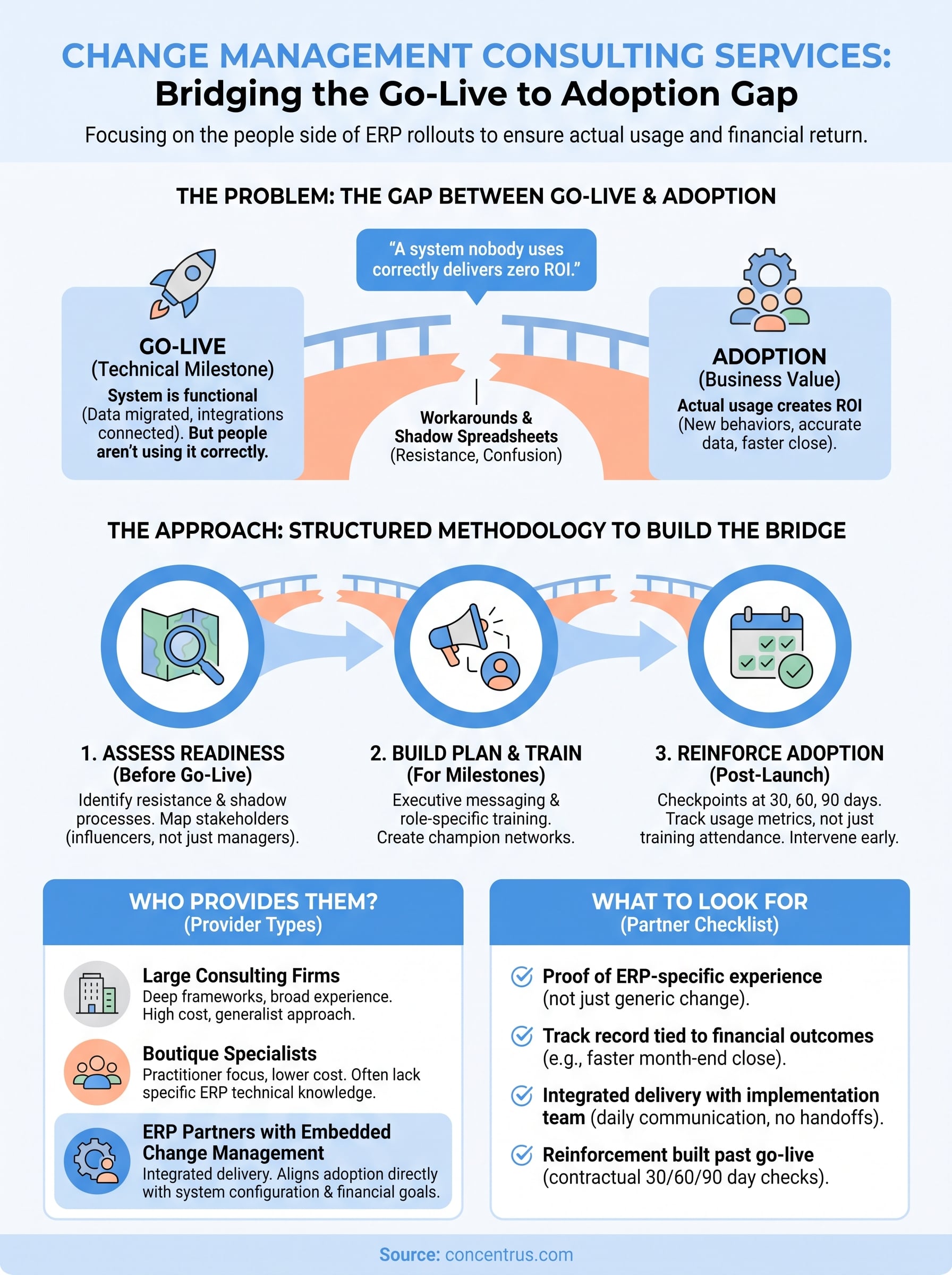
Going live is a milestone, not a finish line. Most ERP vendors and even many implementation partners measure success by whether the system is technically functional at cutover: data migrated, integrations connected, users provisioned. Change management consulting services measure something different: whether people are actually using the system the way it was designed six weeks, six months, and a year later. That distinction matters enormously to a CFO, because a technically successful go-live with low adoption still produces the same broken month-end close, the same manual reconciliations, and the same inaccurate reporting the new system was supposed to eliminate.
A system nobody uses correctly delivers zero ROI, no matter how well it was configured.
Why finance leaders are usually the ones who call
CFOs and finance directors tend to be the ones who initiate this kind of engagement, and that’s not a coincidence. They’re the ones staring at the numbers when a $400,000 ERP investment produces the same closing timeline as the old system. They’re also usually the executive sponsor accountable to the board or ownership group for the project’s financial outcome. When adoption stalls, it’s finance that absorbs the pain first, through delayed reporting, inaccurate inventory counts, or AP/AR processes that quietly revert to old habits. Financial accountability is why finance leaders push for structured change management rather than hoping the issue resolves itself.
Common triggers that push organizations to invest
A handful of situations show up again and again as the reason companies finally bring in change management help, whether that’s a standalone specialist or a firm embedding it into an ERP engagement:
- Multiple failed rollouts. The company has already tried to launch a system once or twice and watched usage collapse within weeks.
- Merger or acquisition integration. Two workforces with different tools and habits need to converge onto one platform without derailing operations.
- Rapid growth outpacing process. The organization has scaled past what manual workarounds and tribal knowledge can support.
- Leadership turnover mid-project. A new CFO or COO inherits a project they didn’t design and need it stabilized fast.
- Board or investor pressure. Private equity ownership or a board demands measurable ROI on a technology spend that hasn’t materialized.
The measurable cost of skipping it
Organizations that skip structured change management don’t just experience vague frustration, they experience quantifiable losses. Slower month-end close cycles mean delayed financial reporting to lenders, boards, or investors. Duplicate data entry between the new system and legacy spreadsheets drains staff hours that should be going toward analysis instead of reconciliation. Shadow systems that persist alongside the ERP create audit risk and inconsistent numbers across departments. Employee frustration compounds all of this, since teams asked to use a system that wasn’t properly introduced tend to blame the software rather than the rollout, which erodes trust in future technology investments too.
Why this differs from general project management
It’s worth being direct about something: a good project manager keeping a Gantt chart on schedule is not the same as someone managing organizational change. Project management tracks tasks, budget, and timeline. Change management tracks whether the humans affected by those tasks actually shift how they work. Firms that fold both disciplines into one team, rather than treating change management as a separate line item that gets cut when budgets tighten, tend to see ROI show up faster after go-live, because adoption planning starts on day one instead of being triaged as an emergency after the fact.
How change management consultants approach an engagement
A competent change management consultant doesn’t start with a training schedule. They start by figuring out who’s going to resist the new system and why, then build a plan around that reality instead of an idealized org chart. Structured methodology separates a real change management engagement from someone parachuting in with a generic slide deck about “managing resistance.” The actual work follows a fairly consistent arc across most firms, even if the branding on the framework changes from one consultancy to the next.
Assessing readiness before touching the system
Every serious engagement opens with a readiness assessment. Consultants interview department heads, floor supervisors, and frontline staff to find out what’s actually happening today, not what the process documentation claims is happening. This surfaces the shadow spreadsheets, the workarounds nobody put in the requirements doc, and the informal power structures that will determine whether a new process gets adopted or quietly ignored. Stakeholder mapping comes out of this phase too, identifying who influences opinion on the floor even if they have no formal authority, because those are the people who make or break adoption regardless of what’s in the org chart.

The people who determine whether an ERP rollout succeeds are rarely the ones listed as project sponsors.
Building the communication and training plan
Once the assessment is done, consultants build a plan tied to specific milestones in the implementation, not a generic onboarding packet handed out the week before go-live. This typically includes:
- Executive messaging that explains why the change is happening, delivered by leadership rather than the consulting team, since employees trust their own management more than an outside vendor.
- Role-specific training built around what each department actually does in the new system, instead of one broad session covering every module.
- Champion networks made up of respected employees in each department who get trained early and act as go-to help before people escalate to IT or give up and revert to old habits.
- Feedback loops that catch confusion or resistance in week one, before it hardens into permanent workarounds.
Reinforcing adoption after go-live
The engagement doesn’t end at cutover. Consultants who understand ROI accountability build in checkpoints at 30, 60, and 90 days post-launch to measure actual usage against the behaviors the project was designed to produce. If the AP team is still exporting to Excel at day 45, that’s a signal to intervene immediately, not a footnote in a quarterly review. Post-launch reinforcement is where a lot of cheaper engagements fall short, because the consulting relationship ends right when old habits are most tempting to fall back into.
This full arc, assessment, planning, training, and reinforcement, is what separates a change management consulting engagement from a one-off training session. Firms that treat it as a phase running parallel to the technical implementation, rather than a cleanup effort after go-live, consistently produce faster adoption and a shorter path back to the ROI the ERP investment was supposed to deliver in the first place.
Who provides change management consulting services
Once a company decides it needs help, the next question is who to actually call. Change management consulting services come from several different types of providers, and the right choice depends heavily on whether you’re launching a new ERP system, rescuing a stalled one, or managing organizational change unrelated to technology at all. Understanding the differences up front saves you from hiring a firm that’s excellent at slide decks but has never touched a NetSuite or Acumatica implementation.
Large management consulting firms
Global and national consulting firms offer change management as one service line among many, often bundled with strategy, operations, or HR consulting work. These firms bring deep frameworks and experienced facilitators, and they’re a reasonable fit for large-scale cultural transformations spanning thousands of employees across multiple business units. The tradeoff for a midsized company is cost and specificity: you’re often paying for a brand name and a generalist methodology rather than someone who has actually configured the ERP system your teams are resisting.
Boutique change management specialists
Smaller firms that focus exclusively on organizational change bring sharper practitioner experience and typically charge less than the big-name consultancies. They’re strong at stakeholder mapping, communication planning, and training design. What they usually lack is technical fluency in the ERP platform itself, which means they’re coordinating with a separate implementation vendor and hoping the two workstreams stay in sync. That coordination gap is exactly where a lot of midsized ERP projects lose momentum.
ERP implementation partners with embedded change management
The third category, and the one most relevant to CFOs running an ERP project, is the implementation partner that builds change management directly into the project team rather than outsourcing it. Embedded change management means the same firm configuring your workflows is also mapping resistance, training champions, and tracking adoption at 30 and 60 days post-launch. This eliminates the handoff risk between a technical team and a separate change consultant, and it ties adoption work directly to the financial outcomes the ERP was supposed to deliver in the first place.
The fewer handoffs between the people configuring your system and the people managing adoption, the fewer excuses either side has for a stalled rollout.
Internal HR and operations teams
Some midsized companies try to handle change management internally through HR or operations staff who already understand the culture. This works reasonably well for small process shifts but tends to break down under the scale of a full ERP rollout, where internal staff are already stretched thin running the business day to day.
| Provider type | Strength | Common limitation |
|---|---|---|
| Large consulting firms | Deep frameworks, broad experience | High cost, generalist approach |
| Boutique change specialists | Practitioner focus, lower cost | Limited ERP platform knowledge |
| ERP partners with embedded change management | Aligns adoption directly with system rollout | Fewer firms offer this combination |
| Internal HR/operations teams | Cultural familiarity | Bandwidth constraints, less formal methodology |
Weighing these options against your project’s size, budget, and how much technical ERP expertise the engagement requires will point you toward the right fit faster than a generic vendor search ever will.
What to look for in a change management consulting partner
Picking a change management partner shouldn’t feel like a leap of faith. Concrete evidence of past results matters far more than a polished pitch deck, and you should be able to ask pointed questions and get specific answers, not vague reassurances about “proven methodologies.” If a firm can’t tell you how adoption was measured on their last three engagements, that’s a warning sign worth taking seriously.
Proof of ERP-specific experience
Generic change management experience isn’t the same as experience managing change around NetSuite or Acumatica specifically. Platform fluency matters because the resistance patterns around an ERP rollout are different from a generic software adoption or a cultural initiative. Ask for references from companies in your industry who went through a similar rollout, and ask those references directly whether adoption stuck past the 90-day mark, not just whether the consultant was pleasant to work with.
A track record tied to financial outcomes
Any consultant can talk about stakeholder engagement. Fewer can show you a case where adoption work translated into a faster close, cleaner inventory counts, or reduced manual entry. Financial outcomes are the real test of whether change management consulting worked, not attendance at training sessions or satisfaction survey scores. Push for numbers: how many days did the close shrink, how much duplicate data entry disappeared, how quickly did shadow spreadsheets stop circulating.
If a consultant can’t connect their work to a financial metric, they’re managing activity, not change.
Integration with your implementation team
A partner who treats change management as a separate workstream from the technical implementation introduces a coordination risk you don’t need. Integrated delivery means the people mapping stakeholder resistance are talking daily with the people configuring workflows, not exchanging status updates once a week through a project manager. Ask how the change management team and the technical team communicate day to day, and ask what happens when the two disagree about a rollout timeline.
Reinforcement built past go-live
Many firms wind down their involvement right at cutover, which is precisely when old habits are most tempting. Post-launch checkpoints at 30, 60, and 90 days should be part of the contract, not an optional add-on you have to negotiate for later. Confirm in writing what happens if adoption metrics are lagging at day 45, because a partner without a plan for that scenario is planning to walk away right when you need them most.
A short checklist before you sign
Use this list during vendor conversations to keep the evaluation concrete rather than relying on gut feel:
- Do they have direct experience with your specific ERP platform, not just generic change management credentials?
- Can they show measurable financial results from past engagements, not just satisfaction scores?
- Is the change management team embedded with the implementation team, or a separate vendor coordinating loosely?
- Do they commit to post-launch checkpoints at 30, 60, and 90 days in the contract itself?
- Will they name specific stakeholders they expect to resist, based on your org structure, before the project even starts?
A firm that answers these questions with specifics, rather than reassurance, is one worth taking seriously.
Change management consulting in action
Abstractions about stakeholder mapping and readiness assessments only mean so much until you see how they play out inside an actual company. Illustrative scenarios like the one below reflect the pattern that shows up again and again across midsized ERP rollouts, whether the platform is NetSuite, Acumatica, or something else entirely. The details vary by industry, but the shape of the problem, and the fix, stays remarkably consistent.
A manufacturing rollout that stalled after go-live
Picture a $40 million manufacturer that went live on a new ERP system six months ago. The implementation was technically clean: data migrated, integrations tested, users trained in a series of one-hour sessions before cutover. Adoption still collapsed. The warehouse team kept using paper pick tickets because nobody explained why the new scanning process mattered to them specifically. Finance was three weeks behind on close because the AP team reverted to a legacy spreadsheet the moment the new approval workflow felt unfamiliar. The system worked. The organization didn’t use it.

A technically flawless go-live means nothing if the warehouse quietly goes back to paper the following Monday.
What the intervention looked like
Bringing in change management consulting at that stage meant starting over on the human side of the project without touching the technical configuration. The engagement typically follows a sequence like this:
- Rapid readiness assessment across the warehouse, AP, and sales teams to identify exactly where the workarounds were happening and why.
- Champion identification on the floor, picking respected supervisors rather than whoever volunteered first, and training them ahead of everyone else.
- Targeted retraining built around the specific tasks each role actually performs, replacing the generic sessions that had already failed once.
- Weekly usage checkpoints for the first 60 days, tracking scan compliance and approval workflow adoption instead of relying on anecdotal feedback.
- Executive reinforcement, with the plant manager and CFO publicly backing the new process instead of leaving it to the ERP vendor to explain.
Engagements structured this way tend to move faster than the original rollout did, precisely because the resistance points are already known rather than being discovered for the first time.
The measurable turnaround
Numbers make the case better than testimonials do, and they’re what a CFO actually cares about when deciding whether the spend was worth it.
| Metric | Before intervention | 90 days after intervention |
|---|---|---|
| Month-end close | 12 business days | 6 business days |
| Warehouse scan compliance | 34% | 91% |
| AP workflow adherence | 28% | 88% |
| Shadow spreadsheets in active use | 7 | 1 |
Results like these are the actual point of hiring change management consulting services in the first place. Financial recovery at that speed rarely happens by accident. It happens because someone mapped the resistance, trained the right people first, and checked the numbers every week instead of waiting for a quarterly review to notice the close was still slow.
Putting change management into practice
A new ERP system only pays for itself when people actually use it the way it was designed. That’s the whole point of change management consulting services: turning readiness assessments, champion networks, and post-launch checkpoints into adoption you can measure in a shorter close, cleaner inventory counts, and fewer shadow spreadsheets. Skip that work and you end up with a technically sound system that nobody trusts, which is the exact outcome every CFO is trying to avoid when they sign off on the budget.
The firms worth hiring treat adoption as part of the implementation, not a cleanup project after go-live. Embedded expertise in both the ERP platform and the people side of the rollout is what separates a project that recovers ROI from one that quietly limps along for another year.
If your ERP project is stalling or you’re planning one that can’t afford to, talk to Concentrus about building change management into the roadmap from day one.