

NetSuite ERP ROI: How CFOs Should Actually Measure ValueWhy Industry Fit Matters More Than Features in NetSuite ERP ImplementationsERP implementations fail for many reasons, but the most common one has nothing to do with software. It’s people. When employees don’t understand why processes are changing, don’t know what’s expected of them, or simply resist the shift, even the best-configured system stalls out. That’s exactly the problem Prosci change management was built to solve. It gives organizations a structured, repeatable way to move people through change, and it’s become the most widely adopted change management methodology in the world for good reason.
At Concentrus, we see this play out constantly during NetSuite and Acumatica ERP implementations and rescues. A technically sound project can still underdeliver on ROI if the human side of the transition gets overlooked. Prosci’s frameworks, particularly the ADKAR model, give finance leaders and project teams a concrete way to address adoption risks before they become budget-draining problems.
This article breaks down what the Prosci methodology actually includes, its core models, the certification programs available, what they cost, and whether the investment makes sense for your career or organization. Whether you’re evaluating Prosci to support an upcoming ERP rollout or considering certification for yourself or your team, you’ll walk away with a clear understanding of the methodology and enough detail to make an informed decision about next steps.
What Prosci change management is
Prosci is a research and advisory firm founded in 1994, and its methodology is built around one core idea: organizational change only succeeds when the individuals inside that organization actually change. Prosci change management gives practitioners a structured, data-backed approach to managing the human side of a transition, not just the technical or logistical side. Instead of treating adoption as something that will happen on its own once a system goes live, Prosci treats it as a deliberate outcome you have to plan and engineer, the same way you plan a project timeline or a budget.
The founding and research base
Jeff Hiatt founded Prosci after observing that most change initiatives failed not because of bad technology or poor strategy, but because of weak people management. Over three decades, Prosci has built one of the largest change management research libraries in the world, drawing on data from more than 50,000 participants across hundreds of organizations globally. That research foundation is what separates Prosci from methodologies built on theory alone. Every framework it offers, from the ADKAR model to its structured rollout process, is grounded in patterns identified across real-world projects spanning multiple industries and geographies.
The methodology is applied in more than 80 countries and is recognized by organizations like the Project Management Institute as a leading standard in professional change management practice.
What the methodology actually covers
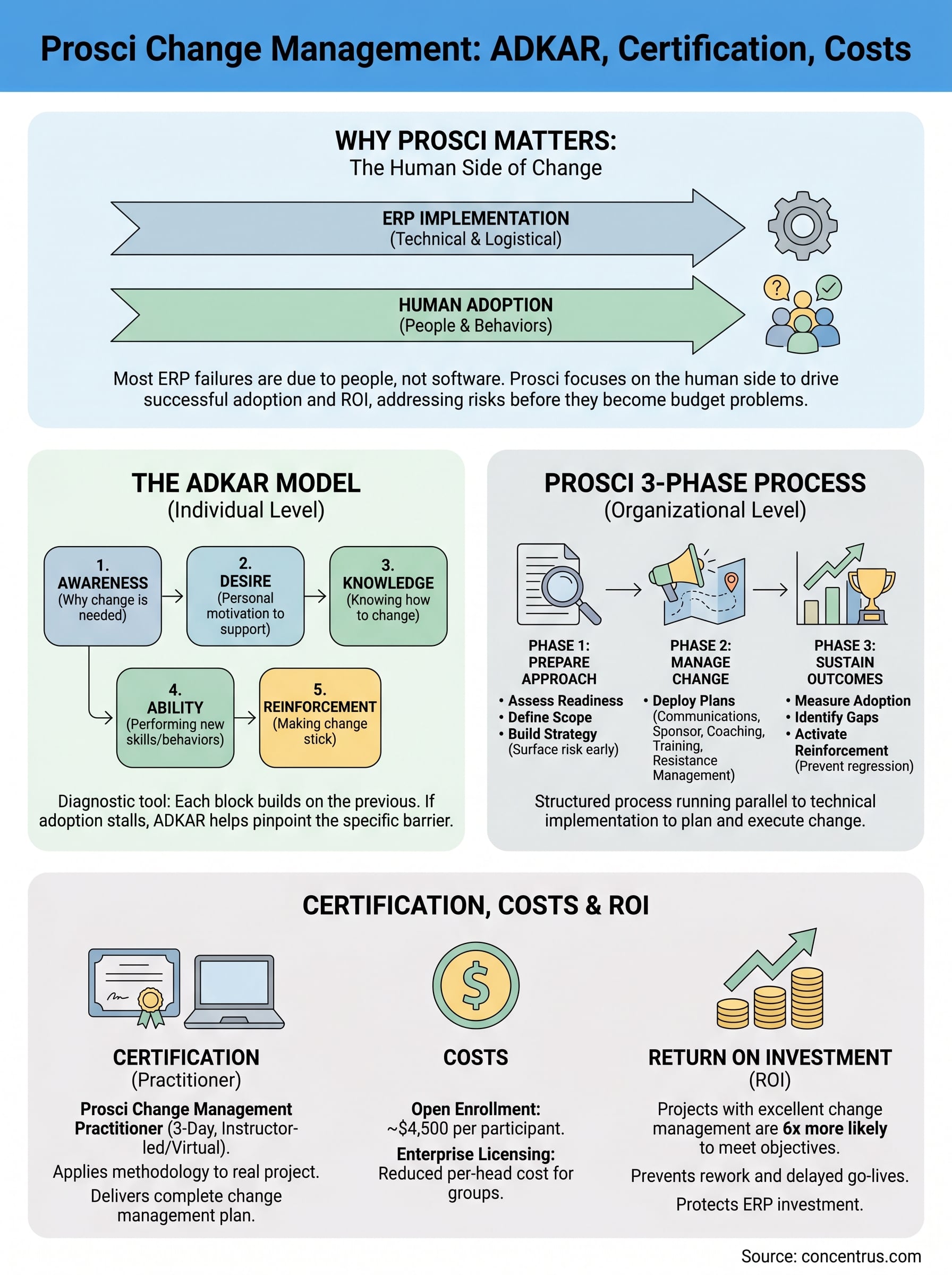
Prosci is not a single tool or a checklist. It is a complete system made up of interconnected frameworks that address change at two distinct levels: the organizational level, which covers what leaders and project teams need to do to support change, and the individual level, which addresses what each person needs to move through the transition successfully. At the organizational level, Prosci provides a three-phase structured process covering preparation, management, and reinforcement. At the individual level, the ADKAR model breaks down exactly what a person needs to progress: Awareness, Desire, Knowledge, Ability, and Reinforcement.
The methodology also draws a sharp line between project management and change management. Project management focuses on tasks, timelines, and deliverables. Change management focuses on people, behaviors, and adoption rates. Both are necessary for a project to deliver results, but they solve different problems. Prosci’s framework is designed to run alongside your technical project plan, not replace it, so the human and operational tracks move forward together.
Why organizations use it repeatedly
Part of Prosci’s appeal is that it’s practical and scalable across team sizes. You don’t need a dedicated change management department to apply it. A single certified practitioner embedded in a project team can use Prosci tools to spot resistance early, build sponsor engagement, and track adoption progress before problems escalate. Organizations from large enterprises to mid-market businesses use the same core models because the frameworks are flexible enough to adapt to different project scopes, industries, and organizational structures.
Consistency is the other driver. When your entire project team, whether that includes project managers, HR leaders, or finance executives, speaks the same language around change, it becomes much easier to align on what success looks like beyond a go-live date. Prosci gives you a shared vocabulary and a repeatable playbook, which matters most when you’re managing multiple system rollouts or working with an outside implementation partner who brings their own processes to the table.
Why Prosci matters on ERP and finance change
ERP implementations carry a specific kind of risk that most project plans don’t account for: the gap between a system going live and people actually using it correctly. That gap costs money. Research from Prosci consistently shows that projects with excellent change management are six times more likely to meet their objectives than those with poor change management. For CFOs and finance leaders, that statistic is not abstract. It translates directly into delayed financial close cycles, inaccurate reporting, and ROI that never materializes.
The hidden cost of skipping people management
When organizations skip structured change management on an ERP rollout, the problems rarely announce themselves clearly. Instead, they show up as workarounds, shadow spreadsheets, and low system utilization months after go-live. Finance teams revert to old processes because no one effectively built their Desire or Knowledge to use the new system. The result is a platform that technically works but functionally underperforms, and the organization ends up paying twice: once for the implementation and again for the fixes.
Prosci change management research shows that the top contributor to project failure is lack of active and visible sponsorship, not technical problems.
This is why applying Prosci’s frameworks from the start of an ERP project changes the outcome. When your project team uses structured assessments to identify resistance early and builds a clear sponsorship coalition before training even starts, you reduce the likelihood of those expensive post-go-live recovery efforts.
What finance leaders specifically need from change management
Finance leaders operate under a different kind of pressure during ERP transitions. You are not just managing your own adoption of a new system. You are also responsible for every downstream financial report, audit trail, and period-close process that depends on data integrity from day one. If your team enters data incorrectly because they never fully understood the new workflows, the consequences reach further than a single department.
Prosci’s structured approach gives finance leaders a clear framework for communicating the business case for the change to their teams, identifying which roles face the highest transition risk, and measuring adoption progress before it’s too late to course-correct. Rather than finding out at month-end close that adoption has stalled, you get early signals and intervention tools built into the process. That level of control over the human side of an ERP transition is exactly what CFOs need to protect their ROI projections and meet the financial milestones tied to the project’s business case.
The ADKAR model, explained simply
ADKAR is the individual-level framework at the core of prosci change management. The acronym stands for Awareness, Desire, Knowledge, Ability, and Reinforcement, and each element represents a distinct milestone that a person must reach before they can successfully adopt and sustain a change. If you skip one element or it doesn’t fully take hold, the person stalls, and so does your project’s adoption rate.
The five building blocks of ADKAR
Each element builds directly on the one before it, which means you can use ADKAR as a diagnostic tool to pinpoint exactly where someone is struggling and target your support there, rather than defaulting to more training when training isn’t the actual problem.
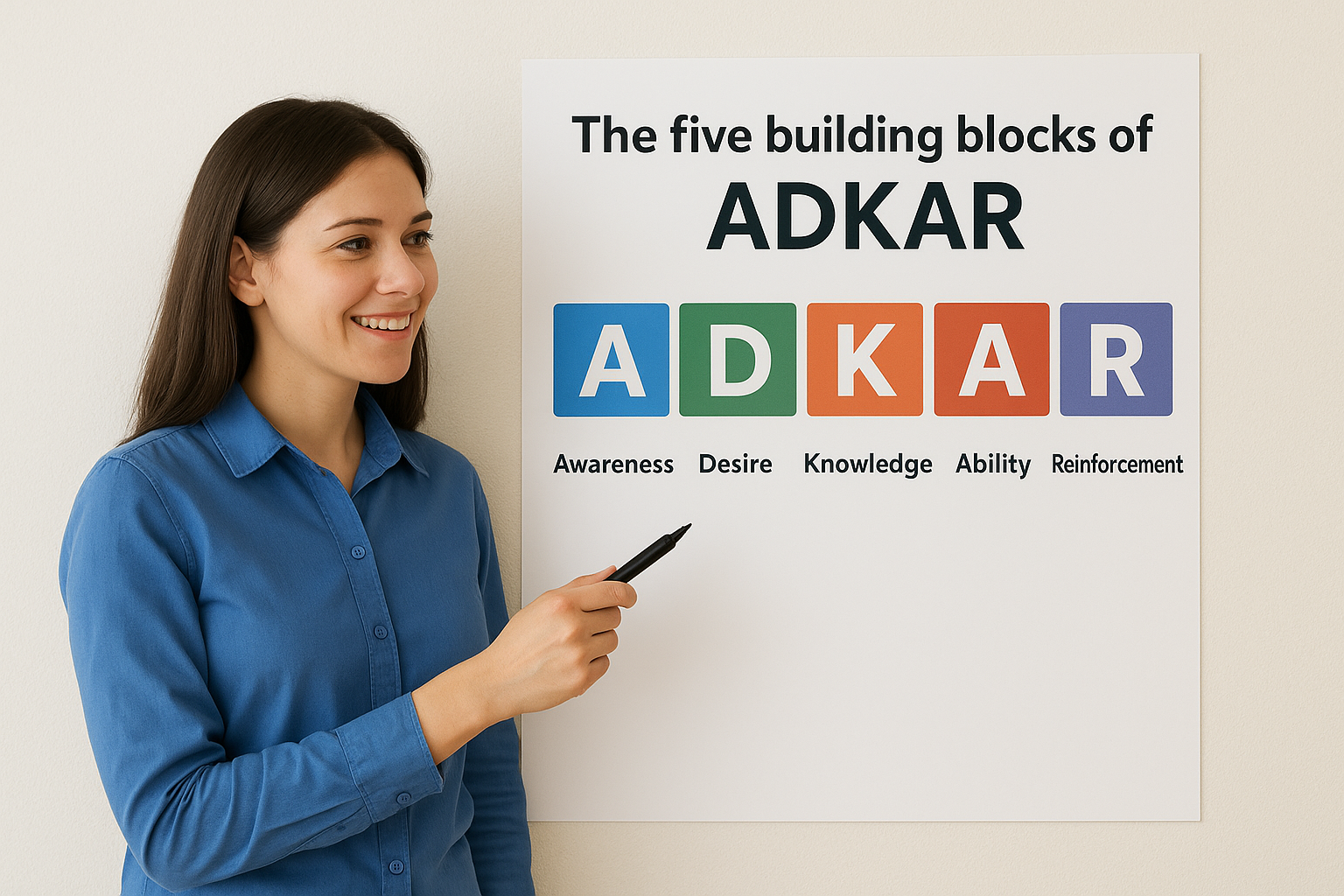
- Awareness: The person understands why the change is happening and what risks the organization faces if it doesn’t make the shift.
- Desire: The person has a personal motivation to support and participate in the change, not just an intellectual understanding of it.
- Knowledge: The person knows how to change, meaning they understand the new processes, systems, and behaviors required of their role.
- Ability: The person can actually perform the new skills and behaviors in practice, not just in a training environment.
- Reinforcement: Systems, recognition structures, and accountability mechanisms exist to make the new behaviors stick over time.
Most ERP training programs focus almost entirely on Knowledge and Ability, but if Awareness and Desire are missing, training alone will not drive real adoption.
Why ADKAR works in sequence
The sequence matters because each building block depends on the previous one. You cannot build genuine Desire in someone who lacks Awareness. You cannot develop real Ability in someone who lacks Knowledge. When adoption stalls after go-live, ADKAR gives your team a precise way to diagnose the gap rather than assuming the problem lies in the technology or the quality of your training materials.
For finance teams navigating an ERP transition, this framework is especially practical. If your team reverts to spreadsheets three months after launch, the issue is rarely that they don’t know how to operate the system. More often, they lack Desire or Reinforcement, meaning they were never fully convinced the new system serves them better, or no structure exists to hold them accountable for using it. ADKAR tells you exactly which building block broke down and gives you a targeted way to respond.
The Prosci 3-phase process and core tools
The ADKAR model tells you what individuals need to move through change. But prosci change management also gives project teams a [structured organizational process](https://concentrus.com/change-management-framework/) for planning and executing change at the project level. That process is called the Prosci 3-Phase Process, and it runs parallel to your technical implementation from kickoff through reinforcement.

Phase 1: Prepare approach
In Phase 1, your team builds the foundation before any change activity starts. You assess organizational readiness, define the scope and impact of the change, and build your change management strategy. This phase surfaces risk early. If your organization has a history of failed technology rollouts or low executive support, Phase 1 is where you identify that and adjust your strategy before the project is already in motion. The key deliverables from this phase include:
- A change impact assessment identifying which roles and processes are most affected
- A change management strategy tailored to your organization’s size and risk profile
- An initial sponsor assessment and engagement plan
Phase 2: Manage change
Phase 2 is where your team executes the plans built in Phase 1. You deploy communications plans, sponsor roadmaps, coaching plans, training plans, and resistance management plans, all built around the specific groups affected by the change. Each tool targets a different barrier to adoption. Sponsor roadmaps, for example, guide executives on the specific visible actions they need to take to build support across the organization.
Research from Prosci shows that projects with strong, active executive sponsorship are significantly more likely to achieve their stated change objectives than those without it.
Your communications plan ensures the right messages reach the right people at the right time, building Awareness and Desire in the people who need it most. Your resistance management plan gives managers a concrete way to identify and respond to pushback before it spreads.
Phase 3: Sustain outcomes
Phase 3 is where most organizations underinvest, and where ROI is most commonly lost. After go-live, you need to measure adoption levels, identify gaps, and activate reinforcement mechanisms to make new behaviors permanent. Prosci provides structured tools for conducting adoption assessments and building corrective action plans when specific groups fall behind.
Without this phase, the work done in Phases 1 and 2 fades quickly, and utilization rates drop back toward the old patterns you were trying to move away from in the first place. For finance teams, that regression shows up directly in reporting accuracy and period-close performance.
Prosci certification and what you learn
Prosci offers structured certification programs designed to give practitioners a working command of the full methodology, not just surface-level familiarity with the ADKAR model. The flagship offering is the Prosci Change Management Practitioner certification, which is the most widely recognized credential in the field and the one most organizations reference when they want to verify that someone can actually lead change on a real project.
What the practitioner certification covers
The program runs over three days and combines instruction, application, and assessment. You don’t just sit through lectures. You apply the Prosci 3-phase process to a change project from your own organization, which means the learning is immediately relevant rather than theoretical. By the time you complete the program, you have built out actual change management deliverables, including a change management strategy, a sponsor plan, and a communications framework, that you can use on a live project.
Prosci designed the certification so that practitioners finish with a complete change management plan for a real project, not just a credential that proves they sat through a course.
The curriculum walks you through each phase of prosci change management in sequence, covering how to assess organizational readiness, how to develop a change management strategy, how to activate sponsorship, how to manage resistance, and how to measure adoption after go-live. Each module connects directly to the tools your team will use in the field.
The learning formats available
Prosci offers the practitioner certification in several delivery formats. You can attend an in-person, instructor-led program at a Prosci training center, complete it in a virtual instructor-led format, or go through an enterprise licensing model if your organization wants to train a larger group. The virtual format covers the same curriculum and results in the same credential, which makes it a practical option if travel constraints are a factor for your team.
For organizations that want to build internal capability across multiple teams, Prosci also offers an Enterprise License that allows a trained internal facilitator to deliver the curriculum to employees directly. This model reduces per-head cost significantly when you need to certify large numbers of project managers, HR leaders, or finance executives across a rollout program.
Advanced and specialized credentials
Beyond the practitioner level, Prosci offers advanced certification options for experienced practitioners who want to develop deeper competency in program management or coaching. These programs build on the foundational credential and are designed for practitioners who are already applying the methodology regularly and need tools to handle more complex, multi-stream change environments.
Prosci certification cost, ROI, and career value
Understanding what the certification costs and what it returns matters before you commit time and budget to the program. The investment varies depending on the delivery format you choose and whether you’re enrolling as an individual or as part of an organizational cohort, so it’s worth breaking down both dimensions clearly.
What the certification costs
The public open enrollment program for the Prosci Change Management Practitioner certification typically runs around $4,500 per participant for the three-day instructor-led course, whether in-person or virtual. Pricing can shift slightly depending on delivery format and timing, so confirming current rates directly through Prosci’s website gives you the most accurate number before you register. For organizations that need to certify multiple team members at once, the enterprise licensing model reduces per-head cost significantly by allowing an internal facilitator to deliver the program in-house after completing a separate train-the-trainer certification. If you’re evaluating this for a large ERP rollout where five or more project team members need the credential, the enterprise path usually makes more financial sense than enrolling people individually through open enrollment.
The return on the investment
For organizations, the ROI case for certification comes down to project success rates. Prosci research consistently shows that projects with excellent change management are six times more likely to meet their stated objectives than projects with poor or no change management. When you apply that to an ERP implementation already costing six or seven figures, spending a few thousand dollars on practitioner training pays for itself the moment it prevents a single phase of rework or a delayed go-live. Finance leaders benefit in a specific way here, because certified practitioners can connect every change management activity to measurable adoption outcomes, which keeps ROI tracking tied to real behavior change rather than a go-live checkbox.
The real cost of skipping certification isn’t the training fee. It’s the recovery cost when adoption fails and your ERP project underdelivers on its business case.
Career value and market recognition
On the individual side, the Prosci credential carries strong recognition across industries because it is the most widely referenced change management certification globally. Project managers, HR directors, and finance executives who hold it consistently find it broadens their role on complex technology programs, since organizations actively look for practitioners who can manage the human side of large implementations alongside the technical work. As digital transformation programs continue to expand across mid-market companies, demand for certified prosci change management practitioners remains steady, making this a durable career investment rather than a credential that ages quickly.
Where to go from here
Prosci change management gives you a structured, research-backed way to protect your ERP investment by managing the people side of the transition with the same rigor you apply to timelines and budgets. You now understand the ADKAR model, the three-phase process, and what certification costs and delivers, which puts you in a concrete position to decide whether to pursue training, bring in a certified practitioner, or build the methodology into your next implementation from day one.
If you are working through an ERP implementation or trying to recover ROI from one that has underdelivered, the human adoption gap is almost always part of the problem. Concentrus specializes in NetSuite and Acumatica ERP implementations that tie every phase directly to measurable financial outcomes, and our team can help you close that gap before it costs you more.