

Every ERP implementation reshapes how people work, new systems, new processes, new expectations. Yet most midsized companies focus almost entirely on the technology and skip the human side. That gap is exactly where organizational change management consulting comes in. It’s the discipline of preparing, equipping, and supporting the people who actually have to use the system every day, so the investment pays off instead of collecting dust.
The numbers back this up. Projects with strong change management are six times more likely to meet objectives than those without it, according to Prosci’s benchmarking data. For CFOs and finance leaders who need measurable returns from ERP investments, ignoring change management is one of the most expensive mistakes on the table. It doesn’t matter how well-configured your NetSuite or Acumatica instance is if your teams resist it, work around it, or never fully adopt it.
At Concentrus, we see this firsthand. Our ROI Roadmap™ methodology ties every ERP project to financial outcomes, faster closes, stronger margins, better cash flow. But those outcomes depend on people changing how they operate. That’s why understanding organizational change management consulting matters whether you’re planning a new implementation, rescuing a stalled one, or trying to figure out why your current system isn’t delivering.
This article breaks down what organizational change management consulting actually involves, how it connects to ERP ROI, and what to look for when evaluating firms that offer these services.
What organizational change management consulting is
Organizational change management consulting is a professional service that helps organizations navigate the human side of business transformation. Consultants in this space work directly with leadership and front-line staff to manage resistance, build readiness, and drive adoption of new systems, processes, or operating models. Unlike technology implementation, which focuses on configuring software and migrating data, change management focuses on the people who have to change their daily habits and workflows to make that technology actually work.
The core definition
At its core, organizational change management (OCM) is a structured approach to transitioning individuals, teams, and organizations from a current state to a desired future state. Change management consulting brings outside expertise, proven frameworks, and dedicated resources to that transition so you are not figuring it out on the fly. Research organizations like Prosci have built widely adopted methodologies around this discipline, each grounded in data showing that human factors drive the majority of project failures, not technical ones.
Research consistently shows that resistance from employees and lack of management support are the top two reasons change initiatives fail, not software bugs or configuration errors.
The consulting engagement typically starts before the technology is even configured. OCM consultants assess your organization’s readiness for change, identify where resistance is likely to surface, and build a plan to address those friction points proactively rather than scrambling to fix them after go-live.
The scope: beyond training and communication
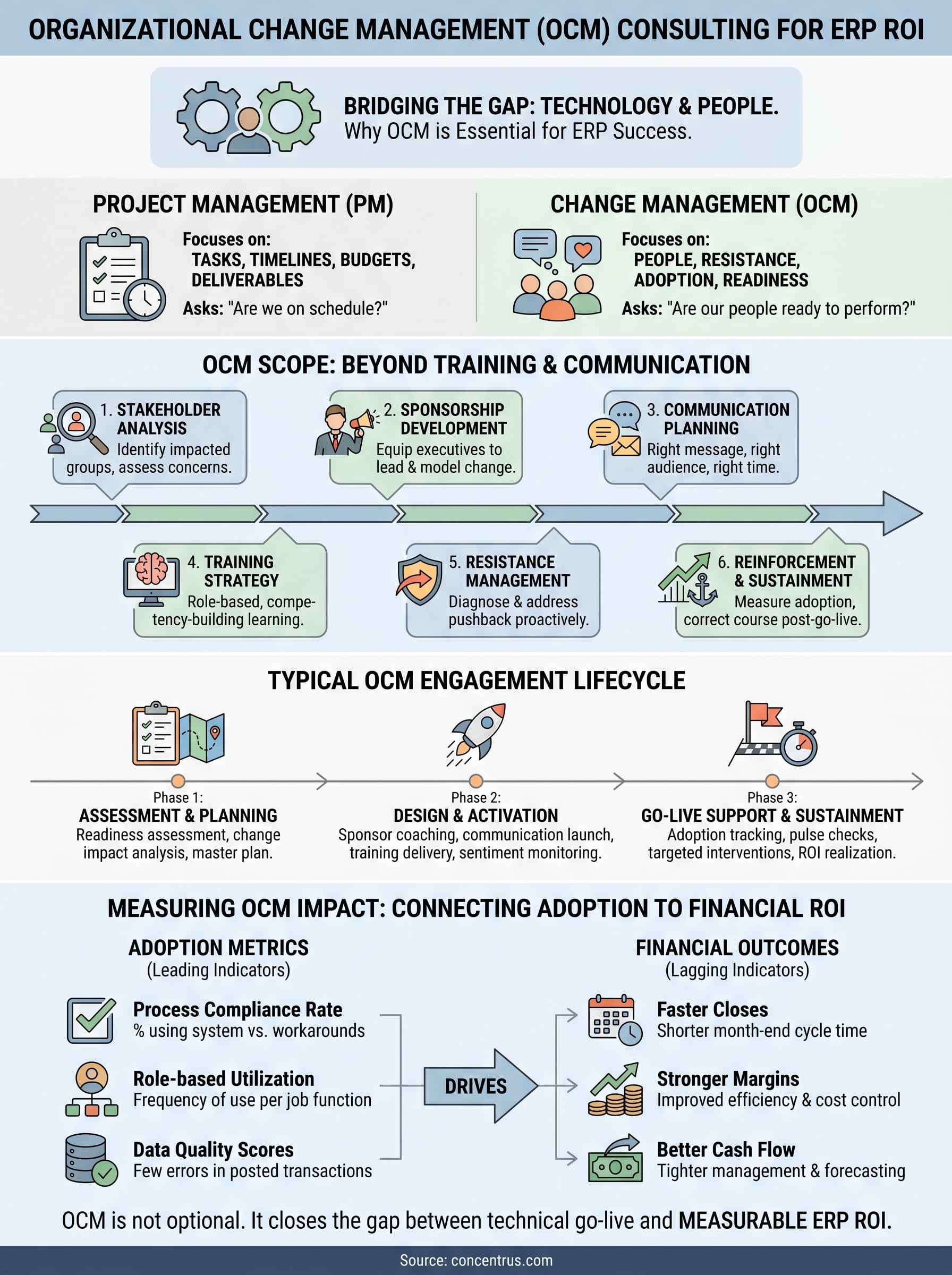
Many companies assume change management means scheduling a few training sessions and sending out email announcements. That framing undersells the discipline significantly, and it is also one of the main reasons ERP projects stall after launch. Organizational change management consulting covers a much broader set of activities, including stakeholder analysis, leadership alignment, change impact assessments, communication strategy, resistance management, and sustained reinforcement well after the system is live.
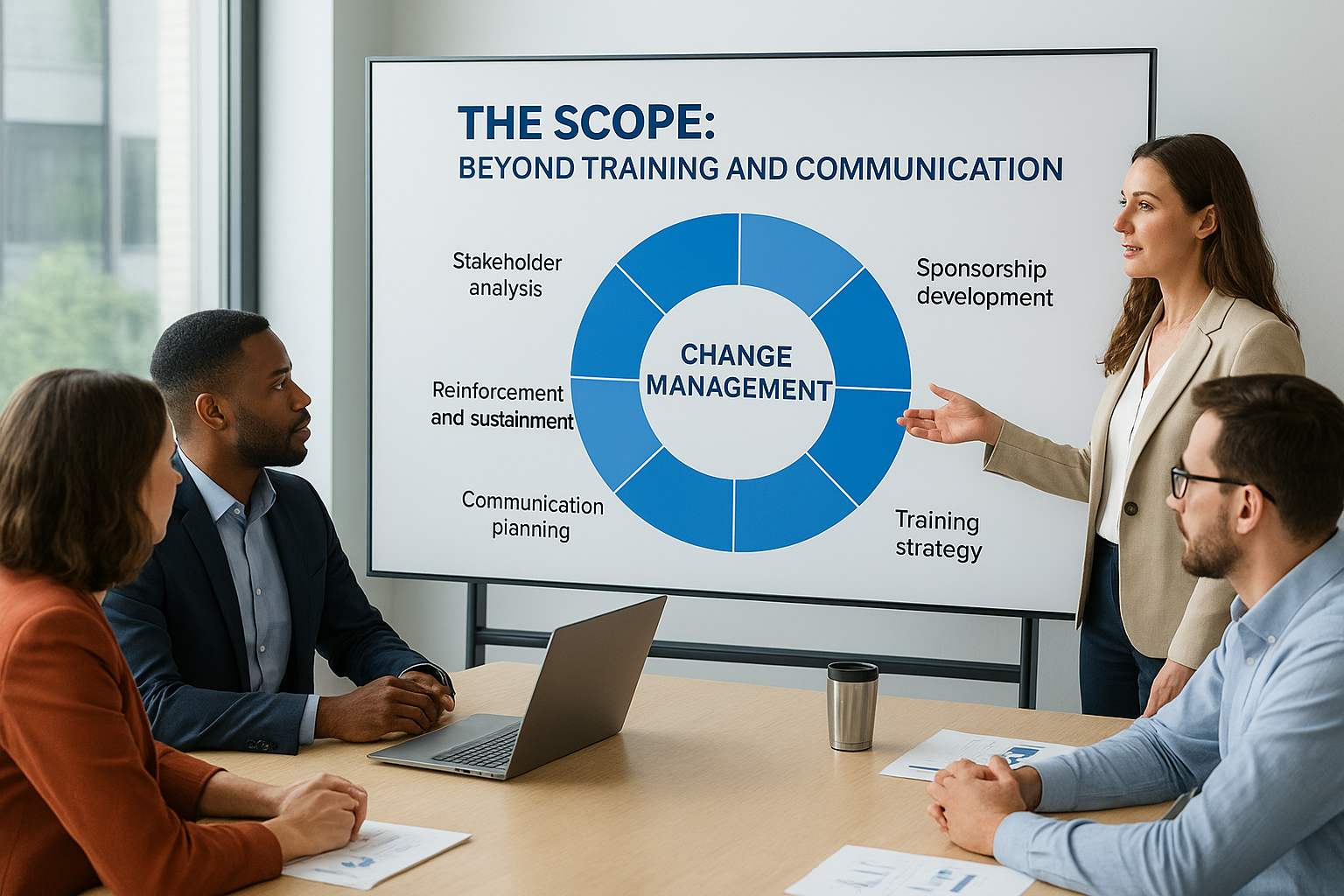
Here is a breakdown of what typically falls within OCM scope:
- Stakeholder analysis: Identifying who is affected by the change, how significantly, and what their specific concerns are
- Sponsorship development: Equipping executives and managers to actively lead and model the change, not just approve it
- Communication planning: Crafting the right messages for the right audiences at the right points in the project timeline
- Training strategy: Designing role-based learning that builds real competency rather than just checkbox completion
- Resistance management: Diagnosing the root causes of pushback and addressing them directly with targeted interventions
- Reinforcement and sustainment: Measuring adoption after go-live and correcting course before bad habits become permanent
How it differs from project management
Project management tracks tasks, timelines, budgets, and deliverables. Change management tracks people: their awareness, willingness, and ability to operate effectively in the new environment. Both disciplines are necessary for a successful ERP rollout, but they answer different questions. Project management asks “are we on schedule?” while change management asks “are our people ready to perform in the new system?”
When you bring in an OCM consultant, you are adding someone whose entire focus is adoption and performance readiness. They work alongside your project team, your system integrator, and your internal sponsors to make sure the technical go-live translates into measurable business results, not just a date crossed off the calendar.
Why it matters for ERP outcomes and ROI
Most ERP projects fail not because the software is wrong, but because adoption falls short of what the business needs. Your system can be perfectly configured, your data clean, and your go-live date met on schedule. None of that guarantees the financial outcomes you sold to your board. The returns on an ERP investment come from people working differently, and organizational change management consulting is what closes the gap between a system that is technically live and one that actually changes how your business performs.
The adoption gap and what it costs you
When adoption is low, the cost is immediate and measurable. Finance teams still run shadow spreadsheets. Approval workflows get bypassed. Reporting stays manual. Month-end close does not shrink the way it should. Every workaround your team builds represents time, money, and risk that your ERP was supposed to eliminate. Research from McKinsey shows that 70% of change programs fail to achieve their goals, largely because of people-related factors rather than technical failures.
If your team is not using the system the way it was designed, you are paying ERP licensing costs without capturing ERP-level efficiency.
The gap compounds over time. Bad habits formed in the first 90 days after go-live tend to solidify into permanent workarounds that cost far more to unwind later than they would have cost to prevent upfront.
How OCM connects directly to financial results
Finance leaders need to see a direct line between change management investment and return on investment. That line exists. When your teams adopt the system fully and consistently, you gain the accurate, real-time data that drives faster closes, tighter cash flow management, and better forecasting. Higher adoption rates directly shorten the time between go-live and the point where your ERP delivers the ROI you projected.
Concentrus ties every ERP engagement to specific financial KPIs: close cycle time, margin improvement, working capital efficiency. Those numbers only move when people operate the system as intended. A change management approach built into your ERP project from day one means your adoption curve is steeper, your risk of regression is lower, and your path to measurable financial outcomes is shorter. That is not a soft benefit. It is the engine behind your projected ROI.
What OCM consultants do and key deliverables
OCM consultants work across every phase of your ERP project, not just at go-live. They build the infrastructure for adoption by assessing organizational readiness, aligning leadership behavior, sequencing communication, and tracking whether your teams actually shift how they work. The deliverables they produce give you concrete, measurable checkpoints rather than vague assurances that people will come around once the system is live.
Diagnosing readiness and risk
Before training or communication planning begins, an OCM consultant conducts a change readiness assessment. This analysis maps which departments, roles, and individuals face the highest degree of change, where resistance is likely to surface, and what is driving that resistance. The output is a risk-ranked view of your organization that tells your project leadership exactly where to concentrate resources before problems appear.
A readiness assessment at project launch surfaces the resistance points that would otherwise surface as go-live failures, when they cost far more to fix.
This diagnostic foundation is where organizational change management consulting earns its place in your project budget. Without it, training programs get built on assumptions and sponsorship gets deployed in the wrong places, which means you discover gaps after launch rather than before.
Building stakeholder and communication infrastructure
Once the consultant understands your risk landscape, they design a stakeholder engagement plan that identifies key sponsors, coaches them to actively model and lead the change rather than just sign off on it, and sequences messaging so each audience gets the right information at the right time. Deliverables in this phase typically include:
- A sponsor roadmap with defined roles and structured talking points
- A communication calendar with audience-specific messages tied to project milestones
- A manager toolkit for addressing questions and handling resistance at the team level
Designing role-based training and sustainment
Training in an OCM engagement is not a single event or a generic walkthrough of the system. Your consultant builds role-specific learning paths that reflect how each job function will actually interact with the platform day to day. A controller needs different depth than an accounts payable clerk, and your training design should reflect that reality. After go-live, the consultant tracks adoption metrics, identifies where teams are reverting to old behaviors, and recommends reinforcement steps tied directly to your financial KPIs. The final deliverable is not just a training schedule but a sustained adoption roadmap that stays active until your teams perform at the level your ROI projections require.
How an OCM engagement typically works
An organizational change management consulting engagement runs in parallel with your ERP implementation from kickoff through post-launch reinforcement. It is not a one-time workshop or a box you check before go-live. Your OCM consultant integrates into your project structure from day one, working alongside your system integrator and internal project team to make sure the human side of the rollout stays on pace with the technical side.
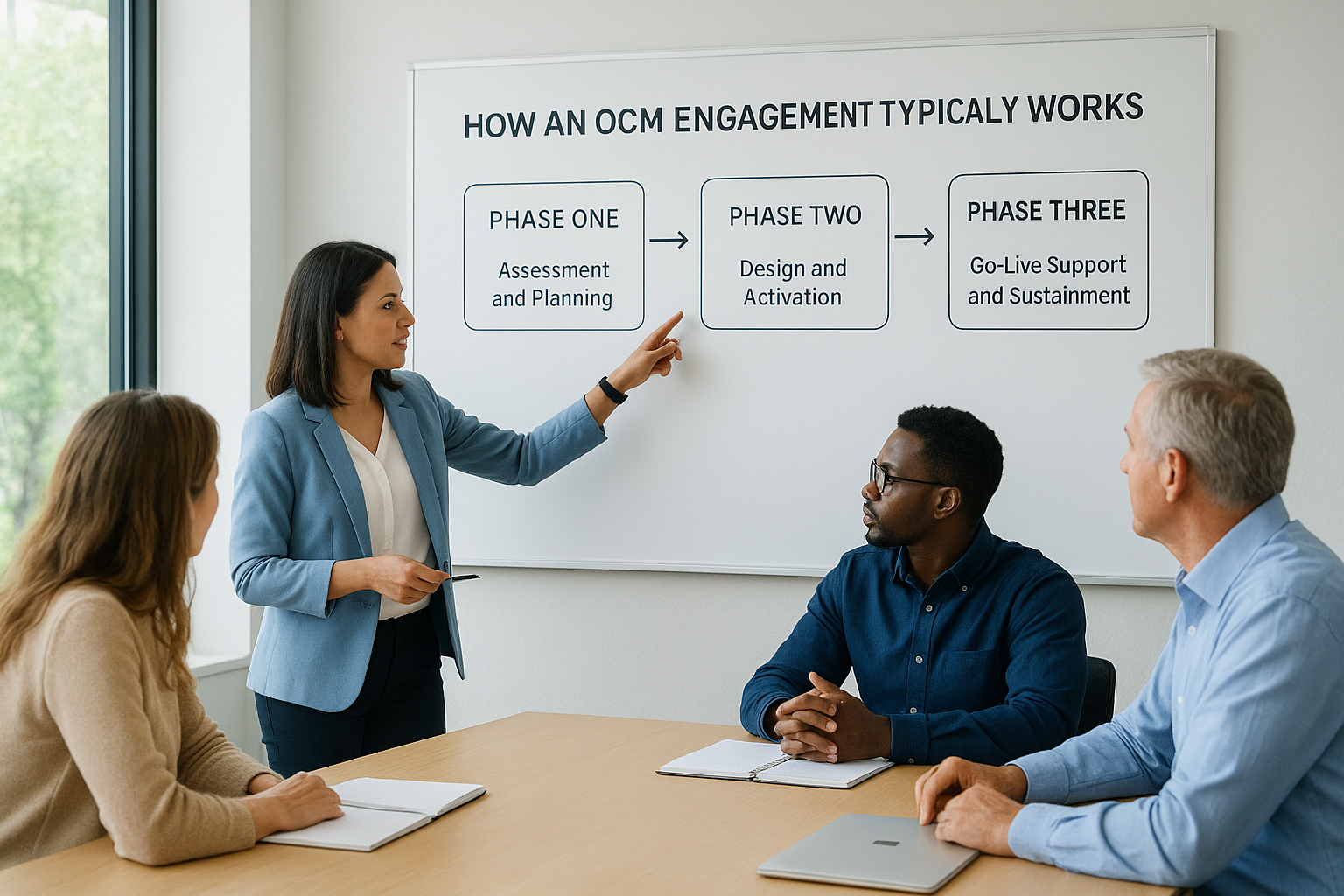
Phase one: assessment and planning
Your consultant starts by gathering the data they need to build a realistic change strategy. This means conducting stakeholder interviews, reviewing organizational structure, and mapping which roles face the steepest learning curve. The output is a change impact assessment that quantifies disruption by department and identifies your highest-risk groups before the project ever reaches configuration. From there, the consultant drafts a master change plan with defined timelines, sponsor responsibilities, communication milestones, and training design parameters, all tied to your project schedule.
The planning phase is where most organizations save the most money: catching adoption risks early costs a fraction of what it costs to fix them after go-live.
Phase two: design and activation
Once planning is in place, your consultant builds and executes the deliverables. Sponsor coaching sessions begin, equipping executives and managers to lead visibly rather than simply approve decisions from a distance. Your communication calendar activates with audience-specific messaging at each major project milestone. Training design gets underway using role-based scenarios drawn from your actual workflows, not generic platform walkthroughs. Your consultant also monitors sentiment and early resistance signals, adjusting the engagement plan in real time if certain groups show signs of disengagement or confusion.
Phase three: go-live support and sustainment
The engagement does not end when the system goes live. Your consultant stays active in the weeks and months following launch, tracking adoption metrics, running post-go-live pulse checks, and identifying where teams are reverting to manual workarounds. If adoption lags in a specific department, the consultant diagnoses the root cause and deploys targeted interventions, whether that is additional coaching, refresher training, or escalation to executive sponsors. This sustainment phase is what converts a successful go-live into actual ROI, because consistent system use is the mechanism that drives the financial outcomes your project was designed to deliver.
How to measure ROI, adoption, and risk
Measuring the impact of organizational change management consulting requires you to track more than user login counts or training completion rates. Real measurement connects adoption behavior to the financial outcomes your ERP project was designed to produce. Without a defined measurement framework, you cannot tell the difference between a team that is technically using the system and one that is using it in a way that actually moves your KPIs.
Adoption metrics that signal real progress
Your consultant should define adoption metrics before go-live, not after. Lagging indicators like close cycle time or manual journal entry volume tell you whether adoption is translating into financial results, but you need leading indicators to course-correct in real time. The following metrics give you a practical view of adoption health across the engagement:
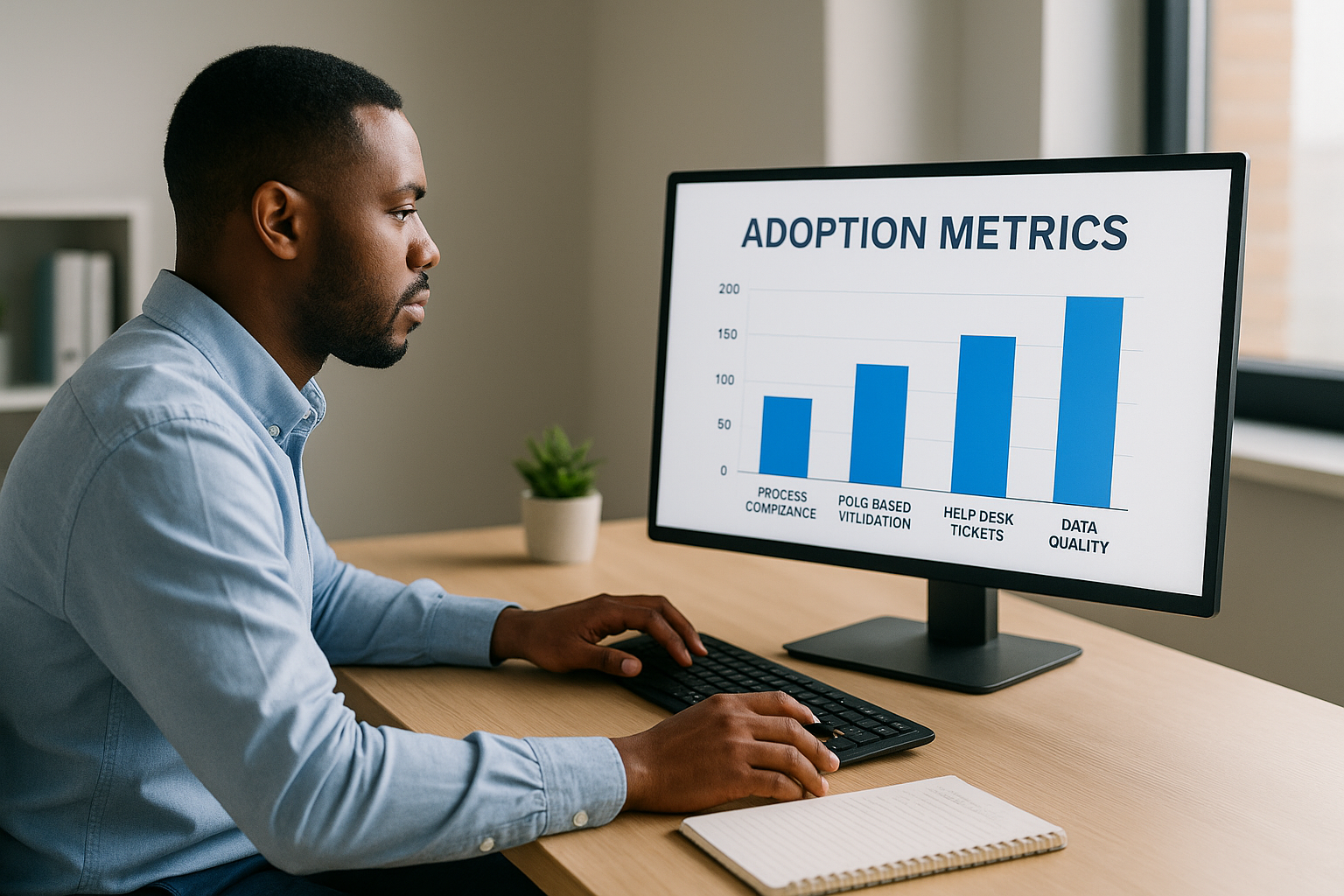
- Process compliance rate: the percentage of transactions processed through the system rather than manual workarounds
- Role-based system utilization: how frequently each user group engages with the specific modules their job requires
- Help desk ticket patterns: a spike in tickets from a specific department often signals training gaps or unresolved resistance
- Data quality scores: errors in posted transactions reveal whether users understand the workflows, not just the interface
Tracking process compliance rate by department in the first 60 days after go-live gives you the clearest early signal of where adoption is breaking down before it becomes a financial problem.
Connecting adoption data to financial outcomes
Once you have adoption data, your job is to link it directly to the financial KPIs your ERP project was built around. If your accounts payable team’s process compliance rate is high, you should see a corresponding reduction in late payment penalties and manual reconciliation hours. If your inventory team is fully utilizing replenishment workflows, working capital efficiency should improve within the quarter. Mapping adoption metrics to financial outcomes is what transforms change management from a soft discipline into a measurable driver of ROI.
Tracking risk throughout the engagement
Risk in a change engagement is not static. New resistance can emerge after go-live as the pressure of the old way of working resurfaces. Your consultant should run structured pulse surveys at 30, 60, and 90 days post-launch to identify where sentiment is slipping and which managers need additional coaching to keep their teams on course. Risk tracking is what keeps your adoption curve moving in the right direction after the project team has moved on.
How to choose an OCM consulting partner
Choosing the right organizational change management consulting partner is not just a procurement decision. The firm you select shapes whether your ERP project delivers financial results or leaves your teams stuck in the same manual workflows you were trying to leave behind. Most firms can produce a communication plan and a training schedule. Fewer can connect adoption behavior directly to the financial KPIs your leadership expects to see move.
Look for ERP-specific change management experience
Generic change management expertise does not transfer cleanly into an ERP context. You need a partner who understands how people actually resist system transitions, not just organizational restructuring or culture initiatives. Ask candidates directly how many ERP implementations they have supported, which platforms they have worked on, and what adoption metrics they tracked after go-live. The answers reveal whether their experience is relevant to your situation or theoretical.
When you evaluate firms, use these questions to separate strong candidates from generic vendors:
- Can they show you examples of adoption metrics from past ERP engagements?
- Do they have documented experience with your specific platform, whether NetSuite, Acumatica, or another mid-market ERP?
- How do they define success after go-live, and how do they measure it?
- Can they describe a situation where their engagement plan changed based on real-time resistance signals?
A firm that cannot answer these questions with specifics is likely to deliver generic deliverables that do not address the actual friction in your organization.
Evaluate how they integrate with your project team
Change management only works when it runs alongside your implementation, not after it. Your OCM partner should have a clear model for working directly with your system integrator, your internal project sponsors, and your finance leadership from day one. Ask how they coordinate with the technical project team on timeline dependencies and how they escalate when adoption risks surface mid-project.
You also want a partner whose measurement framework ties directly to financial outcomes, not just training completion or survey scores. If a firm cannot explain how they connect process compliance data to close cycle time or cash flow efficiency, they are measuring activity rather than results. That distinction determines whether your change management investment drives ROI or simply checks a box on your project plan.
Key takeaways and next steps
Organizational change management consulting is not optional for ERP projects that need to deliver real financial results. The technology is only part of the equation; your teams have to change how they actually work, and that requires deliberate planning, structured communication, and sustained reinforcement well past go-live. When you integrate change management into your ERP project from the start, you shorten the path between implementation and measurable ROI rather than spending months correcting adoption failures after launch.
Your next step is to evaluate whether your current or planned ERP project has the change infrastructure it needs. If you are working with NetSuite or Acumatica and your adoption curve is flatter than your projections required, the problem is almost always on the people side, not the technology side. Talk to the Concentrus team about how the ROI Roadmap™ methodology connects change management directly to the financial outcomes your leadership expects.