

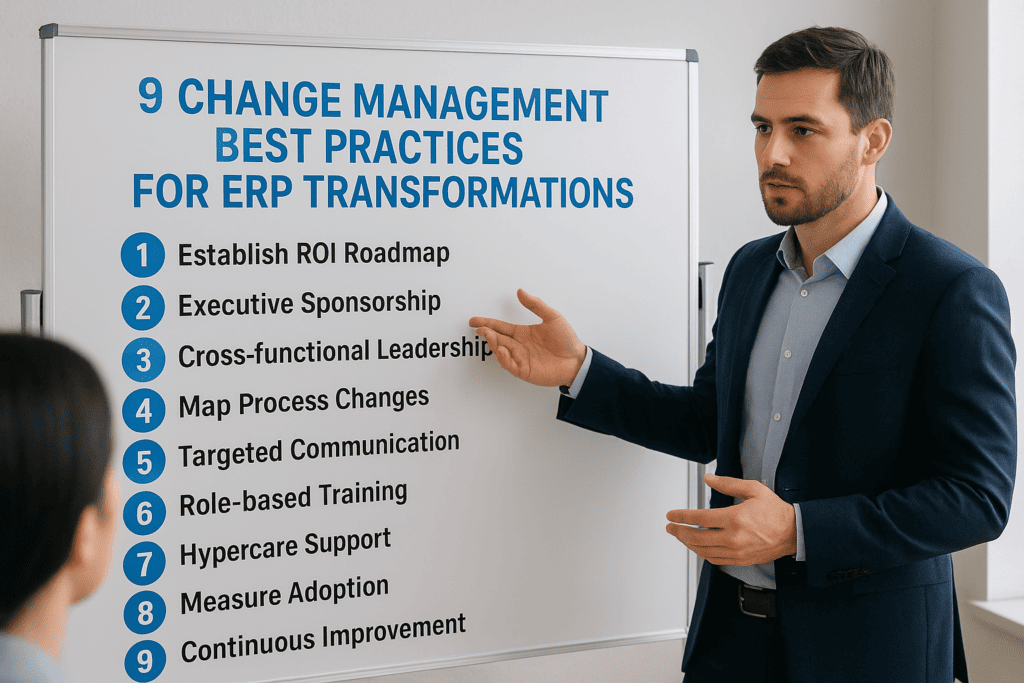
Most ERP projects don’t fail because of the technology. They fail because nobody prepared the people who have to use it. You can pick the right platform, nail the configuration, and still watch adoption crater, because the human side of the rollout got treated as an afterthought. That’s exactly why change management best practices matter more than most CFOs and finance leaders realize, and why skipping them is one of the most expensive mistakes a midsized company can make.
At Concentrus, we’ve implemented and rescued enough NetSuite and Acumatica ERP projects to see the pattern clearly. The organizations that build change management into their project plan from day one hit their ROI milestones faster and with far less friction. The ones that bolt it on later, or ignore it entirely, end up with underperforming systems and frustrated teams who quietly revert to spreadsheets.
This article breaks down nine proven practices that protect your ERP transformation from the inside out. Each one is grounded in what actually works during live implementations, not theory. Whether you’re planning a new ERP rollout or trying to recover from one that went sideways, these practices will give you a concrete framework for earning buy-in, reducing risk, and driving measurable results across your organization.
1. Use an ROI Roadmap to define success
Every ERP transformation needs a clear definition of success before anyone touches a configuration screen. Without it, your change management efforts have no anchor, and your teams have nothing to align around. An ROI Roadmap connects every project decision, training milestone, and adoption target back to measurable financial outcomes like faster month-end close, improved cash flow, or lower cost per transaction.
What this means for ERP transformations
An ROI Roadmap is not a project plan. It is a strategic document that ties your ERP initiative directly to the financial KPIs your organization needs to hit. For CFOs and finance leaders, this means ERP change stops being an IT project and becomes a business transformation with real accountability attached to it.
When people understand how their adoption of a new system connects to company-wide financial goals, resistance drops and urgency rises.
How to build an ROI-first change plan
Start by working with your executive sponsor and department heads to identify the top three to five financial outcomes you expect the ERP to drive. Then map each outcome to specific process changes, user roles, and training needs. This makes your change plan a direct extension of your financial strategy, not a separate workstream running alongside it.
Your change milestones should match your ROI milestones. If faster invoice processing is a target, your change readiness checkpoints should confirm that AR teams are proficient and the workflow is fully live before you declare success at that stage.
What to baseline and track from day one
Before go-live, document your current performance benchmarks: close time, error rates, manual touchpoints, and cycle times. These baselines give you the data you need to prove ROI after stabilization. Without them, you are relying on assumptions that won’t hold up in a board-level conversation about whether the investment paid off.
Missteps that break ROI accountability
The most common mistake is treating ROI as a post-go-live exercise. If you wait until after cutover to define what success looks like, you lose the ability to course-correct during implementation. Another frequent misstep is assigning ROI tracking to IT rather than finance, which disconnects the metrics from the people who own the financial outcomes.
2. Mobilize an active and visible executive sponsor
An ERP transformation without a committed executive sponsor will stall. Employees watch leadership behavior closely, and if no one at the top is visibly invested, middle management and end users take that as a signal that the project is optional. Your sponsor is the single most important human factor in whether your change management best practices hold or collapse under project pressure.
What “active and visible” looks like in ERP programs
Active sponsorship means showing up at key milestones, not just signing off on a project charter. Your sponsor should attend training kickoffs, town halls, and go-live readiness reviews in person or on camera, not through a delegated message.
Employees don’t follow policies during a major ERP change, they follow people, and they follow the person with the most authority who clearly cares.
How to set sponsor roles, time, and decisions
Define your sponsor’s involvement in writing before the project kicks off. Specify which decisions require sponsor input, how many hours per week the role demands, and which escalations go directly to them. Without this structure, sponsors disappear into their operational workload when you need them most.
How the sponsor drives priority and removes blockers
When a department resists process changes or IT deprioritizes a critical integration, your sponsor must intervene quickly and directly. Their authority clears political gridlock that a project manager cannot touch.
Sponsor anti-patterns that fuel resistance
The most damaging sponsor behavior is public silence combined with private skepticism. If your sponsor questions the project in leadership meetings but says nothing to the broader organization, that doubt spreads fast and quietly undermines adoption at every level.
3. Build a cross-functional change leadership team
Your project team handles configuration and delivery, but they cannot own adoption. You need a separate change leadership team that represents the business, holds accountability for readiness in each function, and makes decisions that your project manager doesn’t have the authority or context to make.
The core roles you need beyond the project team
At minimum, your change leadership team should include a change lead or change manager, a representative from finance, one from operations, one from IT, and a training lead. Larger rollouts may also need department-level change champions who carry the message and surface resistance from the floor up.
How to set decision rights and escalation paths
Define in writing which decisions each team member owns, which require a group vote, and which escalate to the executive sponsor. Ambiguous authority creates delays and allows individual departments to opt out of decisions they don’t like. A simple RACI matrix covering major change milestones resolves this before it becomes a conflict.
Clear decision rights protect your timeline more than any project management tool will.
How finance, operations, and IT share ownership
Each function owns its readiness milestone, not just its workstream. Finance confirms process designs meet reporting requirements. Operations validates that workflows map to how work actually gets done. IT owns data quality and integration readiness. Shared ownership means no single team can declare readiness without the others aligned.
What breaks when governance stays informal
Informal governance produces competing priorities, skipped approvals, and shadow decisions made outside the team. When that happens, your change management best practices lose their structural foundation and adoption suffers across every department.
4. Map role-based change impacts and process owners
ERP systems change how people work, not just which screens they navigate. Before you can train anyone or communicate anything meaningful, you need a clear picture of which roles are affected, how their daily work changes, and who owns each process going forward.
How ERP changes work, not just screens
Most organizations underestimate the depth of process change that comes with an ERP implementation. A new system doesn’t just replace software; it restructures workflows, changes approval paths, and shifts accountability between roles and departments.
How to identify impacted roles and workflows
Map every process that touches the new system and document the current state versus future state for each role. Prioritize roles with the highest volume of daily system interactions first. This gives your change and training teams a ranked list of readiness priorities rather than a flat inventory.

The roles most disrupted by an ERP transition are rarely the ones that get the most change management attention.
How to assign process owners and approve future state
Each future-state process needs a named process owner who approves the design, validates the training content, and holds accountability for adoption in their area. Without clear ownership, process decisions drift and training materials go stale before go-live. This step is one of the most overlooked change management best practices in midsized ERP programs.
Where impact mapping commonly goes wrong
The most frequent failure is completing an impact assessment at the start of the project and never updating it. Processes evolve during configuration, and your impact map must reflect those changes or your training and communication plans will be built on outdated assumptions.
5. Communicate early, often, and from the right senders
Communication is where most ERP change programs lose people. When employees hear nothing official, they fill the silence with speculation, and that speculation is almost always worse than the reality. One of the most overlooked change management best practices is building your communication strategy before the project announcement, not after the first question arrives.
The messages employees actually need for ERP change
Your teams don’t need project status updates. They need answers to three questions: what is changing for me specifically, why this is happening now, and what support they will have. Build every communication around these three answers and you’ll hold attention far better than any generic project newsletter.
How to structure cadence, channels, and timing
Set a regular communication rhythm from the moment the project launches. Bi-weekly touchpoints keep the project visible and prevent rumors from filling the gaps. Use multiple channels in parallel to cover your bases:
- Email updates for formal announcements
- Team meetings for Q&A and real-time concerns
- Leadership briefings for escalation and alignment
Silence is never neutral during an ERP rollout. It reads as a signal that something is wrong.
How to tailor comms by audience and location
Finance teams, warehouse staff, and customer service reps all experience different process changes and carry different concerns. Segment your communication plan by role and location so each group receives messages tied to their actual day-to-day work, not a one-size summary.
Communication mistakes that create rumor cycles
The most damaging mistake is sending communications only from project managers or IT leads. Employees trust messages more when they come from their direct manager or a senior leader they recognize, which means equipping both groups to carry the message accurately is not optional.
6. Equip people managers to coach adoption
Your people managers sit between leadership and end users, which makes them the most important adoption multiplier in your ERP program. When managers actively support the change, their teams follow. When they stay silent or visibly frustrated, adoption stalls regardless of how strong your change management best practices are on paper.
Why managers make or break ERP adoption
Employees look to their direct manager for cues about how seriously to take any major change. If a manager treats the ERP rollout as extra work imposed from above, that attitude spreads fast and undermines user adoption before training even begins.
Managers who frame ERP adoption as a business priority, not an IT project, consistently produce faster time-to-proficiency in their teams.
What managers need to say and do each phase
Give managers phase-specific talking points that align with the project timeline. During design, they explain why the process is changing. During training, they reinforce attendance and accountability. After go-live, they recognize early adopters and redirect anyone reverting to old methods.
How to handle resistance, workload, and morale
Train managers to spot resistance early by watching for workarounds, complaints about system speed, and skipped training sessions. Equip them with scripts for direct conversations that acknowledge the real workload impact while keeping their teams focused on the goal.
Common manager enablement gaps to avoid
Most organizations brief managers once and assume they are ready. Regular touchpoints with your change lead, brief weekly check-ins, and a shared FAQ document give managers the confidence and current context they need to stay effective through go-live and beyond.
7. Train to proficiency with hands-on practice
Training is where change management best practices most visibly succeed or fail. Most ERP programs schedule training too late, compress it into a few days, and measure success by session completion rather than whether anyone can actually perform their job in the new system.
Why “training delivered” is not the goal
Completing a training session and reaching actual proficiency are two completely different outcomes. Your goal is not attendance; it is confirmed competence in the specific tasks each role must perform on day one of go-live.
Marking training complete before users can execute real transactions is one of the fastest ways to generate a support crisis at cutover.
How to design role-based, process-based training
Build your training curriculum around specific job roles and end-to-end processes, not system modules. A warehouse manager does not need a general ledger overview; they need to master receiving, inventory adjustments, and transfer orders in the exact sequence they run daily.
How to validate proficiency before cutover
Require every user to complete a hands-on proficiency check in a sandbox environment before go-live clearance. Use scenario-based assessments that mirror real transactions and edge cases from their workflow, not generic system walkthroughs.
Training pitfalls that show up after go-live
The most common post-launch breakdown is training content built before configuration was final, leaving users with instructions that no longer match the live system. Lock down your configuration before you finalize training materials to avoid this problem entirely.
8. Design go-live for adoption with real support
Go-live day is the moment your change management best practices either hold or break down. Most cutover plans focus on technical tasks, but the organizations that sustain adoption treat go-live as a people event first and a technical event second.
How to plan cutover around people, not just tasks
Build your cutover plan around role readiness and user confidence, not just data migration and system checks. Confirm proficiency sign-offs are complete, schedule extra staffing for high-volume roles, and communicate exactly what users should do if they hit a problem in the first 24 hours.
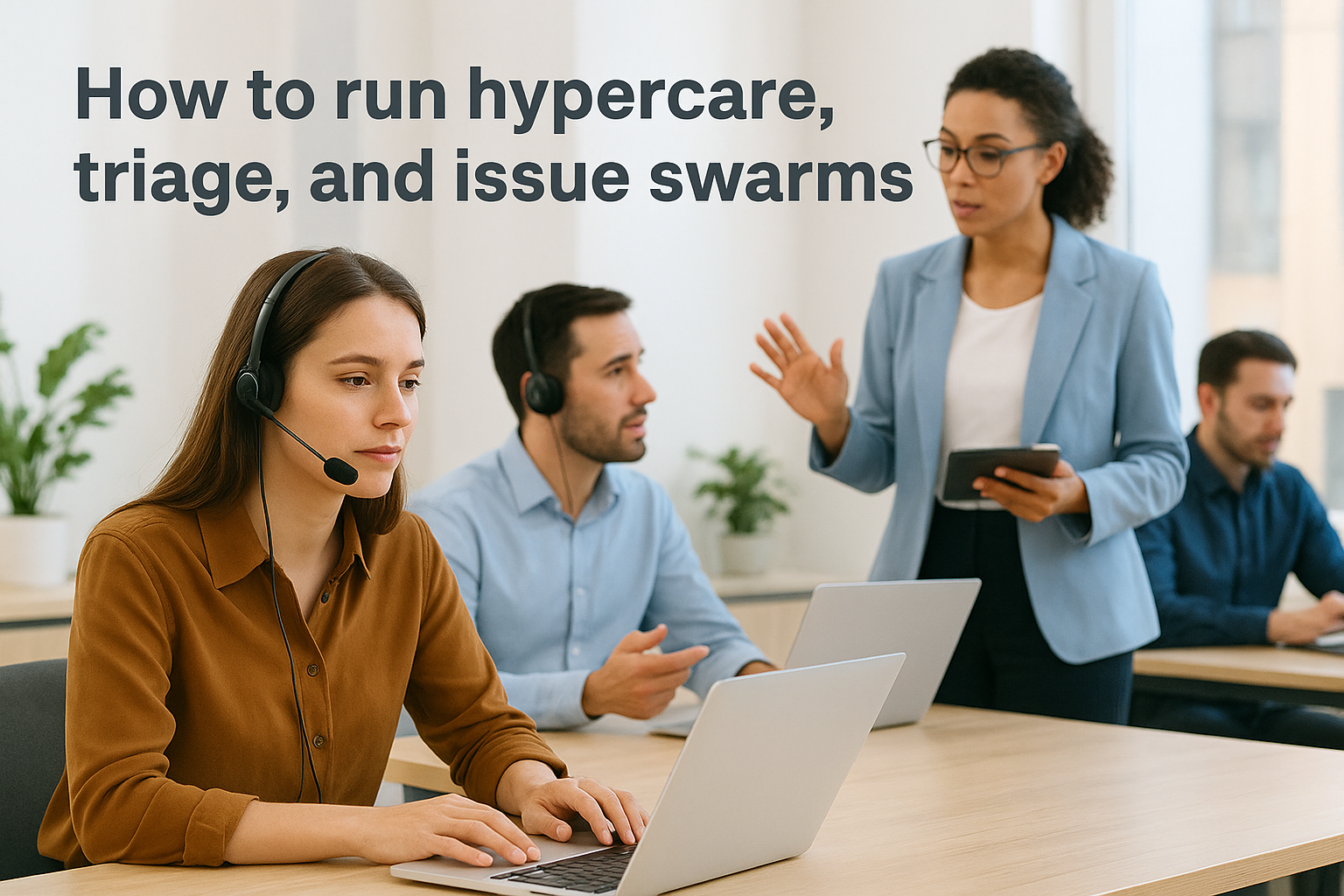
How to run hypercare, triage, and issue swarms
Set up a dedicated hypercare team that is available on-site or on call for the first two to four weeks post-launch. Route issues to the right resolver immediately using a triage protocol that separates system bugs from user errors, so fixes reach the right team without delay.
A slow response during hypercare is the fastest way to lose user trust and trigger workarounds.
How to prevent workarounds and shadow systems
Watch for users reverting to spreadsheets or manual processes outside the system. Shadow systems emerge fast when the official process feels harder than the old one. Address root causes immediately by fixing friction points in the workflow or closing proficiency gaps through targeted retraining.
What to standardize in support and documentation
Create a single source of truth for job aids, process guides, and FAQs that users can access without submitting a ticket. Standardize how updates to documentation get approved and published so your support materials stay accurate well beyond the stabilization window.
9. Reinforce the change with adoption and ROI metrics
Go-live is not the finish line. Sustained adoption and measurable financial outcomes are, and both require active reinforcement well past the stabilization window. This is where your change management best practices either compound into real value or quietly disappear.
The adoption metrics that predict ERP value
Track system login rates and transaction completion rates in the first 90 days alongside process exception volumes. These leading indicators tell you whether users are working in the system or around it before your financial results reflect the gap.
How to connect adoption to close, cash, and margin
Map each adoption metric directly to a financial KPI you baselined before go-live. If AR teams are fully proficient in the new collections workflow, days sales outstanding should move. If it doesn’t, you have a process or behavior problem, not a technology problem.
Adoption data without a financial connection gives you activity reports, not accountability.
How to build reinforcement into routines and incentives
Embed ERP usage expectations and process compliance standards into existing team meetings, performance reviews, and department scorecards. When managers discuss adoption metrics in their regular one-on-ones, the behavior becomes normalized rather than policed.
How to keep improvements going after stabilization
Assign a named process owner for each major workflow and schedule quarterly reviews to surface friction points, close training gaps, and document wins. Stabilization marks the start of continuous improvement, not the end of change leadership.
Make ERP change stick
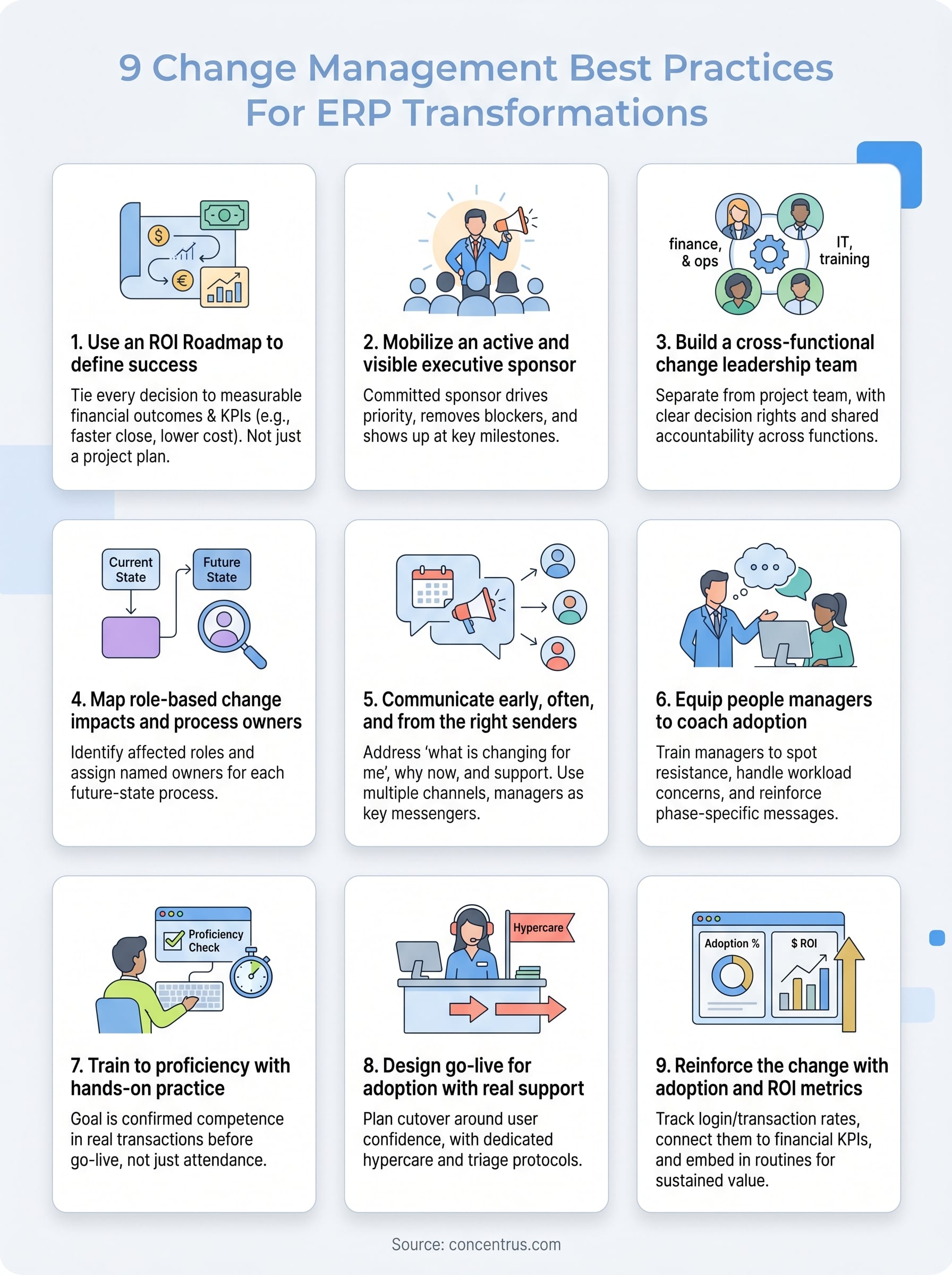
ERP transformations succeed when change management best practices are built into every phase, not patched in after problems surface. The nine practices in this article give you a structured path from executive alignment to sustained adoption, with ROI accountability anchoring each decision along the way.
Your biggest risk after stabilization is treating the project as closed. Adoption gaps and process drift appear quietly, often months after go-live, when leadership attention has already shifted to the next initiative. The organizations that protect their ERP investment keep a named owner on each major process, review adoption metrics on a regular cadence, and close training gaps before they turn into shadow systems.
Building this level of structure into a transformation takes expertise that most midsized finance teams don’t have in-house. If you want a partner who ties every implementation decision to measurable financial outcomes from day one, connect with the ERP and ROI experts at Concentrus to see how the ROI Roadmap methodology protects your transformation at every stage.