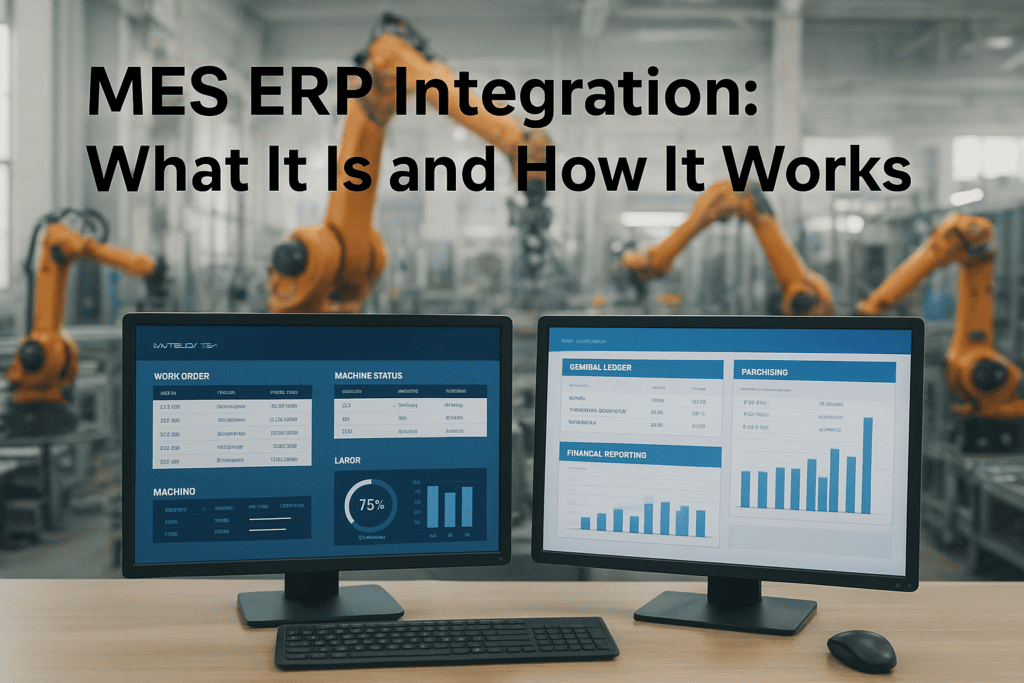
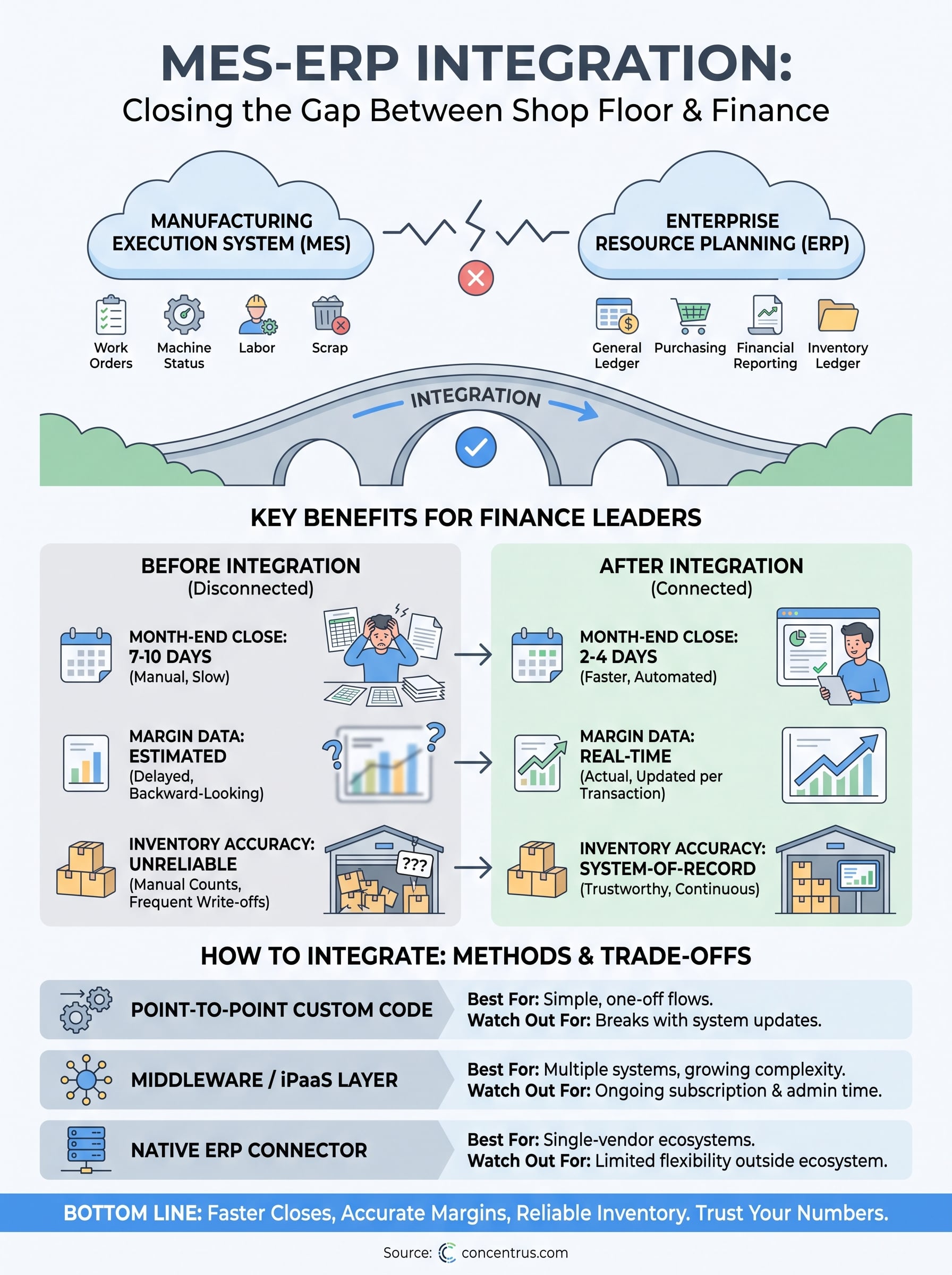
Your shop floor runs on one system and your finance team runs on another, and every month someone spends days reconciling the two by hand. That gap is exactly what mes erp integration closes. It connects the Manufacturing Execution System that tracks work orders, machine status, and labor in real time with the ERP that handles your general ledger, purchasing, and financial reporting, so both sides finally speak the same language.
If you’re trying to figure out how MES and ERP actually connect, the short answer is through data mapping and middleware or APIs that sync production data with financial and planning modules automatically. Done right, this integration gives CFOs accurate margin data by job, faster month-end closes, and inventory numbers you can actually trust instead of a spreadsheet built from three different exports.
In this article, we’ll break down what MES ERP integration means in practice, the common integration methods manufacturers use, the financial and operational benefits you should expect, and the challenges that trip up midsized companies when they try to connect these systems on their own.
Why MES-ERP integration matters for finance leaders
For a CFO, MES-ERP integration isn’t an IT project. It’s a finance project that happens to touch the shop floor. When production data flows into your ERP automatically, you stop waiting until the third week of the month to find out that a job ran over budget or that a machine sat idle for two shifts. You see it the day it happens, in the same system where you already track cost of goods sold, work-in-process, and margin by product line.
Real-time margin data instead of month-end surprises
Without integration, your erp and mes integration gap forces someone on your team to manually pull labor hours, scrap rates, and machine downtime from the MES and re-key them into the ERP for costing. That process is slow, error-prone, and always backward-looking. With integration, actual labor and material consumption post to the ERP as work orders complete, so your margin-by-job reports reflect reality, not a rough estimate built three weeks after the fact.
Finance leaders who integrate MES and ERP stop managing the business through the rearview mirror.
Faster closes and fewer reconciliation headaches
Manual data transfer between systems is one of the biggest reasons midsized manufacturers still run seven-to-ten-day closes. Every export, every spreadsheet formula, and every manual journal entry is a place where numbers can drift apart between the two systems. Connecting them removes that friction. The table below shows the pattern we see repeatedly at midsized manufacturers before and after mes integration with erp systems.
| Finance Process | Without Integration | With Integration |
|---|---|---|
| Month-end close | 7-10 business days | 2-4 business days |
| Inventory accuracy | Manual counts, frequent write-offs | System-of-record accuracy |
| Job costing | Estimated, updated monthly | Actual, updated per transaction |
| Labor variance reporting | Reconstructed from timecards | Captured automatically from MES |
Inventory and cash flow you can actually plan around
Inventory is where a lot of midsized manufacturers bleed cash without realizing it. If your MES tracks raw material consumption and finished goods but your ERP’s inventory ledger updates on a delayed batch cycle, you’re making purchasing and cash flow decisions on stale numbers. Once the systems talk to each other continuously, your ERP reflects what’s actually on the floor, which means fewer emergency purchase orders, less safety stock sitting idle, and a more accurate cash conversion cycle.
The cost of staying disconnected
Skipping integration doesn’t just cost you convenience, it costs you decision-making speed. Boards and lenders ask for margin trends, capacity utilization, and inventory turns that a disconnected MES and ERP simply can’t produce reliably without days of manual work. That’s the exact gap Concentrus’s ROI Roadmap™ methodology is built to close, tying every integration decision back to a measurable financial outcome instead of a technical checkbox. Treating integration as optional puts your reporting integrity, your close timeline, and ultimately your ability to scale without adding headcount at risk.
How to integrate your MES and ERP systems
Getting your MES and ERP integration off the ground starts with picking a connection method, not picking software. Most midsized manufacturers choose between three approaches: point-to-point custom code, a middleware or iPaaS layer (think Celigo or Boomi), or a native connector built by your ERP vendor. Each has tradeoffs in cost, maintenance burden, and how well it survives a future system upgrade.
Pick the right connection method
Choosing wrong here is expensive to fix later, since ripping out custom point-to-point code after two years of accumulated business logic is a real project, not a weekend fix.
| Method | Best For | Watch Out For |
|---|---|---|
| Point-to-point custom code | One-off, simple data flows | Breaks with every system update |
| Middleware/iPaaS | Multiple systems, growing complexity | Requires ongoing subscription and admin time |
| Native ERP connector | Single-vendor ecosystems | Limited flexibility outside that ecosystem |
The integration method you choose today decides how much you’ll spend maintaining it for the next five years.
Map the data before you touch the systems
Data mapping is the unglamorous work that determines whether your erp mes integration actually holds up under real production volume. You need to define exactly which fields move where: work order status, labor hours, scrap quantities, machine downtime codes, and material consumption all need a clear home in your ERP’s costing and inventory modules. Skipping this step is the number one reason integrations that look fine in testing fall apart once real shop floor data starts flowing through them.
Build in validation and rollback before go-live
Running a pilot on a single production line before flipping the switch company-wide catches mismatched units, timing gaps, and duplicate transactions while the stakes are still low. Here’s the sequence we walk midsized manufacturers through:
- Map every data field between MES and ERP, including units of measure and timing rules.
- Build the connection using middleware or a native connector, not manual exports.
- Run a parallel test period where old and new processes run side by side.
- Reconcile a full month-end close using integrated data before retiring the manual process.
- Assign clear ownership for monitoring the integration after go-live.
Skipping straight to full deployment is how a promising mes erp integration project turns into a six-month firefighting exercise instead of a clean win.
Common challenges in MES-ERP integration
Even with the right method and a solid data map, most mes and erp integration projects hit friction somewhere between the pilot and full rollout. Knowing where midsized manufacturers typically get stuck lets you build safeguards in before you’re troubleshooting a broken integration during a live production run.
Data format and unit mismatches
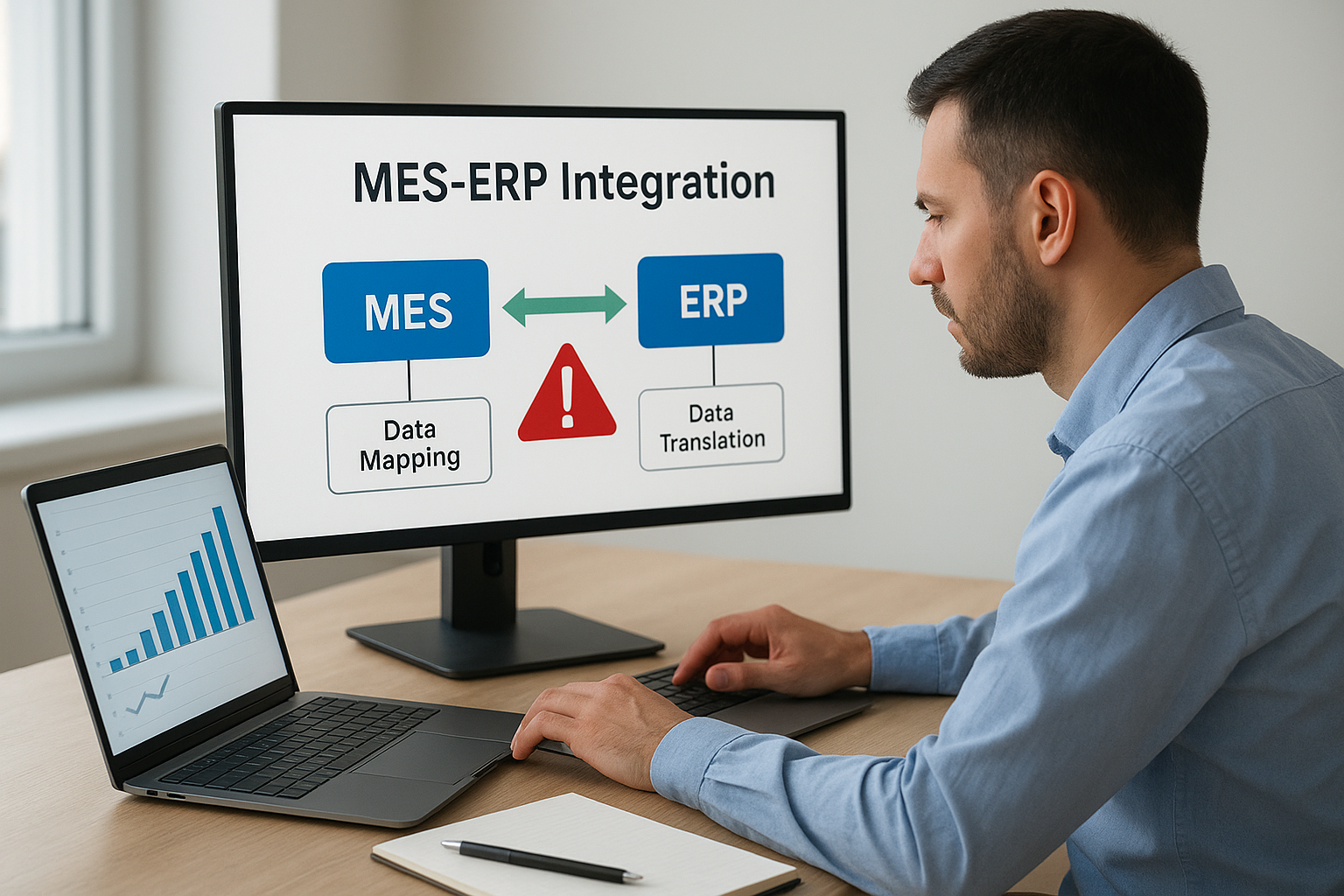
Mismatched units of measure are the most common technical failure point in erp mes integration work. Your MES might track material in kilograms while your ERP’s purchasing module runs in pounds, or your MES logs downtime in minutes while your ERP expects hours for labor variance reporting. These mismatches don’t always throw an error, they just quietly produce wrong numbers that finance discovers weeks later during a close.
A silent unit mismatch is more dangerous than a failed connection, because nobody notices until the numbers stop making sense.
Legacy systems that resist real-time syncing
Older MES platforms and heavily customized ERP instances often weren’t built with modern APIs in mind. If your MES was implemented a decade ago, batch exports every few hours may be the fastest data flow it can support, which limits how close to real time your financial reporting can actually get. Middleware helps bridge this gap, but it can’t manufacture API endpoints that were never built.
Unclear ownership after go-live
Integrations rarely fail on day one, they fail six months later when a system update breaks a data field and nobody on either the IT or finance side owns fixing it. Assigning a single accountable owner, not a committee, for monitoring the integration prevents small breaks from turning into a full quarter of unreliable job costing.
Underestimating the change management effort
Budgeting for connectors and consultants while ignoring the training, documentation, and workflow changes needed on the shop floor is a common miscalculation. Operators need to understand why data entry accuracy in the MES now directly affects finance’s numbers, not just their own production reports. Companies that treat mes integration with erp as a pure technical project, rather than one that changes daily habits, tend to see the highest failure rate. Concentrus’s ERP Rescue services exist largely because of integrations that skipped this step and had to be realigned after the fact.
MES vs ERP vs other manufacturing systems
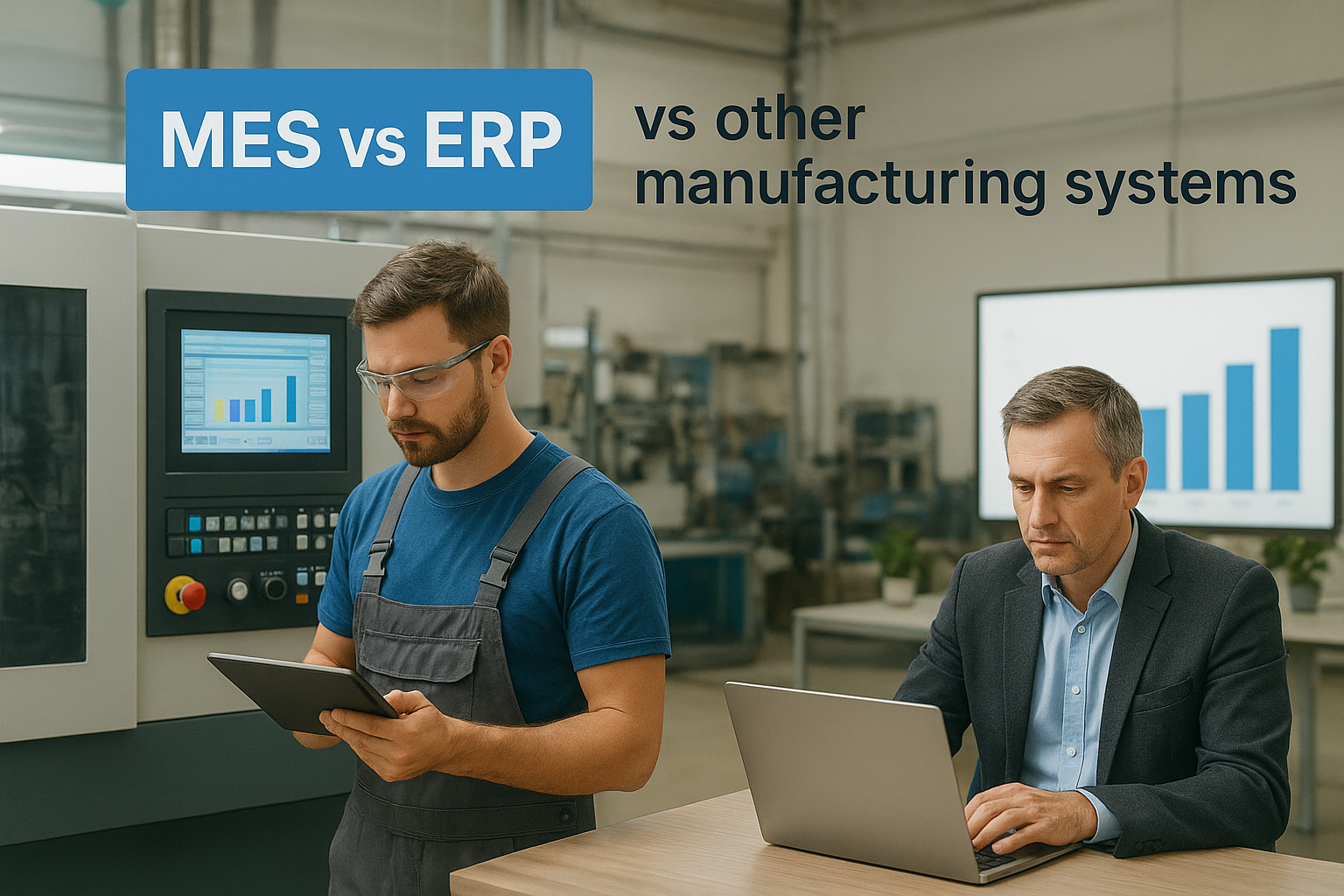
Confusing MES with ERP is easy because both systems touch production, but they answer different questions. Your Manufacturing Execution System lives on the shop floor and tracks what’s happening right now: which machine is running, which operator is on which job, and how much scrap just came off the line. Your ERP system lives at the business level and tracks what all that activity means financially: cost of goods sold, purchasing, payroll, and the general ledger. Neither one replaces the other, and that’s exactly why mes erp integration exists in the first place.
Where SCADA and WMS fit into the picture
Beyond MES and ERP, most manufacturers also run a couple of adjacent systems that sometimes get lumped into the same conversation. SCADA and PLC systems control the machines themselves, feeding raw sensor data up to the MES rather than to the ERP directly. A warehouse management system tracks physical inventory movement inside the four walls, which often needs to sync with both the MES and the ERP to keep production and financial inventory numbers aligned. The table below lays out how these systems divide the work.
| System | Primary Job | Data It Owns | Talks To |
|---|---|---|---|
| MES | Track production execution | Work orders, labor, machine status, scrap | ERP, SCADA |
| ERP | Track financial and planning data | GL, purchasing, costing, margin | MES, WMS |
| SCADA/PLC | Control physical equipment | Sensor data, machine signals | MES |
| WMS | Track physical inventory movement | Location, pick/pack, stock counts | MES, ERP |
Mixing up what each system owns is the fastest way to build an integration that solves the wrong problem.
Why the distinction matters for your integration project
Getting this hierarchy backward is a common mistake we see midsized manufacturers make: trying to have the ERP manage shop floor execution, or expecting the MES to handle financial reporting it was never built for. Sorting out which system owns which data before you start mapping fields keeps your erp and mes integration project focused on connecting the right pieces instead of forcing one system to do a job it wasn’t designed for. Once you know what belongs where, deciding how to sync MES and ERP data becomes a much simpler technical conversation.
Signs your company needs MES-ERP integration
Some of these signs are obvious the moment you see them listed, and others are the kind of low-grade friction you’ve learned to work around without questioning. If more than two of the following sound familiar, your systems are costing you more than the price of an integration project would.
Your close takes longer every quarter, not shorter
Watch what happens to your close timeline as order volume grows. If month-end close keeps stretching instead of shrinking even as your team gets more experienced with the process, that’s a sign the bottleneck isn’t people, it’s the manual data transfer between MES and ERP. Growth should make a mature finance process faster, not slower, and a widening close window is usually the clearest signal that mes and erp integration has moved from nice-to-have to necessary.
When your close gets slower as the company grows, the problem is your systems, not your team.
Job costing feels like an estimate, not a fact
Finance teams that rely on standard costs updated monthly, rather than actual labor and material consumption pulled straight from the shop floor, are flying with a two-to-four week delay on every margin decision. If you can’t tell a board member which product line is actually profitable this week, without pulling a special report first, that gap is your answer.
A quick self-check
Run through this list honestly:
- Someone manually re-keys production data into the ERP at least weekly
- Inventory counts in the ERP regularly disagree with what’s physically on the floor
- Job costing reports lag actual production by more than a few days
- You’ve had a customer or auditor catch a data discrepancy before your team did
- Adding a new product line or shift means someone builds a new spreadsheet workaround
Three or more checked boxes means you’re not looking at a minor inconvenience anymore.
Growth is outpacing what spreadsheets can hold
Expansion into a second shift, a new facility, or a higher SKU count exposes disconnected systems fast, because the manual workarounds that covered for a small operation simply don’t scale. If your team is adding headcount just to keep reconciling two systems by hand, that’s a direct signal to bring in erp mes integration expertise before the next growth phase makes the gap even more expensive to close.
What integration means for your bottom line
MES ERP integration isn’t a technical upgrade you check off a list. It’s the difference between running your company on real numbers and running it on estimates that get corrected weeks too late. Every benefit covered here, faster closes, accurate margins, reliable inventory, traces back to one decision: whether your shop floor and your finance system actually talk to each other.
Getting there without the right guidance is where most midsized manufacturers lose months and budget, patching together connectors that break the first time a system updates. Concentrus built its ROI Roadmap™ methodology specifically for this problem, tying every integration decision to a measurable financial outcome instead of a vague technology goal. If you’re ready to stop reconciling two systems by hand and start trusting your numbers, talk to Concentrus about what an integration built around your ROI actually looks like.