


You are evaluating an ERP project, or watching one struggle, and someone keeps mentioning you need an erp implementation consultant. But what does that person actually do, and why does it matter to your bottom line rather than just your IT department? That question deserves a straight answer, not a sales pitch.
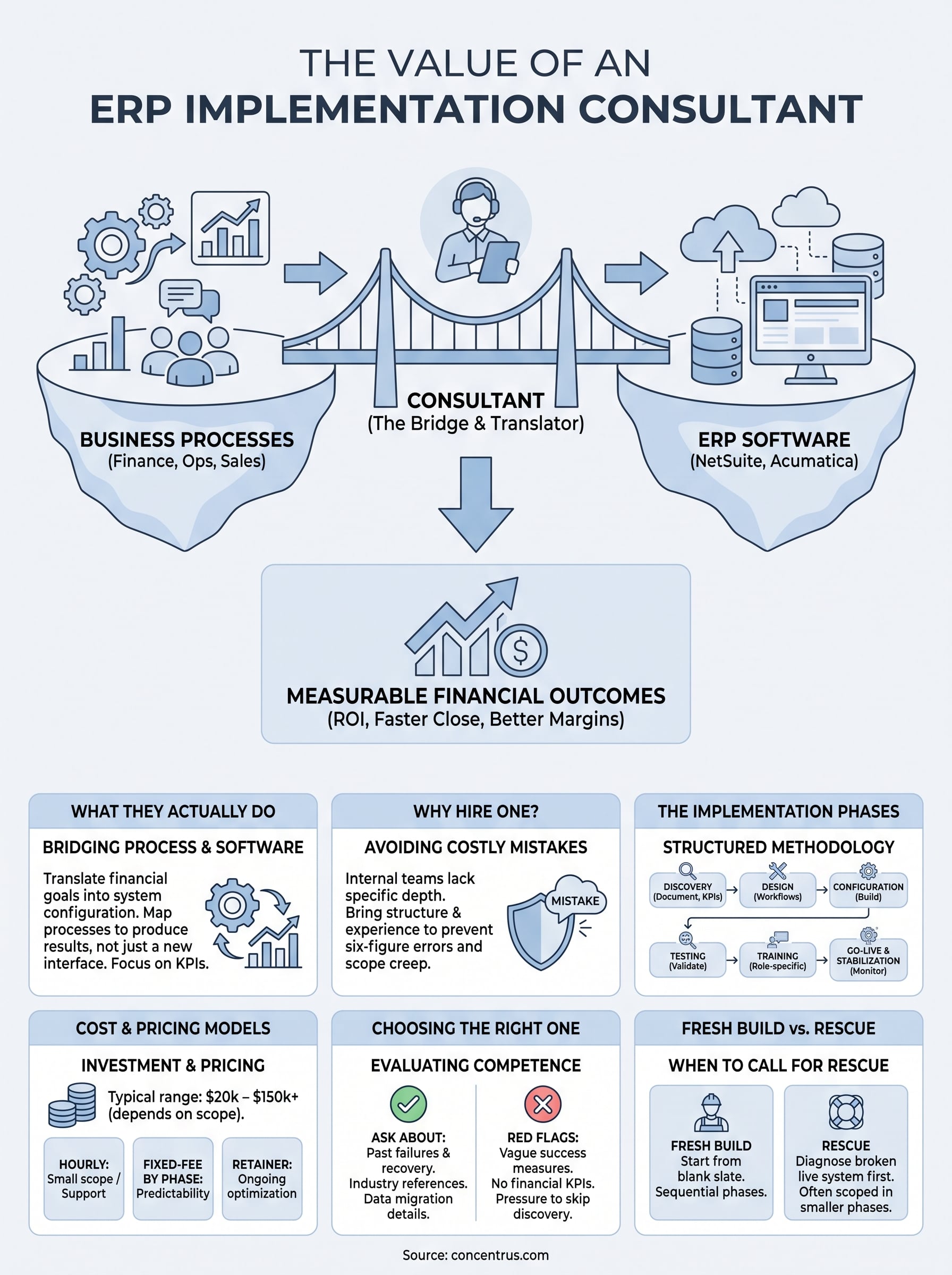
An ERP implementation consultant is the person who bridges your business processes and the software itself, translating financial goals into system configuration, data migration, and staff training. A good erp software implementation consultant does more than flip switches in NetSuite or Acumatica. They map your close process, your margin drivers, and your supply chain steps into a system that produces measurable results, not just a new interface.
In this article, we break down exactly what these consultants do day to day, the difference between a generalist and one who ties every decision to ROI, and how to evaluate whether the person or firm you’re hiring will actually improve financial outcomes or just complete a checklist. We’ll also cover career paths into this field for those exploring it professionally, and what separates a consultant worth paying for from one who leaves you rebuilding the project a year later.
Why businesses hire an ERP implementation consultant
Most midsized companies don’t have anyone on staff who has configured NetSuite or Acumatica more than once or twice. That’s the core problem. An ERP rollout touches finance, operations, sales, and IT all at once, and internal teams are usually running the business full time while also being asked to rebuild it. Bringing in an erp implementation consultant isn’t about admitting weakness. It’s about recognizing that a six-figure software decision deserves someone who has already made the common mistakes on someone else’s project, not yours.
Internal teams lack platform-specific depth
NetSuite alone has thousands of configuration settings, and Acumatica’s flexibility means two companies in the same industry can end up with completely different builds. A controller or finance director might understand the general ledger cold, but they won’t know which SuiteScript customizations will break during the next platform update, or how a poorly designed item record structure will cause inventory valuation errors six months down the road. Consultants who live inside these systems daily catch these issues before they become six-figure fixes.
Failed implementations are common and expensive
ERP failure rates get quoted a lot, but the pattern holds across industry surveys: a significant share of implementations run over budget, miss go-live dates, or get shelved entirely before delivering value. Gartner has long noted that ERP projects frequently exceed their original budgets, and the reasons are rarely about the software itself. They’re about scope that ballooned, requirements that were never tied to financial outcomes, and internal teams stretched too thin to manage change management on top of daily operations.
A consultant’s real job isn’t installing software. It’s preventing the six-figure mistakes that internal teams don’t know they’re making until it’s too late.
Consultants bring structure your team doesn’t have time to build
Speed matters here, and so does sequencing. A structured methodology, like tying every phase to a measurable KPI such as days to close or gross margin by SKU, keeps a project from drifting into an open-ended IT exercise. Without that structure, projects tend to expand scope indefinitely because nobody has defined what “done” actually looks like. Financial accountability built into the plan from day one is what separates a consultant-led rollout from an internal team improvising as they go.
Signs your business needs outside help
Certain patterns show up again and again in companies that end up calling a consultant after trying to go it alone:
- Your finance team is spending more time fixing spreadsheets than closing the books
- Nobody can say which KPIs the ERP project is supposed to improve
- Your internal IT staff has never implemented this specific platform before
- Leadership disagrees on what “successful go-live” even means
- A previous vendor or internal effort stalled without a clear reason why
Recognizing even two or three of these signs early saves months of rework later. Waiting until the project is already off track costs more than hiring the right help from the start.
How ERP implementation consultants guide a project
Guiding an ERP project isn’t a single event, it’s a sequence of decisions made in the right order. A consultant maps out discovery, design, configuration, data migration, testing, training, and go-live as distinct phases, each with its own deliverables and sign-off. Skipping steps to save time almost always costs more later, usually in the form of a re-do during user acceptance testing or a data migration that has to run twice because nobody validated the source records first.
The phases of a consultant-led implementation
Every reputable engagement follows a version of this sequence, whether the platform is NetSuite, Acumatica, or something else entirely:

- Discovery – document current processes, pain points, and the financial KPIs the project needs to move
- Design – translate those processes into system workflows, chart of accounts, and role permissions
- Configuration – build the environment, set up modules, and connect third-party tools like Avalara or Celigo
- Data migration – clean and transfer historical records without corrupting reporting history
- Testing – run real transactions through the system before anyone touches it live
- Training – get staff comfortable enough to work independently, not just click through a demo
- Go-live and stabilization – monitor the first close cycles closely and fix what breaks fast
Good consultants don’t rush past discovery just to look productive early. Rushed discovery is where most six-figure rework problems get planted.
Keeping the project tied to financial outcomes
Sequencing alone isn’t enough. A consultant worth hiring ties each phase back to a measurable result, whether that’s a faster month-end close, tighter inventory accuracy, or fewer manual journal entries. Without that link, teams finish a technically successful go-live that still doesn’t move the numbers leadership actually cares about.
If a project phase doesn’t connect to a financial metric, it’s scope creep waiting to happen.
Tracking should happen throughout the build, not as an afterthought once the system is live. Consultants who build KPI checkpoints into the plan, rather than promising results at the end, give finance leaders visibility into whether the project is on track long before go-live day arrives.
Core responsibilities and skills of an ERP consultant
An erp implementation consultant juggles technical configuration, financial translation, and project management, often within the same afternoon. The job title sounds narrow, but the daily work spans requirements gathering, system building, and change management, all while keeping an eye on the numbers leadership actually cares about. Understanding this range matters whether you’re hiring one or considering the role as a career path yourself.
What the day-to-day work actually looks like
Beyond the phases of a project, a consultant’s daily responsibilities include:
- Running discovery interviews with finance, operations, and sales stakeholders
- Writing functional specifications for customizations and integrations
- Configuring modules in NetSuite or Acumatica, including workflows and approval chains
- Validating migrated data against source system reports before go-live
- Training end users on the specific processes their role touches, not generic system tours
- Documenting configuration decisions so the client isn’t dependent on one person’s memory
The best consultants spend as much time asking questions as they do clicking through screens.
Technical and financial skills that separate strong consultants from weak ones
Platform knowledge gets a consultant in the door, but financial fluency is what makes their recommendations useful to a CFO. A consultant who can’t explain how a chart of accounts change affects month-end reporting is a system administrator, not a strategic partner.
| Skill area | What it looks like in practice |
|---|---|
| Platform configuration | Deep knowledge of NetSuite SuiteScript or Acumatica customization tools |
| Financial process mapping | Ability to translate close cycles and margin drivers into system logic |
| Data migration | Experience cleaning and validating historical records at scale |
| Change management | Skill in getting reluctant staff to adopt new workflows |
| Third-party integration | Familiarity with tools like Avalara, Celigo, or ShipHawk |
| Communication | Comfort presenting to both IT staff and finance executives |
Software certifications, like a NetSuite SuiteFoundation credential, show baseline knowledge, but they don’t guarantee someone can manage a full rollout under budget pressure. References from actual clients, particularly ones in your industry, tell you more about a consultant’s real-world judgment than any certificate on a resume.
How much does an ERP implementation consultant cost
Cost is usually the first question CFOs ask, and the honest answer is: it depends on scope, but you can still get useful ranges. An erp implementation consultant typically bills hourly, by project phase, or as a flat fee tied to defined deliverables. Midsized companies implementing NetSuite or Acumatica should expect consulting fees ranging from $20,000 for a lean, single-entity rollout to well over $150,000 for a multi-subsidiary implementation with heavy customization and integrations.
Pricing models you’ll actually encounter
Budget conversations get easier once you understand how firms structure their fees. Most fall into one of three models:

| Pricing model | How it works | Best fit |
|---|---|---|
| Hourly | Billed per hour of consultant time, often $150-$300/hr | Small scope changes or ongoing support |
| Fixed-fee by phase | Set price for discovery, design, configuration, etc. | Companies wanting budget predictability |
| Retainer | Monthly fee for ongoing optimization after go-live | Businesses needing continued platform support |
Fixed-fee arrangements tend to protect you from scope creep better than hourly billing, since the consultant has already priced the defined deliverables into the contract.
What actually drives the price up or down
Every quote depends on a handful of variables that either shrink or expand the work involved. Data volume matters, since migrating a decade of transaction history costs more than migrating clean, recent records. Customization scope matters too, because heavily customized workflows and integrations with tools like Avalara or Celigo take longer to build and test than an out-of-box setup. The number of subsidiaries or entities involved also drives cost, since multi-entity consolidations require more configuration and testing time than a single-company rollout.
The cheapest quote rarely produces the lowest total cost once you factor in rework, delays, and missed go-live dates.
Why the cheapest bid often costs more
Lowballing a proposal often means the consultant plans to cut discovery short or skip proper data validation, both of which resurface as expensive fixes after go-live. Comparing quotes purely on price ignores the difference between a consultant who ties every phase to a measurable financial outcome and one who’s just trying to win the bid. Ask any firm quoting a suspiciously low number exactly what’s included in discovery and testing before you sign anything.
How to choose the right ERP implementation consultant
Choosing an erp implementation consultant comes down to more than checking a certification badge or comparing hourly rates. You’re hiring someone to make hundreds of small decisions that shape how your company closes books and tracks margin for years. Getting this choice wrong costs more than a bad software license ever could, since a poor fit means rebuilding trust with your finance team on top of rebuilding the system itself.
Questions that actually reveal competence
Asking the right questions upfront separates consultants who talk about methodology from those who actually practice it. Before signing anything, ask candidates to walk you through a past project where the go-live date slipped, and listen for how they explain the recovery, not just the setback. Request references from clients in your industry, since a consultant who’s only implemented ERP for retailers may stumble on manufacturing’s inventory valuation quirks. Push for specifics on their data migration process, because a vague answer here usually predicts a messy go-live.
A consultant who can’t explain a past failure in detail probably hasn’t managed a project complex enough to matter.
Red flags that predict trouble later
Certain warning signs show up consistently in engagements that later need rescue work:
- Vague answers when asked how they measure project success
- No mention of financial KPIs anywhere in the proposal
- Pressure to skip discovery to “save time and budget”
- Reluctance to provide references from actual clients
- A proposal that reads identically for every industry they serve
Spotting even one of these during the sales process is reason enough to keep looking.
Fit matters as much as credentials
Experience with your specific platform, whether NetSuite or Acumatica, narrows the field considerably, but industry fit narrows it further. A software implementation consultant who’s spent years in wholesale distribution will ask different discovery questions than one from professional services, because the financial levers that matter are different. Look for firms whose proposal explicitly ties deliverables to your company’s KPIs rather than generic milestones copied from a template. If a consultant can’t articulate how their work will move your specific numbers, whether that’s days to close or gross margin by SKU, they haven’t done their homework, and neither should you before signing the contract.
When you need an ERP rescue consultant instead
Sometimes the project already happened, and it didn’t go well. An ERP rescue consultant is a different specialist from the one who guides a clean implementation from day one. Rescue work means diagnosing what’s broken in a live or half-finished system, not building from a blank slate, and that difference changes everything about how the engagement runs.
Signs you need rescue work, not more implementation help
Businesses usually wait too long to call for rescue support because they assume the problems will resolve themselves once staff adjust. They rarely do. Watch for these patterns:
- Month-end close takes longer now than it did before go-live
- Staff have built shadow spreadsheets because they don’t trust the system’s numbers
- Customizations break every time the platform pushes an update
- The original consultant or vendor is unresponsive or gone
- Leadership has stopped trusting reports pulled directly from the ERP
If your team trusts a spreadsheet more than the ERP you paid for, you don’t need another feature. You need a rescue.
How rescue engagements differ from a fresh build
Diagnosis comes first in rescue work, and it takes longer than most companies expect. A rescue consultant has to reverse-engineer decisions someone else made, often without documentation, before touching a single configuration setting. Rebuilding blind is how a rescue turns into a second failed project, so a competent consultant spends real time auditing the chart of accounts, item records, and workflow logic before proposing fixes.
Cost structures shift too. Rescue projects often get scoped in smaller, sequential phases rather than one large fixed fee, since the full extent of the damage isn’t clear until the audit is done. That’s not a red flag here, it’s the responsible approach. A firm that quotes a full rescue price before ever opening your system is guessing, not diagnosing.
Why platform-specific rescue expertise matters most here
General ERP knowledge helps less in rescue work than deep, platform-specific experience. Fixing a broken NetSuite implementation requires someone who’s untangled SuiteScript conflicts before, not just someone comfortable in the interface. Concentrus built a NetSuite ERP Rescue Roadmap specifically because rescue work follows its own logic, tying every fix back to the financial outcomes the original project was supposed to deliver in the first place.
The bottom line on ERP consultants
Hiring an erp implementation consultant is really a decision about risk. You’re paying someone to make the mistakes on paper during discovery instead of live in your general ledger six months after go-live. The right consultant ties every phase back to a financial outcome you can measure, not just a system that technically works. The wrong one leaves you with a technically functional ERP that still doesn’t move your close time, your margins, or your cash flow, which is the whole point of the investment in the first place.
Whether you’re evaluating a fresh implementation or staring down a rollout that’s already gone sideways, the questions are the same: does this person tie their work to your numbers, and can they prove it with past clients who’ll vouch for them? If you’re weighing either path right now, talk to Concentrus about building an ROI Roadmap for your ERP project before you sign anything else.