

Getting a straight answer on NetSuite implementation cost can feel like pulling teeth. Vendors quote licensing fees, partners quote professional services, and suddenly you’re staring at a spreadsheet full of line items that don’t add up to anything resembling a clear budget. For CFOs and finance leaders at midsized companies, this lack of transparency creates real problems, especially when you’re trying to justify the investment to stakeholders or compare competing proposals.
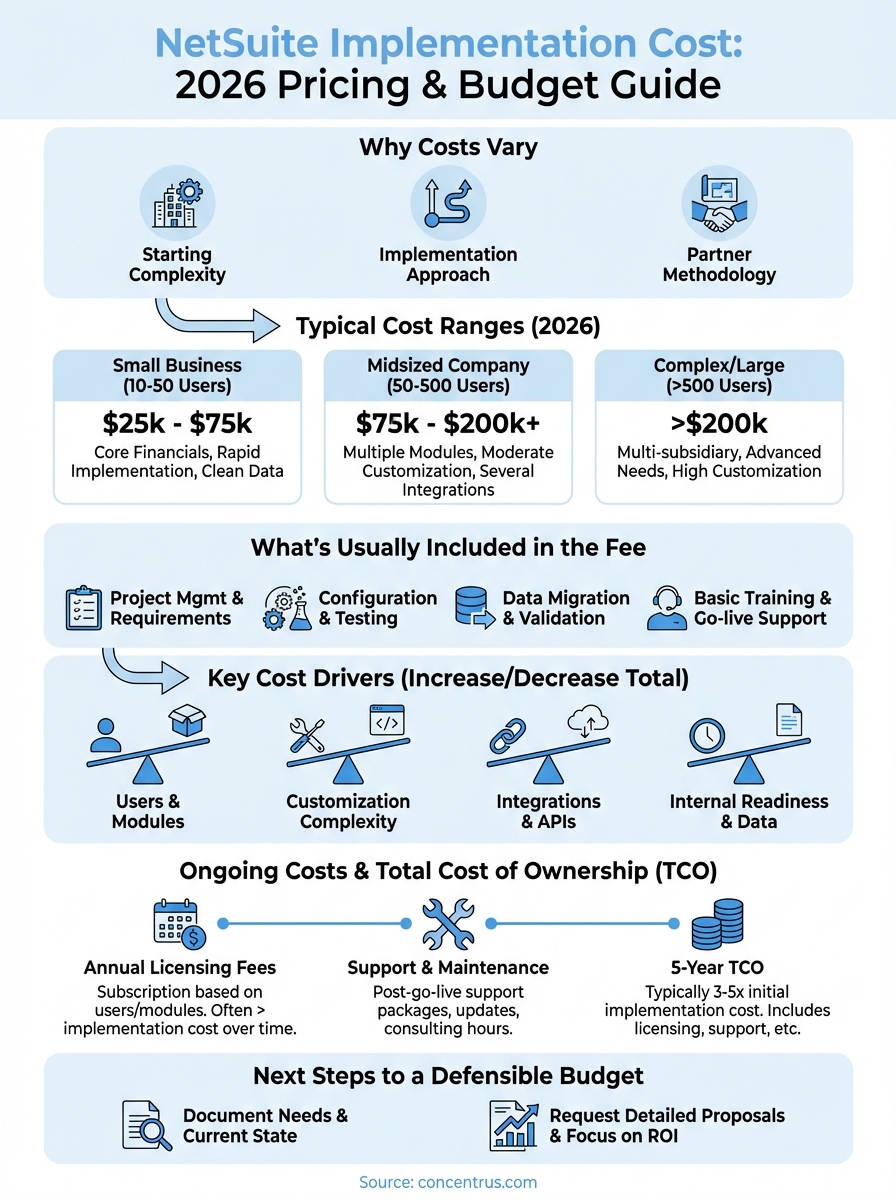
The reality is that NetSuite implementation costs vary significantly based on your company’s size, complexity, and specific requirements. A small business might spend $25,000 to $75,000, while a complex midsized operation could easily exceed $150,000 or more. Understanding what drives these numbers is essential before you sign anything.
At Concentrus, we’ve guided hundreds of midsized companies through NetSuite implementations with our ROI Roadmap™ methodology, which means we’ve seen exactly where budgets go sideways and where companies overspend. This guide breaks down everything that factors into your total cost: licensing structures, professional service fees, customization, training, and the ongoing expenses most vendors don’t mention upfront. By the end, you’ll have the clarity to build an accurate budget and evaluate any quote with confidence.
Why NetSuite implementation costs vary so much
The short answer is that no two companies implement NetSuite the same way. Research shows that ERP cost overruns most often occur when these variables are not fully defined during discovery, leaving organizations comparing proposals that are scoped differently despite appearing similar on the surface (Panorama Consulting Group, 2023). Your Netsuite implementation cost depends on factors that range from obvious (like how many users you have) to less visible (like whether your partner uses a fixed-price or time-and-materials model). The problem is that vendors and implementation partners rarely walk you through these variables upfront, which means you’re left comparing quotes that measure different things entirely.
Your starting point determines baseline complexity
Your company’s current state sets the floor for what implementation will cost. A $10 million business with 15 employees, basic inventory management, and straightforward financials will require fewer configuration hours than a $100 million operation with multiple subsidiaries, complex revenue recognition rules, and dozens of integrations. User count alone doesn’t capture this, even though it’s often the first metric partners ask about.

Industry matters more than most CFOs expect. If you operate in manufacturing with work orders, bill-of-materials structures, and shop floor tracking, you’ll need more advanced NetSuite modules than a professional services firm that mainly tracks time and invoices. Each added module increases both licensing costs and the professional services hours required to configure, test, and train your team on the functionality. Each additional module increases both annual licensing costs and implementation effort, expanding configuration, testing, training, and reporting requirements (Oracle NetSuite, 2024).
Implementation approach drives professional service hours
The difference between a rapid implementation and a phased rollout can double your costs. Some partners offer accelerated implementations that compress timelines but require intense internal commitment and may limit customization options. Others advocate for phased approaches that spread costs across quarters but extend the time before you see full ROI.
Research indicates that projects rushed without sufficient requirements definition are significantly more likely to incur rework and exceed original budgets (Panorama Consulting Group, 2023).
Your team’s readiness affects costs in ways that don’t show up in the initial proposal. If your finance team can dedicate a full-time project manager and subject matter experts to the implementation, your partner will spend fewer billable hours on project coordination and requirements clarification. Companies that expect the partner to do everything while internal staff remain focused on daily operations inevitably face scope creep and additional charges.
Your partner’s methodology and pricing model
Not all NetSuite partners price implementations the same way. Some use fixed-price packages based on predefined scopes, which gives you budget certainty but may limit flexibility if your requirements change. Others bill on time-and-materials, which adapts to your needs but creates budget risk if the project drags. Analyst guidance consistently shows that partners with structured methodologies and strong governance produce better long-term financial outcomes, even when initial quotes appear higher (Cumula 3 Group, 2025).
Partners with mature methodologies like Concentrus’ ROI Roadmap™ tend to quote higher upfront but deliver measurable outcomes tied to financial KPIs rather than just technical deployment. Budget-focused partners may quote lower but often exclude critical services like change management, post-go-live support, or integration work, which means you’ll pay for those separately later. The difference in total cost of ownership often favors the partner who builds a complete scope from the start, even if their initial number looks higher.
NetSuite implementation cost ranges in 2026
Understanding typical price ranges helps you set realistic expectations before you start collecting quotes. The Netsuite implementation cost in 2026 generally falls between $25,000 and $200,000+ for most midsized companies, but that spread reflects enormous differences in scope, complexity, and what’s actually included. These numbers combine professional services fees for implementation work with initial setup, configuration, and basic training, though they typically exclude the ongoing NetSuite licensing fees you’ll pay annually.
The ranges below represent what we see across hundreds of implementations. Your actual costs will land somewhere within these bands depending on user count, modules required, customization needs, and partner rates. Keep in mind that cheaper isn’t always better when you’re investing six figures in a system that will run your entire financial operation for the next decade.
Small business implementations ($25,000 to $75,000)
Based on industry benchmarks and implementation data, NetSuite implementation costs for midsized companies in 2026 generally fall between $25,000 and $200,000+, excluding annual licensing fees (Numeric, 2025). Companies with 10 to 50 employees and straightforward requirements typically fall into this bracket. You’re implementing core financials with basic inventory management, simple reporting, and limited customization. Your partner will likely use a rapid implementation methodology that relies on standard configurations and minimal integration work. Expect 200 to 400 professional service hours over eight to twelve weeks.
This range works if you have clean data to migrate, your team can dedicate internal resources to requirements gathering, and you don’t need complex workflows or multiple subsidiaries. You’ll get NetSuite up and running with essential functionality, but advanced features like revenue recognition, sophisticated inventory rules, or custom integrations will push you into the next tier.
Midsized company implementations ($75,000 to $200,000+)
Most midsized organizations with 50 to 500 employees land here. You need multiple modules like advanced financials, inventory management, order management, and potentially CRM or ecommerce integration. Your implementation requires 500 to 1,200+ hours over three to six months, depending on complexity. This range assumes moderate customization, several integrations, robust reporting requirements, and comprehensive training.
CFOs at this level often underestimate how much internal time their teams will need to invest, which can extend timelines and increase costs even with a fixed-price agreement.
Companies with multi-subsidiary structures, complex revenue recognition needs, or industry-specific requirements (like manufacturing with shop floor control) will see costs approach or exceed $200,000. Partner rates vary significantly, from $150 to $250+ per hour depending on their expertise and methodology, which directly impacts where you land in this range.
What determines your position in these ranges
Your starting complexity matters most. A $50 million manufacturer with multiple locations, work-in-progress tracking, and supplier integrations will cost more than a $50 million professional services firm with straightforward time-and-billing needs. The number of legacy systems you’re replacing and the quality of your existing data also drive hours required for migration and testing.
Partner selection affects costs beyond just hourly rates. Firms that include change management and post-go-live support in their base pricing may quote higher but deliver better outcomes. Those offering rock-bottom prices often exclude critical services you’ll need to purchase separately, which inflates your total spend.
What a NetSuite implementation fee usually includes
When a NetSuite partner quotes you an implementation fee, that number covers the professional services work required to get the system configured, tested, and live. The netsuite implementation cost you see in proposals should break down into specific deliverables rather than just a lump sum, though transparency varies significantly between partners. Understanding what’s actually included versus what costs extra helps you evaluate whether you’re getting a complete solution or just the baseline work that will require additional budget later.
Most reputable partners structure their fees around distinct phases that align with implementation milestones: discovery and requirements, system configuration, data migration, testing, training, and go-live support. The quality and depth of each phase determines whether your implementation succeeds or becomes a rescue project six months after launch. Budget implementations often skimp on upfront discovery work or post-go-live stabilization, which creates technical debt you’ll pay to fix later.
Project management and requirements gathering
Your implementation fee should cover a dedicated project manager who coordinates all workstreams, tracks milestones, and manages communication between your team and the implementation partner. This person owns the schedule, escalates risks, and ensures everyone understands what needs to happen next. Partners who don’t include proper project management in their base fee often leave coordination to your internal team, which extends timelines and increases your hidden internal costs.
Requirements gathering means your partner documents your business processes, reporting needs, and technical specifications before they start building anything. This phase typically includes workshops with your finance, operations, and IT teams to understand how you currently work and where NetSuite needs to adapt. Skipping thorough requirements work is the fastest path to scope creep and budget overruns.
Partners who rush through discovery to accelerate timelines almost always deliver systems that require expensive rework within the first year.
Configuration and testing
Configuration involves setting up your chart of accounts, subsidiaries, customer and vendor records, item lists, workflows, and approval processes within NetSuite. Your partner’s consultants translate your requirements into actual system settings, custom fields, saved searches, and automated workflows. This phase consumes the bulk of your implementation hours and directly impacts whether NetSuite matches how your business actually operates.
Testing should include unit testing of individual configurations, integration testing across modules, and user acceptance testing with your team. Your implementation fee needs to cover multiple test cycles, bug fixes, and refinement based on feedback. Partners who quote minimal testing hours leave you discovering configuration errors after go-live when they’re exponentially more expensive to fix.
Data migration and validation
Moving your existing financial data, customer records, inventory balances, and transaction history into NetSuite requires structured migration work. Your partner should include data mapping, transformation scripting, test loads, and validation in their base fee. The number of legacy systems you’re consolidating and the quality of your existing data determine how many migration cycles you’ll need before your data is production-ready.

Validation means confirming that opening balances match, transaction histories are complete, and nothing got corrupted during migration. Implementation fees should cover at least one full migration rehearsal plus the final cutover, though complex migrations may require additional budget for multiple test loads and reconciliation work.
Cost drivers that raise or lower your total
Beyond the base implementation scope, specific factors can swing your Netsuite implementation cost up or down by 30% to 50% or more. These drivers aren’t always obvious from initial vendor conversations, and partners don’t always flag them early because they depend on decisions you’ll make during the project. Understanding which levers you control versus which are fixed by your business requirements helps you build a realistic budget and identify where you can make tradeoffs if costs start climbing.
Number of users and modules
Your user count affects both licensing fees and implementation complexity, though not always in a linear way. NetSuite licenses in tiers, so adding five users might cost the same as adding one if you’re crossing into a new pricing bracket. Implementation partners price based on how many roles need configuration rather than raw headcount, so 50 users across three departments with similar workflows costs less than 30 users across ten departments with unique requirements.
Module selection creates compounding costs because each additional module requires configuration, testing, and training. Adding inventory management on top of core financials might increase your implementation by $15,000 to $30,000. Layering in advanced revenue recognition, multi-currency consolidation, or manufacturing modules can each add $20,000 to $50,000+ depending on complexity. Partners quote incrementally for modules because each one expands the scope of data migration, reporting requirements, and user acceptance testing your project needs.
Customization complexity
Standard NetSuite configurations handle most common business processes, but custom workflows, scripts, and forms drive implementation hours higher. A custom approval workflow that routes purchase orders based on department, dollar amount, and vendor type might require 20 to 40 hours of development and testing. Multiply that across multiple custom processes and you’ve added $10,000 to $25,000 to your total.
The more you customize NetSuite during implementation, the more you’ll pay for ongoing maintenance and future upgrades because custom code requires testing every time NetSuite releases updates.
SuiteScript development for specialized business logic, custom integrations, or unique reporting needs carries premium rates, often $175 to $250+ per hour depending on complexity. Partners can sometimes achieve the same outcome through creative use of native features rather than custom code, which reduces both implementation cost and long-term technical debt.
Internal readiness and project governance
Companies that assign a dedicated internal project manager and functional experts to the implementation typically spend 20% to 30% less than those expecting the partner to handle everything. Your team’s availability for requirements workshops, testing cycles, and training sessions directly affects how efficiently the project moves forward. Partners bill for time spent waiting on decisions, clarifying requirements, or reworking configurations because internal stakeholders weren’t available.
Data quality determines migration complexity more than data volume. Clean, well-structured data from your legacy system migrates quickly. Inconsistent coding, duplicate records, and incomplete historical data require manual cleanup that can add weeks to the timeline and thousands to the budget. Partners who discover data quality issues mid-project often issue change orders because remediation wasn’t in the original scope.
Integrations and data migration costs
Moving data from your existing systems and connecting NetSuite to other business applications represents a major cost component that partners often underestimate in initial quotes. Integration and migration work can add $15,000 to $75,000+ to your netsuite implementation cost depending on how many systems you’re connecting and the quality of your legacy data. The challenge is that these costs don’t become fully visible until your partner completes discovery and sees exactly what you’re working with.
Third-party integrations and API connections
Connecting NetSuite to your CRM, ecommerce platform, warehouse management system, or payment processors requires either pre-built connectors or custom integration development. Pre-built connectors from platforms like Celigo or Boomi typically cost $500 to $2,000 per month in licensing plus 20 to 60 implementation hours to configure, test, and deploy. Custom API integrations built from scratch cost significantly more because they require SuiteScript development, error handling logic, and ongoing maintenance whenever either system updates.

The number of systems you need to integrate multiplies costs quickly. A typical midsized company might need to connect NetSuite to Salesforce for CRM, Shopify for ecommerce, ShipStation for fulfillment, and Avalara for tax automation. Each connection requires mapping data fields, building transformation logic, and testing bidirectional sync processes. Budget $10,000 to $25,000 per major integration when you’re building a complete ecosystem rather than just implementing NetSuite in isolation.
Partners who quote integration work without first reviewing your actual data structures and system APIs almost always issue change orders once they discover the real complexity.
Data migration planning and execution
Extracting data from your legacy accounting system, spreadsheets, and departmental databases requires structured migration work that scales with data volume and complexity. Your partner needs to map legacy fields to NetSuite equivalents, transform data formats, cleanse duplicate records, and validate that opening balances reconcile perfectly. Simple migrations with clean data from a single source system might cost $5,000 to $15,000, while complex multi-system consolidations can exceed $50,000.
Historical data requirements drive migration hours significantly. Migrating three years of transaction history versus just opening balances can triple the effort because your partner needs to preserve audit trails, maintain referential integrity across related records, and ensure reporting continuity. Companies that need detailed historical reporting for trend analysis or regulatory compliance should budget accordingly rather than discovering migration limitations after go-live.
Testing and validation represent 30% to 40% of total migration costs but partners frequently underprice this phase. Your team needs multiple test migration cycles to verify data accuracy, reconcile totals against legacy systems, and confirm that nothing critical got lost or corrupted during transformation. Skimping on validation work creates data quality issues that haunt your financial close process for years.
Customization and reporting costs
NetSuite offers extensive out-of-the-box functionality, but most midsized companies need some level of customization to match their specific business processes. Customization and reporting work can add anywhere from $10,000 to $75,000+ to your netsuite implementation cost, depending on how much you deviate from standard configurations. The key question isn’t whether you’ll customize, but how much customization truly drives ROI versus just replicating your old system’s quirks in new software.
Custom workflows and business logic
Custom workflows automate approval processes, data validation rules, and business logic that NetSuite doesn’t handle natively. Your partner might charge $5,000 to $15,000 per complex workflow that routes transactions through multiple approval levels based on dollar thresholds, departments, or vendor classifications. Simple workflows using NetSuite’s native workflow engine cost less, while sophisticated multi-step processes requiring SuiteScript development carry premium rates of $175 to $250+ per hour.
Companies that try to replicate every legacy process through customization often overspend without gaining efficiency. Your implementation partner should challenge requirements that don’t align with best practices or financial controls. Sometimes the right answer is changing your process rather than spending $20,000 to preserve a workflow that exists only because your old system couldn’t do better.
Partners who automatically say yes to every customization request without questioning the business value are optimizing for billable hours, not your success.
Reporting and dashboard development
Standard NetSuite reports cover basic financial statements, inventory reports, and operational metrics, but you’ll likely need custom saved searches and dashboards tailored to your KPIs. Basic custom reports using NetSuite’s report builder might cost $500 to $2,000 each, while complex reports requiring formula fields, joined data sources, or scripted calculations can run $3,000 to $8,000+ per report. Your finance team probably needs 10 to 20 custom reports to replace what they had in your legacy system.
Dashboard development costs depend on complexity and interactivity. A simple dashboard displaying static KPIs and standard charts might cost $2,000 to $5,000, while interactive executive dashboards with drill-down capabilities, real-time data feeds, and custom visualizations can exceed $15,000. Budget for dashboard work separately from core implementation because reporting requirements often evolve after your team starts using the system and discovers what insights they actually need versus what they thought they needed during requirements gathering.
Training, change management, and internal effort
Most Netsuite implementation cost proposals include basic training hours, but the real investment in getting your team productive extends far beyond those initial sessions. Training, change management, and the internal effort your staff commits to the project can represent 20% to 40% of your total implementation cost when you account for both direct expenses and opportunity costs. Partners who quote rock-bottom prices often provide minimal training and zero change management support, leaving your team struggling to adopt the system months after go-live.
End-user training and knowledge transfer
Your implementation fee typically includes 20 to 60 hours of training depending on project scope, but that baseline rarely covers what your team actually needs to become proficient. Basic training sessions walk users through core transactions like creating invoices, processing payments, or running standard reports, but they don’t address role-specific workflows, complex scenarios, or troubleshooting that users encounter in real work. Companies with diverse user groups across finance, operations, and sales often need additional training sessions that cost $1,500 to $3,000 per day when purchased separately.
Partners who treat training as a checkbox exercise rather than an ongoing knowledge transfer process create dependencies where your team calls support for issues they should handle independently.
Effective training requires multiple sessions spread across the implementation timeline rather than cramming everything into a single week before go-live. Your team learns better when they receive training just before they’ll use specific features, with reinforcement sessions after they’ve had hands-on experience. Budget for follow-up training 30 and 60 days post-launch to address questions that only emerge once users work with real data.
Change management and organizational readiness
Change management work helps your team understand why you’re implementing NetSuite, what will change in their daily work, and how the new system benefits them. This includes stakeholder communication, process documentation, and managing resistance from users comfortable with legacy systems. Partners who include change management services typically charge $10,000 to $30,000 depending on your organization’s size and complexity, though many exclude it entirely from base implementation fees.
Internal resistance costs more than external consulting when key users refuse to adopt new processes or continue working in shadow spreadsheets instead of NetSuite. Your finance leader or project sponsor needs to dedicate time to reinforcing expectations, celebrating early wins, and addressing concerns throughout the implementation. This internal effort doesn’t appear on your partner’s invoice but represents real cost in management time and distraction from other priorities.
Internal resource commitment
Your team will invest 300 to 800+ hours of internal time across the implementation regardless of how much you pay your partner. Finance staff need to participate in requirements workshops, validate configurations, test transactions, clean data for migration, and document new procedures. Partners can’t do this work for you because they don’t understand your specific business rules, customer relationships, or operational nuances well enough to make critical decisions.
Companies that underestimate internal time commitments extend project timelines when staff can’t balance implementation work with their regular responsibilities. Your best approach allocates dedicated resources at 50% to 100% capacity rather than spreading implementation tasks across people who are already fully utilized.
Licensing, support, and total cost of ownership
The professional services fees you pay for implementation represent just the beginning of your financial commitment to NetSuite. Your annual licensing costs and ongoing support expenses will exceed your implementation investment within two to three years, which means you need to understand the full financial picture before signing. Most CFOs focus heavily on the upfront netsuite implementation cost but underestimate how licensing, support, and maintenance fees compound over time to determine your true return on investment.
Annual NetSuite licensing fees
NetSuite charges annual subscription fees based on user count, modules enabled, and transaction volume. A typical midsized company with 25 to 50 users running core financials plus inventory management pays $60,000 to $120,000 annually in licensing fees. Adding advanced modules like revenue recognition, multi-currency consolidation, or manufacturing can increase your annual subscription by $15,000 to $40,000 per module depending on complexity and user access requirements.
Your licensing costs scale as your business grows. NetSuite typically includes moderate transaction volume in base pricing, but you’ll pay overage fees if you exceed thresholds for invoices, purchase orders, or other transaction types. Companies experiencing rapid growth should budget for 10% to 20% annual increases in licensing costs as they add users and expand into new modules.
Vendors who quote artificially low licensing fees to win deals often structure contracts with aggressive overage charges that catch you by surprise during peak business periods.
Support and maintenance costs
NetSuite includes basic support in your annual subscription, covering access to their help center, technical support tickets, and platform updates. Your implementation partner will likely offer post-go-live support packages ranging from $2,000 to $10,000 per month depending on response time guarantees and the level of assistance you need. Many companies start with premium support during the first six months post-launch, then scale back once internal teams gain proficiency.
Budget for ongoing consulting hours to handle system updates, new user onboarding, and minor enhancements. Most finance teams need 5 to 15 consulting hours monthly, which costs $1,000 to $4,000 depending on partner rates and complexity of requests.
Total cost of ownership beyond year one
Your five-year total cost of ownership typically runs three to five times your initial implementation cost when you account for licensing, support, upgrades, and incremental customization. A company that spends $100,000 on implementation should expect $300,000 to $500,000 in total costs over five years. This includes annual licensing fees, ongoing support contracts, periodic enhancements, and internal resources dedicated to system administration and user support.
Next steps to build a defensible budget
Start by documenting your current system landscape, user count, required modules, and integration requirements before you talk to any vendor. This baseline gives you the specificity needed to evaluate quotes on equal footing rather than comparing proposals with different assumptions built in. Your internal stakeholders need visibility into which costs are fixed by business requirements versus which represent optional choices that affect ROI.
Request detailed proposals that break down professional services hours by phase, licensing fees by module, and ongoing support costs separately. Partners who provide line-item transparency make it easier to identify where you can adjust scope if budget constraints require tradeoffs. Companies that understand their total cost of ownership from the start make better decisions about customization, training investment, and support levels.
If you need help building a realistic NetSuite budget tied to measurable financial outcomes, Concentrus’ ROI Roadmap™ methodology ensures your Netsuite implementation cost delivers guaranteed returns rather than just technical deployment. We help CFOs gain the clarity and confidence needed to justify the investment and track ROI from day one.
References
Panorama Consulting Group. (2023). ERP Report 2023: Key findings from ERP implementations worldwide. Panorama Consulting Solutions. https://www.panorama-consulting.com
Oracle NetSuite. (2024). NetSuite implementation methodology and pricing considerations. Oracle Corporation. https://www.netsuite.com
Cumula 3 Group. (2025). NetSuite pricing and implementation cost guide. Cumula 3 Group. https://www.cumula3.com
Numeric. (2025). NetSuite implementation cost: What to expect and how to budget. Numeric.io. https://www.numeric.io