

Your ERP system holds critical financial and operational data, but if it can’t talk to your other business applications, you’re stuck with manual workarounds, reconciliation headaches, and blind spots that cost real money. That’s exactly the problem an ERP integration platform solves. It connects your ERP to CRMs, ecommerce tools, warehouse systems, and everything in between, so data flows automatically and your finance team stops chasing spreadsheets.
At Concentrus, we implement and rescue NetSuite and Acumatica ERP systems for midsized companies, and integration is one of the most common areas where we see projects stall or underperform. A poorly chosen integration tool can erode the ROI you expected from your ERP investment. A well-chosen one can accelerate time to close, sharpen reporting accuracy, and give CFOs the real-time visibility they need to make confident decisions.
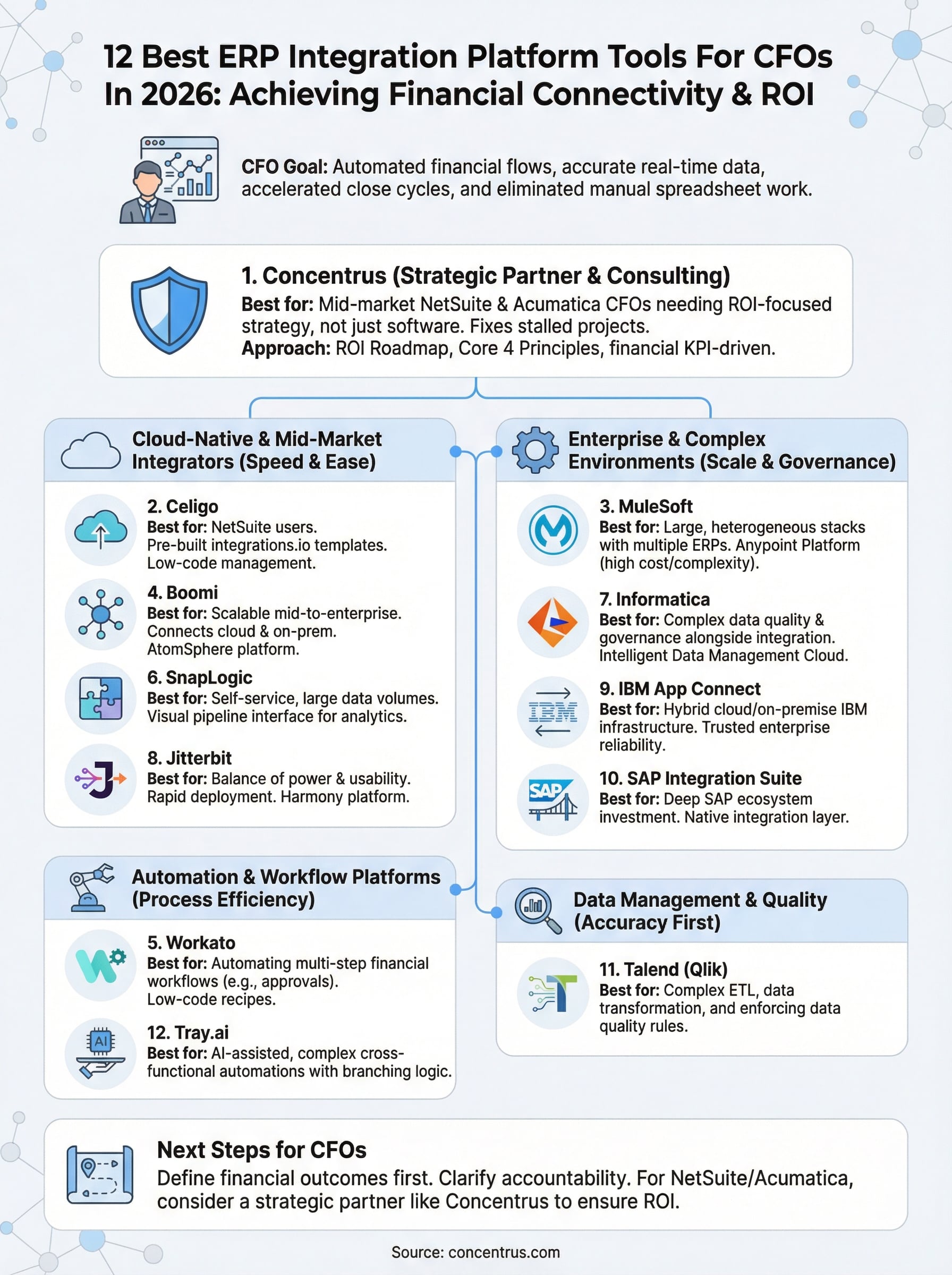
This guide breaks down the 12 best ERP integration platform tools available in 2026, with a focus on what actually matters to finance leaders: reliability, scalability, ease of management, and measurable impact on operations. We’ll cover how these platforms work, what separates a good fit from a costly mistake, and which tools pair best with systems like NetSuite and Acumatica. Whether you’re mid-implementation or trying to fix an integration mess that’s already in motion, this list will help you evaluate your options with clarity.
1. Concentrus
Concentrus is a NetSuite and Acumatica ERP consulting firm built specifically for midsized companies that need their ERP investment to deliver measurable financial outcomes. Unlike software-only platforms, Concentrus brings both the implementation expertise and the integration strategy together under one roof. That means you get a partner who understands your business goals first, then builds the technical connections to support them.

Best-fit CFO use cases
Concentrus works best for CFOs who are either mid-implementation and need integration built correctly from the start, or who have an existing ERP that isn’t connecting reliably with other systems. Common use cases include linking NetSuite or Acumatica to CRM platforms, ecommerce storefronts, 3PLs, and payroll systems. If your team is manually exporting and importing data between systems, Concentrus can identify where that friction is costing you time and accuracy.
The goal isn’t just connectivity, it’s making sure every integration directly supports a measurable financial outcome like faster close cycles or improved cash flow visibility.
ERP and app connectivity approach
Concentrus approaches integration as part of its broader ROI Roadmap methodology, which ties every technical decision back to a specific financial KPI. Rather than connecting apps for the sake of it, the team maps out which data flows actually drive business value. Through the Concentrus Partner Network, the firm also integrates best-in-class third-party tools like Celigo, Avalara, and ShipHawk directly into your ERP environment, so you benefit from proven connectors without managing multiple vendor relationships.
Controls, governance, and risk management
Every integration Concentrus builds includes documented data flows, error handling protocols, and performance benchmarks so your finance team knows exactly what’s moving where and what happens when something breaks. This is particularly important for CFOs who need audit-ready records and accurate reporting across systems. The firm’s Core 4 principles keep accountability and transparency central to every phase of the project.
Pricing and engagement model
Concentrus operates on a project-based and ongoing managed services model, structured around the ROI Roadmap. Pricing varies depending on ERP platform, the number of integrations required, and whether you’re starting fresh or rescuing an existing erp integration platform setup. Contact Concentrus directly for a scoped engagement aligned to your specific financial goals.
2. Celigo
Celigo is a cloud-native integration platform purpose-built for mid-market businesses. It’s one of the tools Concentrus recommends through its Partner Network, and it’s particularly well-suited for companies running NetSuite who need a reliable erp integration platform that doesn’t require a full IT team to manage.
Best-fit CFO use cases
Celigo fits CFOs who need to connect NetSuite with ecommerce, fulfillment, payroll, or CRM systems without long development cycles. Common deployments include syncing order data from Shopify or Amazon into NetSuite, automating vendor invoice processing, and connecting HR systems like ADP or Workday to keep financial records accurate in real time.
If your team is spending hours reconciling data between systems every week, Celigo can eliminate most of that manual effort within a defined implementation window.
ERP and app connectivity
Celigo uses a library of pre-built connectors and integration templates called integrations.io, which speeds up deployment significantly. You get native NetSuite and Acumatica connectors, plus connections to hundreds of SaaS applications. Data mapping and transformation tools are available in a low-code interface, so your operations team can manage routine adjustments without developer support.
Controls, monitoring, and reliability
Celigo provides a centralized dashboard where you can monitor all active integrations, review error logs, and set up automated alerts. This gives your finance team clear visibility into data flow health without needing to dig into technical logs.
Pricing and licensing model
Celigo prices by connector and data volume, with tiered plans starting around $600 per month. Enterprise pricing is available for larger integration needs, and you can request a custom quote directly through Celigo’s website.
3. MuleSoft Anypoint Platform
MuleSoft Anypoint Platform is an enterprise-grade erp integration platform built by Salesforce and designed for organizations that need to connect a large number of systems across on-premise and cloud environments. It’s one of the most powerful tools in this space, but it comes with a complexity and cost level that puts it firmly in the enterprise tier. For CFOs at midsized companies, understanding where MuleSoft fits is critical before committing to it.
Best-fit CFO use cases
MuleSoft works best when your organization runs multiple ERPs or has a large, heterogeneous application stack that requires consistent, governed data flows across dozens of systems. CFOs managing complex environments with custom-built applications, legacy systems, and cloud platforms in parallel will get the most value here. If your integration needs are more straightforward, MuleSoft’s overhead can outweigh its benefits.
MuleSoft is a strong fit when your data architecture is genuinely complex, but it’s rarely the right first choice for a midsized company running a single ERP instance.
ERP and app connectivity
MuleSoft connects to hundreds of applications through its Anypoint Exchange marketplace, which hosts pre-built connectors for NetSuite, SAP, Salesforce, and major cloud platforms. It supports REST, SOAP, and event-driven architectures, giving technical teams flexibility in how they design integrations.
Controls, monitoring, and reliability
Anypoint Platform includes runtime monitoring, API analytics, and centralized governance tools so your IT and finance teams maintain visibility across every active data flow.
Pricing and licensing model
MuleSoft pricing is custom-quoted and typically starts in the six-figure range annually, making it one of the higher-cost options on this list. Contact Salesforce directly for a scoped quote.
4. Boomi
Boomi is a cloud-native erp integration platform originally developed by Dell and now operating as an independent company. It targets midsized to enterprise organizations that need a scalable integration layer without the infrastructure overhead of a platform like MuleSoft.
Best-fit CFO use cases
For CFOs running NetSuite or Acumatica alongside Salesforce, Workday, or supply chain tools, Boomi reduces the cost and complexity of keeping those systems in sync. It works best when your team needs automated data flows between finance and operations without building a dedicated integration engineering team. Common deployments include:
- Syncing order and invoice data between your ERP and CRM
- Automating payroll feeds from HR platforms into NetSuite
- Connecting 3PL or warehouse systems for real-time inventory accuracy
ERP and app connectivity
The AtomSphere platform includes a large library of pre-built connectors and a drag-and-drop interface that speeds up deployment. It supports both cloud and on-premise application connections, which matters if you still run legacy systems alongside your ERP.
Controls, monitoring, and reliability
Real-time monitoring dashboards and built-in error alerting give your team the ability to catch data issues before they affect financial reporting. Audit logs are available across all integration flows, which supports the compliance requirements your finance team needs to meet.
Boomi’s centralized monitoring makes it easier to hold integration performance to the same accountability standards as any other operational process.
Pricing and licensing model
Pricing follows a subscription-based model tiered by usage and connector count. Plans start around $550 per month for smaller deployments, with enterprise-level options available through a custom quote directly from Boomi.
5. Workato
Workato is an enterprise automation platform that combines integration with workflow automation in a single tool. It targets both IT and business teams, which makes it one of the more accessible erp integration platform options for midsized companies that want to move fast without building a large technical team around it.

Best-fit CFO use cases
Workato fits CFOs who need to automate multi-step financial workflows, not just move data between systems. Strong use cases include automating invoice approvals that span your ERP and Slack or email, syncing customer payment data between Salesforce and NetSuite, and triggering alerts when inventory thresholds drop below a defined threshold tied to cash flow planning.
Workato’s strength is that it lets your finance and operations teams build and manage automations themselves, reducing dependency on IT for routine workflow changes.
ERP and app connectivity
The platform uses pre-built connectors called “recipes” that cover NetSuite, Acumatica, Salesforce, Workday, and hundreds of other applications. Recipes are configurable in a low-code interface, so your team can adapt existing templates to match your specific data structure and process logic without writing custom code.
Controls, monitoring, and reliability
Workato provides job history logs and real-time error notifications through its centralized dashboard. You can set up automated alerts tied to specific failure conditions, which keeps your finance team informed when a data flow needs attention without manually checking integration status.
Pricing and licensing model
Workato uses a workspace-based pricing model customized by the number of recipes and users. Pricing typically starts around $10,000 per year and scales with usage. Contact Workato directly for a quote scoped to your environment.
6. SnapLogic
SnapLogic is a cloud-based erp integration platform that focuses on self-service integration for both IT and business users. It uses a visual, pipeline-based interface to connect applications, databases, and data streams, making it a practical option for midsized companies that need integration capability without a large developer team on staff.
Best-fit CFO use cases
SnapLogic fits CFOs who need to move large volumes of financial and operational data across systems quickly, particularly in analytics-heavy environments. Strong use cases include feeding ERP data into business intelligence tools like Tableau or Power BI, syncing procurement data between NetSuite and supplier platforms, and automating financial reporting pipelines that pull from multiple source systems.
SnapLogic’s pipeline approach works well when your priority is data movement at scale rather than complex multi-step workflow automation.
ERP and app connectivity
SnapLogic connects to ERP platforms, cloud apps, databases, and data warehouses through pre-built components called Snaps. These cover major systems including NetSuite, Salesforce, SAP, and AWS, and they reduce the configuration time needed to establish reliable data flows between your core financial systems and surrounding applications.
Controls, monitoring, and reliability
SnapLogic provides real-time pipeline monitoring and error notifications through its centralized dashboard. Your team can track data flow performance, review logs, and identify failures before they affect downstream reporting or financial records.
Pricing and licensing model
SnapLogic uses a capacity-based pricing model tied to data volume and pipeline usage. Pricing is custom-quoted, so contact SnapLogic directly for a proposal matched to your integration scope.
7. Informatica
Informatica is an enterprise data management and integration platform with decades of experience handling large-scale data environments. It sits at the intersection of data integration, data quality, and master data management, making it a strong choice for organizations where data accuracy across systems is as important as connectivity itself.

Best-fit CFO use cases
For CFOs managing complex data environments where governance is non-negotiable, Informatica addresses the root cause of data problems rather than just moving information faster. Strong use cases include consolidating financial data from multiple source systems into a single source of truth, enforcing data quality rules before information enters your ERP, and supporting compliance reporting that requires clean, auditable records.
If your organization struggles with inconsistent or duplicate data across systems, Informatica tackles the quality problem alongside the connectivity problem.
ERP and app connectivity
As an erp integration platform, Informatica connects to NetSuite, SAP, Oracle, and a wide range of cloud and on-premise applications. Its Intelligent Data Management Cloud combines integration with data cataloging and quality tools, giving your team a unified layer for managing how data moves and transforms across your entire environment.
Controls, monitoring, and reliability
Informatica provides built-in data lineage tracking and monitoring dashboards that show where data originates, how it transforms, and where it lands. Your finance team gets the audit trail and visibility needed to support compliance requirements and maintain accurate financial reporting across systems.
Pricing and licensing model
Pricing follows a consumption-based cloud model with costs tied to data volume and feature usage. Rates are custom-quoted, so contact Informatica directly for a proposal matched to your specific integration and data management scope.
8. Jitterbit
Jitterbit is a cloud-based erp integration platform that targets midsized companies looking for a balance between power and usability. It sits between lightweight point solutions and heavyweight enterprise platforms, making it a practical choice when your team needs serious integration capability without the steep learning curve or price tag that comes with tools like MuleSoft.
Best-fit CFO use cases
Jitterbit works well for CFOs who need to connect their ERP to CRM, ecommerce, or HR systems on a defined timeline and budget. Common deployments include syncing NetSuite with Salesforce for real-time revenue visibility, automating purchase order flows between your ERP and supplier platforms, and connecting payroll systems to keep financial records accurate without manual intervention.
Jitterbit’s pre-built templates for common ERP workflows mean your team spends less time configuring and more time realizing value from the integration.
ERP and app connectivity
Jitterbit connects to NetSuite, Salesforce, SAP, and hundreds of other applications through its Harmony integration platform, which includes a library of pre-built connectors and an API management layer. Your team can build and manage integrations through a visual low-code interface, reducing the reliance on dedicated integration developers.
Controls, monitoring, and reliability
Jitterbit provides real-time monitoring, error logging, and alerting through its centralized management console. Your finance team can track integration performance and respond to failures before they affect reporting accuracy or operational continuity.
Pricing and licensing model
Jitterbit follows a subscription-based pricing model with tiers based on the number of connections and data volume. Contact Jitterbit directly for a custom quote matched to your specific environment.
9. IBM App Connect
IBM App Connect is an enterprise-grade erp integration platform built for organizations that operate in hybrid environments, meaning you have applications and data spread across both on-premise infrastructure and the cloud. IBM targets this platform at companies that need structured, governed integration backed by decades of enterprise-level reliability.
Best-fit CFO use cases
IBM App Connect works best when your organization runs IBM infrastructure alongside modern cloud applications and needs a trusted integration layer to connect them. Strong use cases include automating financial data flows between NetSuite and legacy IBM systems, syncing procurement data across cloud and on-premise platforms, and supporting compliance-driven reporting that requires consistent data handling across every connected system.
IBM App Connect’s reliability record makes it a practical choice when your finance team cannot tolerate data flow disruptions that affect reporting accuracy.
ERP and app connectivity
The platform provides pre-built connectors and an API management layer that link ERP platforms, cloud applications, and on-premise systems through a unified interface. You can connect to major systems including Salesforce, SAP, and key financial applications without writing significant custom code, which reduces the burden on your internal technical team.
Controls, monitoring, and reliability
IBM App Connect includes centralized monitoring dashboards and detailed event logs so your team can track every integration flow in real time. Built-in error notifications alert your team to failures before they affect downstream financial data or reporting cycles.
Pricing and licensing model
IBM App Connect follows a consumption-based pricing model with options for cloud-hosted and on-premise deployment. Contact IBM directly for a custom quote matched to your environment and usage requirements.
10. SAP Integration Suite
SAP Integration Suite is an enterprise-grade erp integration platform designed to connect SAP systems with third-party cloud and on-premise applications. If your organization already runs SAP at its core, this platform gives you a native integration layer that reduces the friction of connecting your broader application ecosystem to it.
Best-fit CFO use cases
SAP Integration Suite works best for CFOs whose organizations are deeply invested in the SAP ecosystem and need to extend connectivity to external financial tools, procurement systems, or analytics platforms. Strong use cases include automating intercompany financial flows, connecting SAP to Salesforce for real-time revenue data, and feeding ERP data into reporting dashboards without manual extraction.
If SAP is your system of record, using SAP’s own integration layer removes a significant layer of compatibility risk that third-party platforms introduce.
ERP and app connectivity
The platform provides pre-built integration packages and API management tools through SAP Business Accelerator Hub, which covers hundreds of SAP and non-SAP connectors. Your team can connect to major cloud platforms, legacy systems, and business networks using a unified interface without building connections from scratch.
Controls, monitoring, and reliability
SAP Integration Suite includes centralized monitoring and message tracking across all active integration flows. Your finance team can review error logs, track data movement in real time, and receive alerts when a flow fails before it affects your financial reporting.
Pricing and licensing model
Pricing follows a subscription model tied to usage volume, with options scoped to your specific SAP environment. Contact SAP directly for a custom quote.
11. Talend
Talend is a data integration and data quality platform with strong roots in enterprise ETL workflows. It handles complex data transformations alongside system connectivity, making it one of the few tools on this list that addresses both data movement and data accuracy in a single environment. Qlik acquired Talend in 2023, which has expanded its analytics and data management capabilities.
Best-fit CFO use cases
Talend suits CFOs who need to consolidate financial data from multiple source systems into a data warehouse or analytics layer before it reaches reporting tools. Common deployments include:
- Feeding ERP data into Snowflake or Microsoft Azure for financial reporting
- Enforcing data quality rules before information enters NetSuite or Acumatica
- Automating bulk data loads tied to period-end close processes
ERP and app connectivity
As an erp integration platform, Talend connects to NetSuite, SAP, Oracle, and major cloud data warehouses through a library of pre-built connectors. Its data transformation layer lets your team clean and standardize information before it moves between systems, which reduces the risk of errors compounding across your financial records.
Talend’s combination of integration and data quality tooling makes it a practical choice when data accuracy carries the same weight as data movement speed.
Controls, monitoring, and reliability
Talend provides data lineage tracking and pipeline monitoring so your finance team can trace exactly where data originates and how it transforms across systems. Built-in error alerting catches pipeline failures before they affect downstream reporting accuracy or close cycle timelines.
Pricing and licensing model
Talend offers an open-source Community edition alongside paid cloud plans through Qlik. Pricing is custom-quoted based on feature requirements and data volume, so contact Talend directly for a proposal matched to your environment.
12. Tray.ai
Tray.ai is a cloud-based automation and integration platform that combines AI-assisted workflow building with a broad connector library. It targets technical and business teams that need to move quickly on complex, multi-step automations without writing extensive custom code.
Best-fit CFO use cases
Tray.ai works well for CFOs who need to automate cross-functional financial workflows that span multiple applications and require conditional logic. Strong use cases include automating revenue recognition workflows that pull data from your CRM and push it into your ERP, triggering approval chains for purchase orders based on threshold rules, and syncing customer billing data between your ecommerce platform and NetSuite in real time.
Tray.ai’s strength is handling workflows that involve branching logic and multiple systems, not just point-to-point data movement.
ERP and app connectivity
As an erp integration platform, Tray.ai connects to hundreds of applications through a library of pre-built connectors covering NetSuite, Salesforce, HubSpot, Slack, and major cloud services. Your team can configure integrations through a visual builder that supports both simple data syncs and multi-step automated workflows with conditional branching.
Controls, monitoring, and reliability
Tray.ai provides real-time workflow monitoring and error logging through a centralized dashboard. Your team can set up automated alerts tied to specific failure conditions, which helps your finance team catch data issues before they reach your financial records or reporting cycles.
Pricing and licensing model
Tray.ai uses a custom subscription model priced by usage and workflow complexity. Contact Tray.ai directly for a quote matched to your environment.
What to do next
You now have a clear picture of the top ERP integration platform options available in 2026 and what each one brings to the table for finance leaders. The right choice depends on your current ERP, the number of systems you need to connect, and how much internal capacity you have to manage the integration long-term.
Before you commit to a platform, make sure you can answer two questions: what specific financial outcomes do you need the integration to support, and who owns accountability for keeping it running accurately over time? Without clear answers, even a well-configured integration can drift and erode the ROI you expected.
If you’re running NetSuite or Acumatica and want a partner who ties every integration decision to measurable financial results, talk to the team at Concentrus. They can scope your integration needs and build a plan that keeps your ERP investment performing at the level your business requires.