

Blue Yonder WMS helps midsized companies improve inventory accuracy, warehouse throughput, and labor efficiency through AI-driven warehouse management capabilities. This article explains how Blue Yonder integrates with ERP systems like NetSuite and Acumatica, outlines implementation considerations, and explores how finance leaders can leverage warehouse data for stronger operational visibility and measurable ROI.
In this post...
Tags
If your midsized company runs complex warehouse operations, you’ve likely come across Blue Yonder WMS during your search for a system that can keep pace with growing order volumes and tighter fulfillment windows. Blue Yonder’s warehouse management platform is one of the more established solutions on the market, offering AI-driven capabilities that promise to sharpen inventory accuracy, labor planning, and throughput.
But a WMS doesn’t operate in a vacuum. It needs to work hand-in-hand with your ERP system to deliver the financial visibility and operational control that CFOs and finance leaders actually care about. That’s where our work at Concentrus comes in, we specialize in NetSuite and Acumatica ERP implementations designed around measurable ROI, and we regularly help clients evaluate how third-party solutions like Blue Yonder fit into a broader technology strategy that drives real financial outcomes.
This article breaks down Blue Yonder WMS, its core features, the business benefits it can deliver, and the training and certification paths available for teams looking to build internal expertise. Whether you’re comparing WMS options or trying to understand how Blue Yonder would integrate with your current ERP environment, you’ll walk away with the clarity you need to make a confident decision.
Why Blue Yonder WMS matters to finance
Most finance leaders don’t think about warehouse management software until something goes wrong. When inventory counts are off or fulfillment delays spike, the downstream effect hits your balance sheet fast: excess carrying costs, write-downs, lost revenue, and strained customer relationships. Blue Yonder WMS sits at the intersection of operations and finance, which is exactly why CFOs should be part of the evaluation conversation, not just operations teams.
The cost of inventory inaccuracy
Inventory discrepancies are not just an operations headache. They translate directly into financial exposure. When your system shows stock that isn’t physically there, you overcommit on orders. When stock exists but isn’t recorded accurately, you reorder unnecessarily and inflate working capital. Both scenarios affect your cash flow and profitability in ways that surface in your financials every single quarter.
Companies with inventory accuracy below 95% routinely absorb between 1% and 3% of annual revenue in excess carrying costs and missed sales, according to supply chain management research.
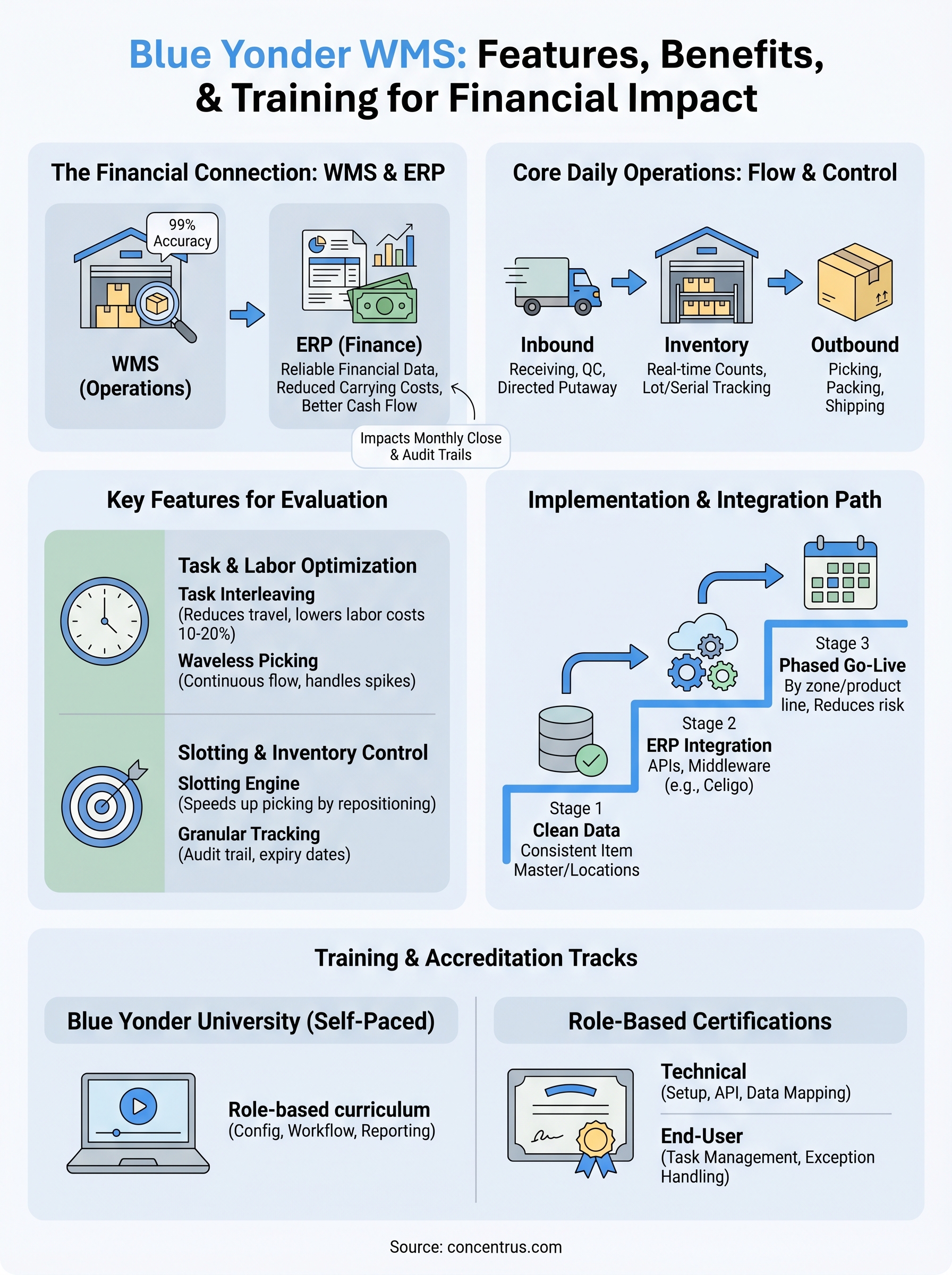
A well-configured WMS can push inventory accuracy above 99% by enforcing cycle counting, directed putaway, and real-time location tracking. That level of precision gives your finance team reliable data to work from when closing the books, forecasting demand, or reporting on working capital positions.
Your ERP system is the financial backbone of your business, but it only produces accurate reports if the data feeding it is trustworthy. When Blue Yonder WMS passes real-time inventory movements to your ERP, your cost of goods sold, landed costs, and stock valuations actually reflect what’s happening on the warehouse floor. That connection shortens your monthly close cycle and cuts the manual reconciliation your accounting team would otherwise spend hours resolving.
Finance leaders who treat WMS selection as purely an operations decision often discover the gap later, when their reporting doesn’t reconcile and the audit trail becomes unreliable.
What Blue Yonder WMS does day to day
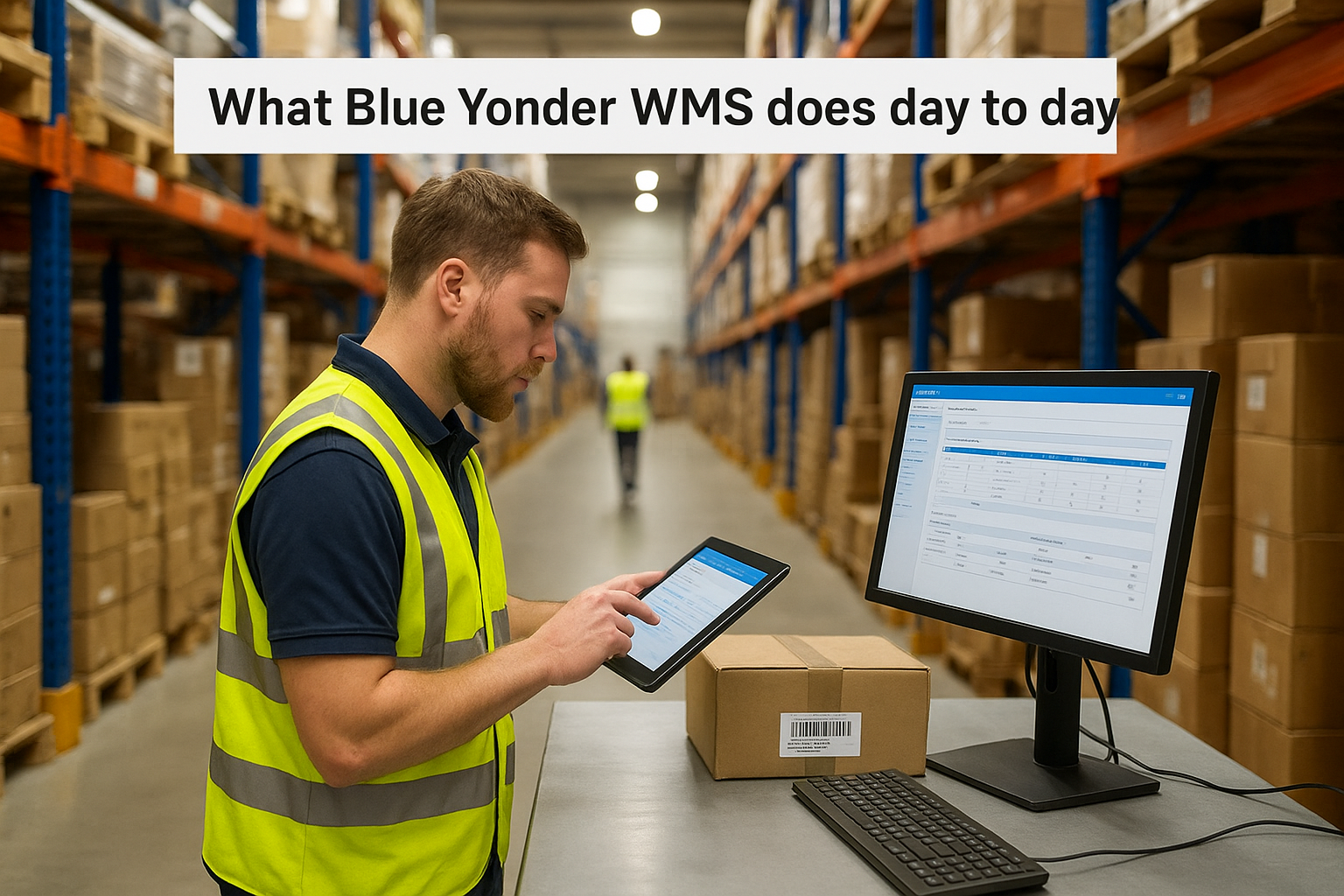
Blue Yonder WMS manages warehouse operations from the moment goods arrive at your dock to the moment a shipment leaves the building. On any given day, it orchestrates receiving, putaway, picking, packing, and shipping through a rules engine that directs workers to the right location at the right time, reducing wasted motion and handling errors across every shift.
Inbound and inventory control
When a truck arrives, the system guides your receiving team through license plate scanning, quality checks, and directed putaway based on product attributes, storage rules, and demand velocity. Inventory counts update in real time, so your ERP reflects accurate on-hand quantities without waiting for a manual count or a batch update at the end of the day.
Accurate receiving is where inventory integrity starts; errors at the dock compound downstream across every fulfillment process that follows.
Core inbound tasks the system handles include cross-docking and putaway optimization, lot and serial number tracking, and vendor compliance checking.
Outbound fulfillment and labor management
On the outbound side, Blue Yonder WMS sequences picks using wave or task-interleaving logic to minimize travel time and maximize worker output. The platform also tracks labor productivity by task, zone, and individual worker, giving supervisors the data they need to staff shifts correctly and spot training gaps before they create costly bottlenecks in your fulfillment operation.
Key features to evaluate in Blue Yonder WMS
Not every WMS platform delivers the same depth of functionality, and Blue Yonder WMS earns its reputation through capabilities that go beyond basic pick-and-ship workflows. Before committing, you need to pressure-test the features that will directly affect your throughput, accuracy, and operational cost.
Task and labor optimization
Task interleaving is one of the platform’s most impactful features. Instead of sending a worker on a single-purpose trip, the system combines complementary tasks into one efficient path through the warehouse, cutting travel time significantly. This can reduce labor costs by 10 to 20 percent in high-volume environments.
Labor is typically the largest variable cost in warehouse operations, so optimizing worker movement has a direct line to your bottom line.
The platform also supports waveless picking, which releases work continuously based on real-time conditions rather than scheduled waves, giving your operation flexibility during demand spikes without requiring supervisors to manually restructure pick batches.
Slotting and inventory control
The slotting engine continuously repositions fast-moving SKUs closer to outbound shipping lanes, cutting pick time without adding headcount. You also get granular lot, serial, and expiry date tracking built into every inventory movement, giving your finance and compliance teams a reliable audit trail.
Additional features worth evaluating:
Yard management integration to align inbound trailer scheduling with dock availability
Cross-docking support for high-velocity SKUs that bypass storage entirely
Implementation and integration considerations
Deploying Blue Yonder WMS in a midsized operation involves more than flipping a switch. Your implementation timeline, integration approach, and data readiness will determine whether you see ROI in the first year or spend months troubleshooting mismatches between your warehouse and financial systems.
Blue Yonder WMS connects to ERP platforms through APIs and middleware layers, but the quality of that connection depends on how well your ERP data is structured before the project starts. If your item master, unit-of-measure definitions, and warehouse locations are inconsistent in your ERP, those same inconsistencies will surface immediately when the two systems try to sync inventory movements. Cleaning that data before go-live is not optional.

Invest time in data governance before implementation starts; fixing dirty data after go-live costs significantly more than resolving it upfront.
Most integrations between Blue Yonder and platforms like NetSuite or Acumatica rely on middleware tools such as Celigo or similar iPaaS solutions to handle real-time data exchange for inventory transactions, purchase orders, and shipment confirmations.
Go-live and change management
Your team’s ability to adopt the new workflows directly affects how quickly the system delivers results. Phased go-lives by warehouse zone or product line reduce risk compared to a full cutover, giving your staff time to build confidence before the entire operation depends on the new platform.
Training and accreditation paths
Building internal expertise on Blue Yonder WMS reduces your reliance on external consultants and gives your team the confidence to optimize the system as your operation grows. Blue Yonder provides structured learning resources through its Blue Yonder University portal, where users access role-based courses, hands-on simulations, and certification exams.
Blue Yonder University and self-paced learning
Blue Yonder University organizes its curriculum by product and role, so your warehouse managers, IT administrators, and implementation leads each follow a learning path matched to their responsibilities. Courses cover system configuration, workflow design, and reporting, and most are available on demand so your team can work through them without disrupting daily operations.
Building proficiency before go-live dramatically shortens the time it takes your team to reach full productivity on the platform.
Role-based certification tracks
Certification tracks vary by function. Implementation consultants and technical staff typically pursue the WMS configuration and integration certifications, which validate skills in system setup, data mapping, and API connectivity. End users and operations supervisors focus on task management, labor reporting, and exception handling modules that map directly to daily workflows. Completing these tracks gives your business a measurable benchmark for internal competency, which also reduces the risk of configuration errors that quietly erode system performance over time.
Next steps
Blue Yonder WMS offers a capable foundation for tightening warehouse operations, but the system only delivers its full financial potential when it connects cleanly to your ERP and your team knows how to run it. If you’re evaluating Blue Yonder as part of a broader technology investment, the most important question is whether your current ERP can support that integration without creating data gaps that undermine reporting accuracy.
Getting that answer early saves you from costly surprises mid-project. Whether you’re implementing NetSuite or Acumatica, or rescuing an ERP project that hasn’t delivered the ROI you expected, Concentrus can help you build a technology stack where every component works together toward measurable financial outcomes. Your warehouse data should feed your financial reports accurately, and your ERP should give you the visibility to act on it. Talk to our ERP and ROI experts at Concentrus to map out an integration strategy that connects your warehouse operations to the financial results your business needs.
If you're a CFO evaluating warehouse management technology, Manhattan WMS has probably landed on your shortlist. Manhattan Associates built its reputation on warehouse execution, and their platform powers some of the largest distribution operations in the world. But reputation alone doesn't answer the question that matters most: will this investment actually pay off for your business?
That's the question we help midsized companies answer every day at Concentrus. As NetSuite and Acumatica ERP implementation and rescue specialists, we've sat across the table from finance leaders who chose warehouse management tools without fully understanding how those tools fit, or don't fit, within their broader ERP ecosystem. The result is often disconnected systems, duplicated data, and ROI that never materializes. Whether Manhattan WMS is the right call or a costly detour depends entirely on your operational reality and how it aligns with your financial goals.
This guide breaks down what Manhattan WMS actually does, where it excels, where it falls short, and how to evaluate it against alternatives that may integrate more tightly with your existing ERP investment. We'll cover features, costs, competitor comparisons, and the ROI considerations that should drive your decision, so you can move forward with clarity instead of assumptions.
Why Manhattan WMS matters to CFOs in 2026
Supply chain disruption has not gone away. Tariff pressures, labor shortages, and rising customer expectations have pushed warehouse efficiency from an operational footnote to a board-level conversation. For CFOs at midsized companies, the question is no longer whether to invest in warehouse technology, it's whether a platform like Manhattan WMS justifies the cost and complexity it brings with it.
The supply chain pressure driving WMS adoption
Warehouse management systems have moved up the priority list because margins are thinner and order accuracy is now a competitive differentiator. Customers, whether they're retail buyers or B2B distributors, expect faster fulfillment with fewer errors. When your warehouse runs on spreadsheets, whiteboards, or a legacy ERP module, you absorb the cost of that gap through chargebacks, expedited shipping, and returns.
The warehouses that consistently outperform in 2026 are not the ones with the most square footage, they're the ones with the tightest connection between inventory data and financial reporting.
Manhattan Associates built their platform specifically for high-volume, high-complexity distribution. Retailers, third-party logistics providers, and large manufacturers have relied on it for decades because it handles multi-node fulfillment, labor management, and slotting optimization at a scale that most warehouse tools cannot match.
What Manhattan WMS actually costs at midsized scale
This is where many finance leaders get caught off guard. Manhattan WMS is an enterprise-tier platform, and its pricing reflects that. Implementation costs typically start in the high six figures and can climb well past seven figures depending on the complexity of your distribution network, the number of warehouse locations, and the level of customization required.
Annual licensing and support adds another significant line item to your budget. For a midsized company running two or three warehouse locations, this raises an immediate question: are you buying more platform than your operation actually needs? Manhattan is engineered for the Fortune 500 distribution center, not the 200,000-square-foot facility that ships 1,500 orders per day.
Why ERP integration is the real financial risk
Even if Manhattan WMS fits your warehouse complexity, the ROI picture shifts dramatically based on how well it connects to your ERP system. A WMS that runs as an island produces real-time inventory data that your finance team cannot act on. Purchase orders, landed costs, and demand signals stay siloed, which means your financial close takes longer and your inventory valuations stay unreliable.
For companies running NetSuite or Acumatica, this integration gap is a known cost driver. Middleware connectors and custom API builds require ongoing maintenance, and every system update on either side creates a regression risk. Before you commit to any WMS investment, your team needs to map exactly how warehouse transactions will flow into your financial statements without manual reconciliation.
How Manhattan WMS works in day-to-day operations
Manhattan WMS manages warehouse activity from the moment inventory arrives at your dock to the moment it ships out the door. The platform assigns receiving tasks, putaway locations, pick paths, and packing instructions to workers in real time based on order priority, inventory position, and labor availability. Every transaction gets logged, which gives warehouse managers a live view of what's happening on the floor without walking it.
What the system controls at the task level
Workers interact with Manhattan WMS through handheld scanners, mobile devices, or voice-directed equipment, depending on your facility setup. The system calculates the most efficient pick path for each order and adjusts dynamically when priorities change. If a high-priority shipment comes in mid-shift, the system re-sequences tasks automatically rather than waiting for a supervisor to intervene.
The real value of a well-configured WMS is not in the technology itself, it is in how quickly your team can execute without making decisions that should be handled by the system.
Labor management is one of the areas where Manhattan's platform separates itself from lighter WMS tools. It tracks engineered labor standards, measures individual worker productivity against those standards, and flags deviations before they compound into fulfillment delays or overtime costs.
How warehouse data reaches your financial team
This is the step that most implementation plans underestimate. Manhattan WMS generates transaction-level data, including inventory adjustments, cost-per-pick metrics, and shrinkage events, that your ERP system needs to produce accurate financial statements. When that data transfer runs on a scheduled batch sync, your finance team is always working with numbers that are hours behind reality, which creates problems during month-end close.
Real-time API connections between your WMS and ERP solve this, but they require deliberate planning and ongoing maintenance, not an afterthought integration bolted on after go-live.
How to tell if Manhattan WMS fits your business
Not every warehouse operation needs enterprise-grade WMS software, and buying the wrong tier of platform is just as costly as running no WMS at all. Before you commit budget to a full Manhattan WMS evaluation, run your operation through a set of honest fitness questions. The answers will tell you quickly whether you're looking at the right tool or spending evaluation time on a platform built for a scale you haven't reached yet.
Signs Manhattan WMS fits your operation
Manhattan WMS delivers its strongest ROI in high-volume, high-complexity environments where the cost of inefficiency is large enough to offset significant implementation and licensing expenses. If your warehouse ships tens of thousands of orders per day, manages multiple fulfillment nodes, or operates under strict retailer compliance requirements, the platform's labor management and slotting optimization features can generate measurable savings.
The fit question is not whether Manhattan WMS is capable, it clearly is. The question is whether your operational complexity justifies the investment relative to alternatives that integrate more cleanly with your ERP.
You also benefit most from Manhattan's feature depth if your workforce is large enough to see a return on engineered labor standards tracking. A facility with 20 pickers will not recoup that investment the same way a facility with 200 will.
Signs you need a different approach
If your company runs one or two warehouse locations and processes under 5,000 orders per day, a native WMS module inside NetSuite or a mid-market alternative will likely cover your needs at a fraction of the cost and integration risk. The implementation timeline alone for Manhattan can consume 12 to 18 months, and a midsized operation often cannot absorb that disruption without significant impact to customer service and cash flow.
Consider whether your ERP partner can extend your current platform before adding a standalone WMS to your technology stack.
How to plan ERP and automation integrations
Your ERP is the financial backbone of your operation, and any WMS you add sits downstream from it. Before you get deep into a Manhattan WMS evaluation, you need a clear picture of how warehouse transactions will flow into your general ledger, inventory valuation, and purchasing workflows. Integration planning is not a technical checkbox, it is a financial risk management exercise that directly determines whether your WMS investment produces the ROI you are targeting.
Map your data flows before you select a vendor
Inventory adjustments, receiving confirmations, and shipment confirmations all need to reach your ERP in a timeframe that supports accurate financial reporting. Start by documenting every transaction type your warehouse generates and identifying which ones trigger a financial event in your system of record. This exercise gives your ERP partner and your WMS vendor a shared integration map to work from before contracts are signed.
The integration architecture you build between your WMS and ERP will either compress your financial close or extend it, so design this correctly before you commit budget.
Skipping this step is the most common reason ERP and WMS projects miss their ROI targets. When data gaps appear after go-live, the cost to repair them escalates quickly because both systems are already in production and your team is already dependent on the outputs those systems generate.
Understand automation dependencies in your fulfillment stack
Modern warehouse operations rely on conveyor controls, dimensioners, and robotic picking systems that generate their own data streams. Each of those systems needs to connect to your WMS, and your WMS needs to pass that data upstream to your ERP without delays that distort your inventory position or force manual reconciliation at month-end.
If you run NetSuite or Acumatica, native connectors or certified middleware partners will reduce your integration maintenance burden compared to custom API builds that break during platform updates. Ask every vendor you evaluate to walk you through their specific integration architecture with your ERP before advancing them past the shortlist stage.
How to build an ROI case and avoid cost traps
Building an ROI case for any WMS starts with total cost of ownership, not just the licensing number a vendor puts in front of you. Manhattan WMS carries significant implementation, integration, and ongoing support costs that midsized finance leaders frequently underestimate when they first model the investment. Before you approve a budget, you need to account for every dollar the project will consume across its full lifecycle, including the productivity loss your team absorbs during a 12 to 18 month go-live cycle.
Calculate the true total cost of ownership
Software licensing and implementation fees are only the starting point for your cost model. Add middleware maintenance, training time, custom development for ERP integration, and the internal labor your finance and operations teams will dedicate to the project. For midsized companies evaluating Manhattan WMS, that full number often looks very different from the initial vendor quote.
If your cost model only includes what the vendor charges, you are missing half the picture before the project even starts.
Your cost model should also include a risk buffer for scope creep and integration rework, which are the two most common drivers of budget overruns in WMS projects. Build a realistic range, not a single number, and stress-test it against a scenario where go-live is delayed by six months.
Tie WMS metrics to financial outcomes
Every operational metric your WMS tracks needs a direct line to a financial KPI your CFO dashboard already measures. Pick-accuracy rates matter because they reduce chargebacks and returns. Labor productivity metrics matter because they compress overtime costs and improve margin. If you cannot draw that line clearly, the metric is noise.
Build your ROI model around three to five financial outcomes you can measure before and after implementation, such as inventory carrying costs, order fulfillment cycle time, and cost per shipment. That framework gives your board a credible payback timeline and gives your team a performance target to work toward from day one.
Next steps for a confident decision
Evaluating Manhattan WMS against your actual operational complexity and ERP environment is the work that separates a sound investment from an expensive mistake. You now have a framework to assess fit, model total cost of ownership, and tie warehouse metrics directly to financial outcomes your board cares about. Use that framework before you sign anything.
Your next move is to pressure-test your current ERP setup against the integration requirements any WMS will demand. If you run NetSuite or Acumatica and you're not certain your system is configured to support that kind of data flow, that gap needs to close first. A poorly integrated WMS will cost you more than no WMS at all, and the time to find that out is before go-live, not after.
Talk to a Concentrus ERP specialist to map your warehouse integration needs against your financial goals before you commit budget.
As your business adds entities, departments, and locations, QuickBooks can technically keep up—but only by pushing more work into spreadsheets and manual processes. This blog explains how growth-driven complexity strains entry-level accounting tools and why NetSuite often becomes the next step to manage consolidation, reporting, and visibility at scale.
Each layer of complexity creates more demand on finance.
QuickBooks may still be usable at this stage, but many teams find that once business structure becomes more layered, finance work becomes more manual. Reporting across the organization gets harder. Consolidation takes longer. Visibility becomes fragmented.
When finance is overwhelmed, the instinct is to hire. But adding people around broken QuickBooks-based processes creates manual process debt, not real scale (PwC, n.d.). This blog explains why strong CFOs analyze root causes—especially software fit—and why upgrading systems often delivers a higher return than another full-time hire (Oracle NetSuite, 2023).
We Are Experts at Generating ROI for our Clients Through Custom Integration of NetSuite and Acumatica ERP Software