

If you’re a CFO or finance leader asking what is warehouse management, you’re likely looking beyond the textbook definition. You want to understand how warehouse operations directly affect your margins, cash flow, and ability to scale. The answer is simple: warehouse management touches nearly every financial metric that matters to a midsized company, from inventory carrying costs to order accuracy to customer retention.
Poor warehouse operations bleed money quietly. Misplaced inventory, slow fulfillment, inaccurate counts, and manual workarounds create compounding inefficiencies that erode profitability over time. On the other hand, well-managed warehouses become a competitive advantage, turning faster inventory, reducing labor costs, and giving leadership clear visibility into real-time stock levels and order status.
The key to getting there? A structured approach to warehouse processes, supported by the right technology. That’s where a Warehouse Management System (WMS), often integrated within an ERP platform like NetSuite or Acumatica, makes a measurable difference. At Concentrus, we help midsized companies connect their warehouse operations to broader financial goals through ERP implementations built around our ROI Roadmap™ methodology. We’ve seen firsthand how aligning warehouse management with enterprise-wide systems transforms operational performance.
This article breaks down the core processes of warehouse management, the business benefits of getting it right, and how a WMS fits into your technology strategy. Whether you’re evaluating a new system or trying to fix one that underdelivers, this guide gives you the foundation to make informed, financially sound decisions.
Why warehouse management matters to the business
When CFOs dig into what is warehouse management, they often find that the warehouse is quietly one of their largest cost centers and one of the most overlooked levers in the business. Inventory typically represents a significant portion of a midsized company’s working capital, meaning that how you manage it directly affects your cash position, carrying costs, and gross margins. If your warehouse runs on manual processes, spreadsheets, or a disconnected system, you’re likely absorbing hidden costs that only surface during audits or when a major order goes wrong.
The financial cost of poor warehouse operations
Poor warehouse management generates costs in ways that are easy to miss on a day-to-day basis. Inaccurate inventory counts lead to overstock situations that tie up cash or stockouts that cost you revenue and customer trust. Labor inefficiencies from manual picking routes, paper-based workflows, and rework from fulfillment errors add up fast, especially as order volumes grow. Organizations tracking supply chain performance consistently find that warehouse errors and returns rank among the top drivers of avoidable operational cost in distribution-focused businesses.
Fixing warehouse inefficiency is not a logistics problem, it is a financial problem that demands a financial leader’s attention.
Here are the most common financial impacts of poor warehouse management:
- Excess inventory carrying costs: storage, insurance, and obsolescence charges
- Order error rates: returns, reshipping, and customer credits that reduce net revenue
- Labor cost overruns: overtime and rework caused by broken processes
- Shrinkage and loss: undetected theft or damage from inadequate tracking
- Delayed cash conversion: slow fulfillment extends the cycle between purchase and payment
How warehouse management connects to company-wide performance
Your warehouse does not operate in isolation. Every inefficiency in receiving, storage, or fulfillment creates ripple effects across finance, sales, and customer service. When inventory data is unreliable, your finance team struggles to produce accurate balance sheets and cost-of-goods-sold figures. When fulfillment is slow or error-prone, your sales team loses customers that took real budget to acquire.
Strong warehouse management gives you real-time visibility into stock levels, order status, and operational throughput. That visibility feeds directly into more accurate financial reporting, sharper demand forecasting, and confident procurement decisions. A well-run warehouse produces clean, consistent data that your entire organization can rely on, which means fewer surprises at month-end close, tighter inventory planning, and a clearer picture of where working capital is tied up and where it could be freed. For CFOs focused on scalable growth, that clarity is not a nice-to-have, it is a fundamental requirement.
The core warehouse management processes end to end
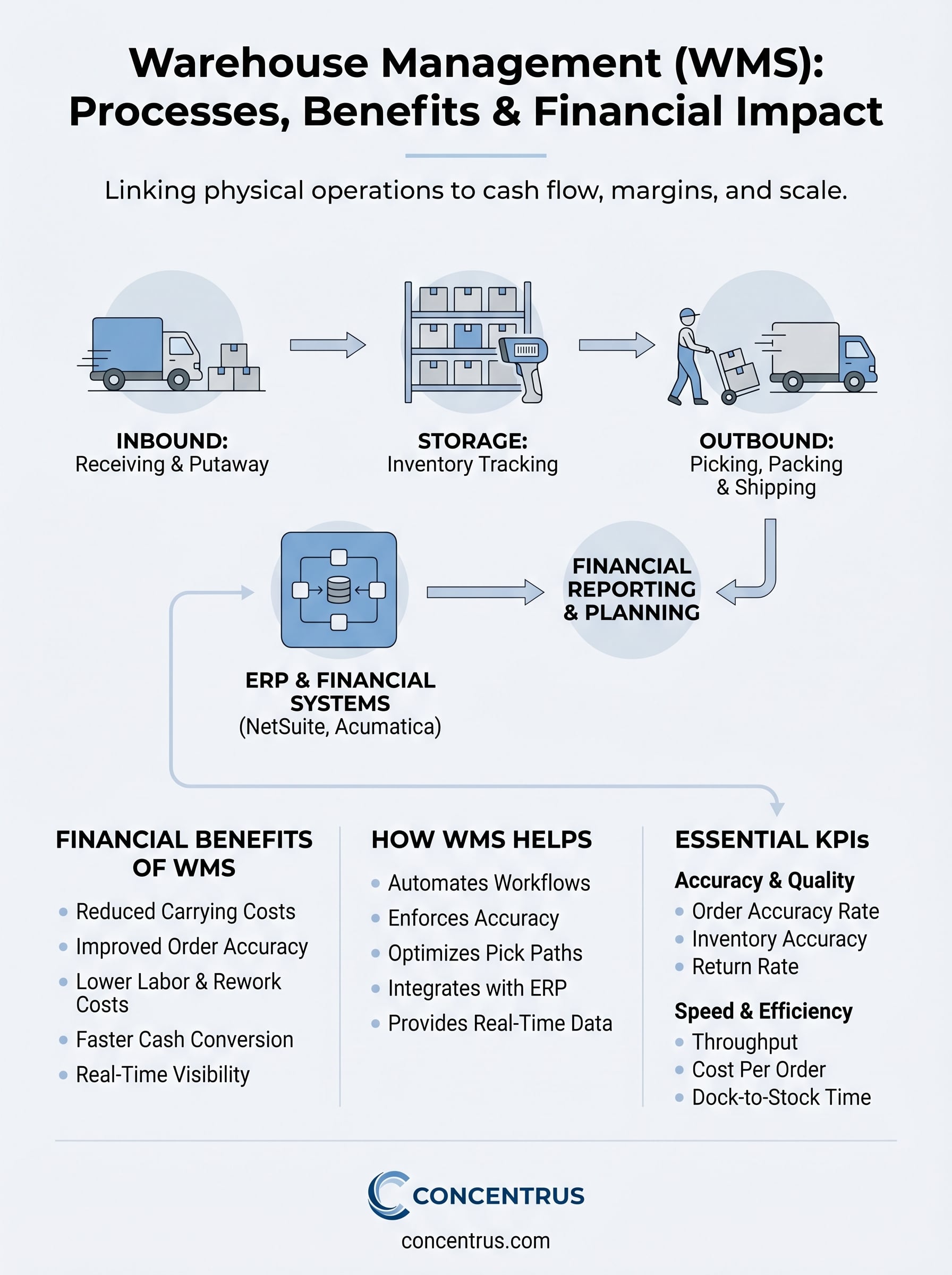
When you ask what is warehouse management, one of the most practical answers is a set of connected processes that move inventory through your facility from the moment it arrives to the moment it ships. Each step depends on the accuracy of the one before it, and a breakdown at any point creates delays, errors, and costs that ripple through your entire operation. Understanding these steps end to end gives you the visibility to identify exactly where your warehouse loses time and money.
Inbound: receiving and putaway
Inbound operations start the moment a shipment arrives at your dock. Your team verifies incoming quantities and condition against purchase orders, flags discrepancies immediately, and assigns stock to the correct storage locations. This step sets the accuracy of everything downstream. If your receiving process is slow or inconsistent, bad data enters your system from the start, and every downstream process inherits that error.

- Receive and verify the shipment against the purchase order
- Inspect goods for damage or quantity discrepancies
- Label and assign items to designated storage locations
- Update inventory records in real time
Outbound: picking, packing, and shipping
Outbound operations are where order accuracy and fulfillment speed become directly visible to your customers and your cash cycle. Once an order is confirmed, your team picks items from their assigned locations, packs them to the required specifications, and prepares shipments with the correct documentation and carrier labels.
The speed and accuracy of your outbound process directly determines your order-to-cash cycle and your customer retention rate.
Efficient picking routes and clear packing standards reduce both labor time and error rates significantly. Shipping confirmation closes the loop by updating your inventory records and triggering the next financial step, whether that is invoicing, revenue recognition, or a replenishment order. When each outbound step runs cleanly, you capture the full financial value of every sale without the drag of returns and re-shipments eating into your margins.
Warehouse management vs inventory management and logistics
When you’re trying to understand what is warehouse management, it helps to draw clear lines between three terms that often get used interchangeably: warehouse management, inventory management, and logistics. Each one describes a distinct scope of operations, and confusing them leads to gaps in accountability, misaligned technology investments, and blind spots in your financial reporting. Warehouse management focuses specifically on the physical operations inside your facility, from how goods are received and stored to how orders are picked, packed, and shipped out the door.
How inventory management differs
Inventory management zooms out from the warehouse floor and focuses on what you own, what it’s worth, and how much you need. It answers questions like how much stock to carry, when to reorder, and how inventory levels affect your balance sheet and cost of goods sold. Warehouse management answers the operational question of how that inventory moves through your facility accurately and efficiently. The two disciplines are deeply connected: poor warehouse processes produce unreliable inventory data, and unreliable inventory data undermines every financial decision tied to stock.
Inventory accuracy is the foundation that connects your warehouse operations directly to your financial statements.
Here is a quick comparison to make the distinction concrete:
| Term | Primary Focus | Key Question It Answers |
|---|---|---|
| Warehouse management | Physical facility operations | How does inventory move through our warehouse? |
| Inventory management | Stock levels and valuation | What do we own, and how much should we carry? |
| Logistics | End-to-end supply chain movement | How do goods move from supplier to customer? |
Where logistics fits in
Logistics covers a broader scope than either of the two terms above. It encompasses the entire supply chain, including transportation, supplier relationships, and last-mile delivery, not just what happens inside your four walls. Your warehouse is one node in that larger network. For CFOs deciding where to focus technology spending and process improvement, understanding these boundaries clarifies where each dollar of investment delivers the most measurable financial return.
What a warehouse management system does and how it helps
Once you understand what is warehouse management at the process level, the next question is what technology supports it. A Warehouse Management System (WMS) is software that automates, tracks, and optimizes the physical operations inside your facility. It handles everything from directing your team to the right storage location during putaway to generating the most efficient pick path for an outbound order. The result is fewer manual steps, fewer errors, and a real-time data layer that connects your warehouse floor directly to your financial systems.
Core functions a WMS handles
A WMS replaces manual, paper-based processes with system-driven workflows that enforce accuracy at each step. When a shipment arrives, the system validates quantities against the purchase order automatically. When an order ships, it updates inventory records instantly and triggers the next step in your order-to-cash cycle.

The more automated your warehouse workflows, the less your financial data depends on someone remembering to update a spreadsheet.
Here are the primary functions a WMS manages across your daily operations:
- Receiving and putaway: validates inbound shipments and assigns storage locations based on rules you define
- Pick path optimization: routes your team through the warehouse in the most efficient sequence to reduce travel time and labor cost
- Packing and shipping: enforces packing standards, generates labels, and confirms shipments to close out orders
- Inventory tracking: maintains real-time stock counts by location, lot, or serial number
- Returns processing: logs returned items and routes them back into usable stock or flags them for disposal
How a WMS connects to your ERP and financial data
A WMS delivers its greatest value when it integrates directly with your ERP platform. In NetSuite or Acumatica, warehouse transactions flow automatically into your financial records, so your balance sheet reflects accurate inventory values and your cost-of-goods-sold figures stay current without manual reconciliation. That integration gives your finance team reliable data at month-end close and removes the guesswork from procurement decisions driven by stock levels.
Warehouse KPIs that show if it works and where to improve
Once you grasp what is warehouse management at both the process and technology level, the next step is measuring whether your operation actually performs. KPIs give you the objective data to distinguish a warehouse that runs well from one that quietly drains your margins. Without clear metrics, you’re making decisions based on gut feel, and gut feel doesn’t belong in a financial leader’s toolkit.
The KPIs you track in your warehouse should connect directly to the financial outcomes your organization is accountable for.
KPIs that measure accuracy and order quality
Order accuracy rate and inventory accuracy are the two metrics that matter most to your financial statements. Order accuracy measures the percentage of orders shipped without errors, which ties directly to your return rate, reship costs, and customer satisfaction. Inventory accuracy compares your system’s recorded stock levels against your physical counts. A low inventory accuracy rate means your balance sheet carries unreliable asset values and your procurement team makes reorder decisions on bad data.
Key accuracy KPIs to track regularly:
- Order accuracy rate: target 99% or higher for most distribution operations
- Inventory accuracy: measured through cycle counts, target above 97%
- Return rate: percentage of orders that come back due to warehouse errors
- Receiving accuracy: percentage of inbound shipments verified without discrepancy
KPIs that measure speed and cost efficiency
Throughput and cost per order tell you whether your warehouse operates at the efficiency level your business model requires. Throughput measures the number of orders your team processes in a given period. Cost per order calculates your total warehouse operating costs divided by total orders shipped, giving you a unit economics figure you can benchmark over time and use to justify technology investments. Dock-to-stock time tracks how quickly your team moves inbound inventory from the receiving dock into a usable storage location, which directly affects how fast new stock becomes available to fulfill demand.
Where to go from here
Understanding what is warehouse management at the process, technology, and metrics level gives you the foundation to make decisions that move the needle on your financial performance. The gap between a warehouse that drains margin and one that drives it almost always comes down to three things: defined processes, the right system to support them, and KPIs that connect daily operations to financial outcomes your leadership team can act on.
Your next step depends on where you are right now. If your warehouse runs on disconnected tools or manual workflows, the priority is getting accurate, real-time data flowing into a system your finance team can trust. If you already have a WMS but it isn’t integrated with your ERP, you’re leaving serious efficiency gains on the table. Either way, the path forward starts with aligning your warehouse operations to measurable ROI goals. Talk to an ERP and warehouse operations expert at Concentrus to find out where your biggest opportunities are.