


If your midsized company runs complex warehouse operations, you’ve likely come across Blue Yonder WMS during your search for a system that can keep pace with growing order volumes and tighter fulfillment windows. Blue Yonder’s warehouse management platform is one of the more established solutions on the market, offering AI-driven capabilities that promise to sharpen inventory accuracy, labor planning, and throughput.
But a WMS doesn’t operate in a vacuum. It needs to work hand-in-hand with your ERP system to deliver the financial visibility and operational control that CFOs and finance leaders actually care about. That’s where our work at Concentrus comes in, we specialize in NetSuite and Acumatica ERP implementations designed around measurable ROI, and we regularly help clients evaluate how third-party solutions like Blue Yonder fit into a broader technology strategy that drives real financial outcomes.
This article breaks down Blue Yonder WMS, its core features, the business benefits it can deliver, and the training and certification paths available for teams looking to build internal expertise. Whether you’re comparing WMS options or trying to understand how Blue Yonder would integrate with your current ERP environment, you’ll walk away with the clarity you need to make a confident decision.
Why Blue Yonder WMS matters to finance
Most finance leaders don’t think about warehouse management software until something goes wrong. When inventory counts are off or fulfillment delays spike, the downstream effect hits your balance sheet fast: excess carrying costs, write-downs, lost revenue, and strained customer relationships. Blue Yonder WMS sits at the intersection of operations and finance, which is exactly why CFOs should be part of the evaluation conversation, not just operations teams.
The cost of inventory inaccuracy
Inventory discrepancies are not just an operations headache. They translate directly into financial exposure. When your system shows stock that isn’t physically there, you overcommit on orders. When stock exists but isn’t recorded accurately, you reorder unnecessarily and inflate working capital. Both scenarios affect your cash flow and profitability in ways that surface in your financials every single quarter.
Companies with inventory accuracy below 95% routinely absorb between 1% and 3% of annual revenue in excess carrying costs and missed sales, according to supply chain management research.
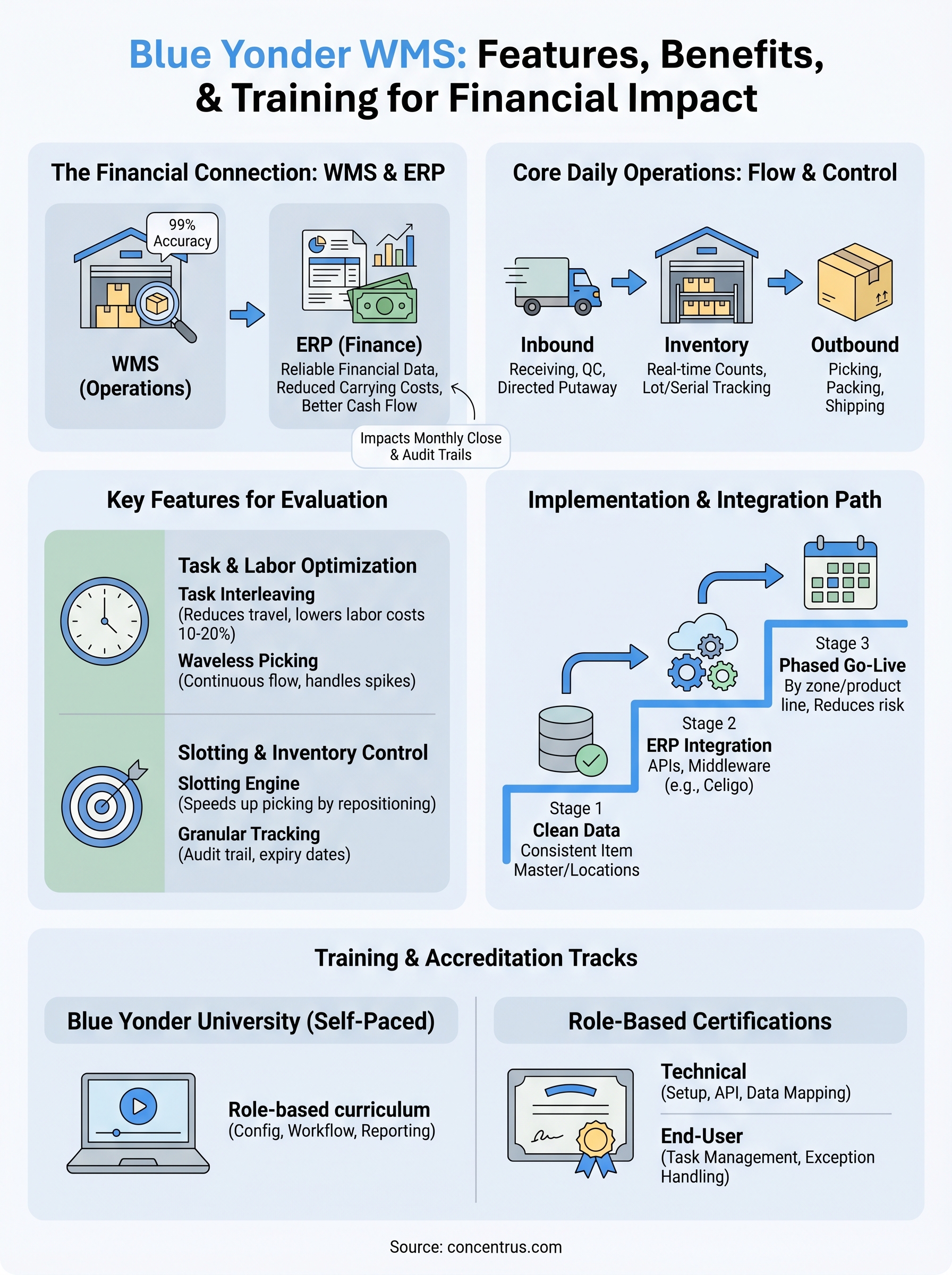
A well-configured WMS can push inventory accuracy above 99% by enforcing cycle counting, directed putaway, and real-time location tracking. That level of precision gives your finance team reliable data to work from when closing the books, forecasting demand, or reporting on working capital positions.
How WMS data connects to financial reporting
Your ERP system is the financial backbone of your business, but it only produces accurate reports if the data feeding it is trustworthy. When Blue Yonder WMS passes real-time inventory movements to your ERP, your cost of goods sold, landed costs, and stock valuations actually reflect what’s happening on the warehouse floor. That connection shortens your monthly close cycle and cuts the manual reconciliation your accounting team would otherwise spend hours resolving.
Finance leaders who treat WMS selection as purely an operations decision often discover the gap later, when their reporting doesn’t reconcile and the audit trail becomes unreliable.
What Blue Yonder WMS does day to day
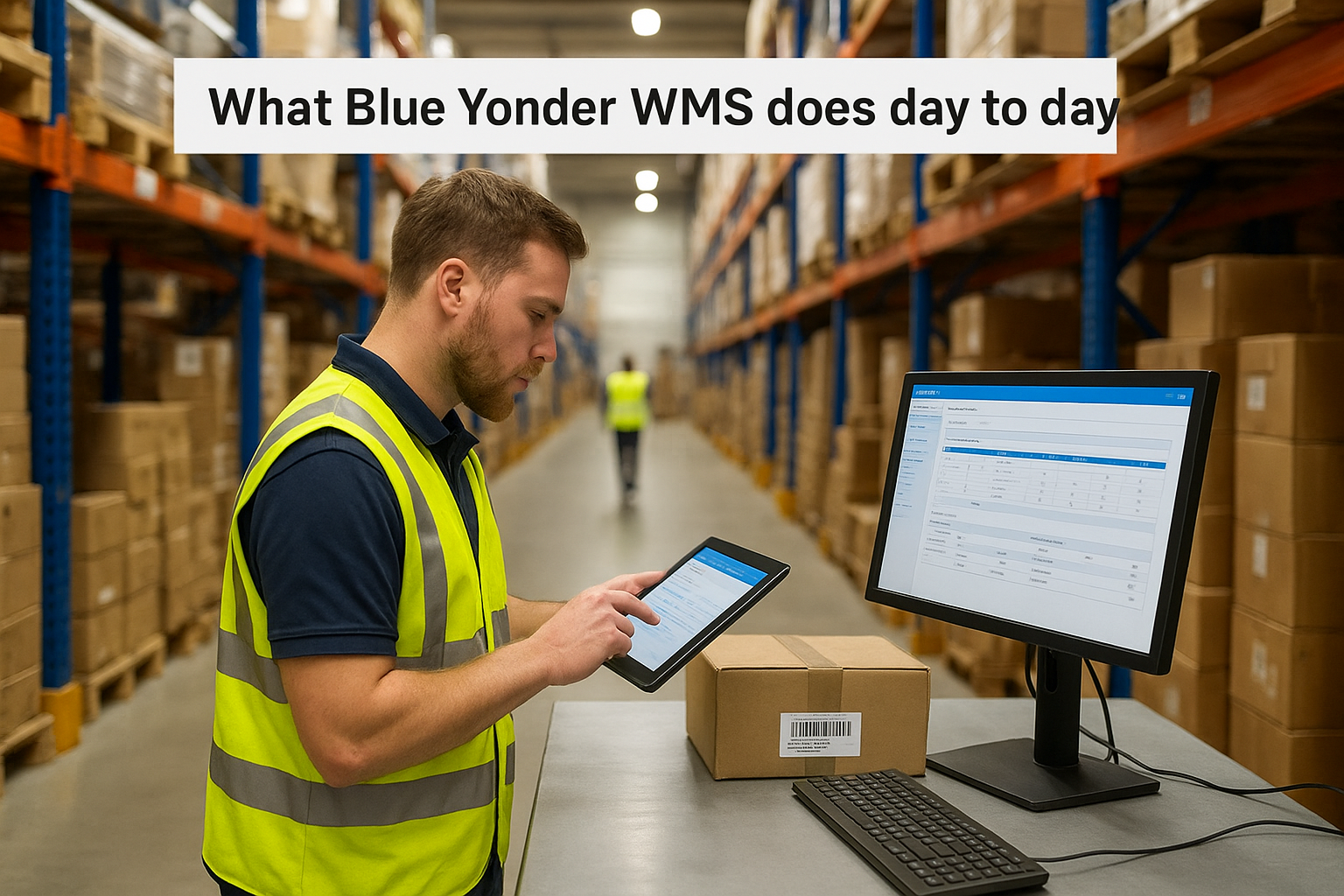
Blue Yonder WMS manages warehouse operations from the moment goods arrive at your dock to the moment a shipment leaves the building. On any given day, it orchestrates receiving, putaway, picking, packing, and shipping through a rules engine that directs workers to the right location at the right time, reducing wasted motion and handling errors across every shift.
Inbound and inventory control
When a truck arrives, the system guides your receiving team through license plate scanning, quality checks, and directed putaway based on product attributes, storage rules, and demand velocity. Inventory counts update in real time, so your ERP reflects accurate on-hand quantities without waiting for a manual count or a batch update at the end of the day.
Accurate receiving is where inventory integrity starts; errors at the dock compound downstream across every fulfillment process that follows.
Core inbound tasks the system handles include cross-docking and putaway optimization, lot and serial number tracking, and vendor compliance checking.
Outbound fulfillment and labor management
On the outbound side, Blue Yonder WMS sequences picks using wave or task-interleaving logic to minimize travel time and maximize worker output. The platform also tracks labor productivity by task, zone, and individual worker, giving supervisors the data they need to staff shifts correctly and spot training gaps before they create costly bottlenecks in your fulfillment operation.
Key features to evaluate in Blue Yonder WMS
Not every WMS platform delivers the same depth of functionality, and Blue Yonder WMS earns its reputation through capabilities that go beyond basic pick-and-ship workflows. Before committing, you need to pressure-test the features that will directly affect your throughput, accuracy, and operational cost.
Task and labor optimization
Task interleaving is one of the platform’s most impactful features. Instead of sending a worker on a single-purpose trip, the system combines complementary tasks into one efficient path through the warehouse, cutting travel time significantly. This can reduce labor costs by 10 to 20 percent in high-volume environments.
Labor is typically the largest variable cost in warehouse operations, so optimizing worker movement has a direct line to your bottom line.
The platform also supports waveless picking, which releases work continuously based on real-time conditions rather than scheduled waves, giving your operation flexibility during demand spikes without requiring supervisors to manually restructure pick batches.
Slotting and inventory control
The slotting engine continuously repositions fast-moving SKUs closer to outbound shipping lanes, cutting pick time without adding headcount. You also get granular lot, serial, and expiry date tracking built into every inventory movement, giving your finance and compliance teams a reliable audit trail.
Additional features worth evaluating:
- Yard management integration to align inbound trailer scheduling with dock availability
- Cross-docking support for high-velocity SKUs that bypass storage entirely
Implementation and integration considerations
Deploying Blue Yonder WMS in a midsized operation involves more than flipping a switch. Your implementation timeline, integration approach, and data readiness will determine whether you see ROI in the first year or spend months troubleshooting mismatches between your warehouse and financial systems.
ERP integration requirements
Blue Yonder WMS connects to ERP platforms through APIs and middleware layers, but the quality of that connection depends on how well your ERP data is structured before the project starts. If your item master, unit-of-measure definitions, and warehouse locations are inconsistent in your ERP, those same inconsistencies will surface immediately when the two systems try to sync inventory movements. Cleaning that data before go-live is not optional.

Invest time in data governance before implementation starts; fixing dirty data after go-live costs significantly more than resolving it upfront.
Most integrations between Blue Yonder and platforms like NetSuite or Acumatica rely on middleware tools such as Celigo or similar iPaaS solutions to handle real-time data exchange for inventory transactions, purchase orders, and shipment confirmations.
Go-live and change management
Your team’s ability to adopt the new workflows directly affects how quickly the system delivers results. Phased go-lives by warehouse zone or product line reduce risk compared to a full cutover, giving your staff time to build confidence before the entire operation depends on the new platform.
Training and accreditation paths
Building internal expertise on Blue Yonder WMS reduces your reliance on external consultants and gives your team the confidence to optimize the system as your operation grows. Blue Yonder provides structured learning resources through its Blue Yonder University portal, where users access role-based courses, hands-on simulations, and certification exams.
Blue Yonder University and self-paced learning
Blue Yonder University organizes its curriculum by product and role, so your warehouse managers, IT administrators, and implementation leads each follow a learning path matched to their responsibilities. Courses cover system configuration, workflow design, and reporting, and most are available on demand so your team can work through them without disrupting daily operations.
Building proficiency before go-live dramatically shortens the time it takes your team to reach full productivity on the platform.
Role-based certification tracks
Certification tracks vary by function. Implementation consultants and technical staff typically pursue the WMS configuration and integration certifications, which validate skills in system setup, data mapping, and API connectivity. End users and operations supervisors focus on task management, labor reporting, and exception handling modules that map directly to daily workflows. Completing these tracks gives your business a measurable benchmark for internal competency, which also reduces the risk of configuration errors that quietly erode system performance over time.
Next steps
Blue Yonder WMS offers a capable foundation for tightening warehouse operations, but the system only delivers its full financial potential when it connects cleanly to your ERP and your team knows how to run it. If you’re evaluating Blue Yonder as part of a broader technology investment, the most important question is whether your current ERP can support that integration without creating data gaps that undermine reporting accuracy.
Getting that answer early saves you from costly surprises mid-project. Whether you’re implementing NetSuite or Acumatica, or rescuing an ERP project that hasn’t delivered the ROI you expected, Concentrus can help you build a technology stack where every component works together toward measurable financial outcomes. Your warehouse data should feed your financial reports accurately, and your ERP should give you the visibility to act on it. Talk to our ERP and ROI experts at Concentrus to map out an integration strategy that connects your warehouse operations to the financial results your business needs.