

Choosing the best inventory management software for manufacturing isn’t just a technology decision, it’s a financial one. Raw materials, work-in-progress, and finished goods represent real capital tied up on your shop floor and in your warehouse. The wrong system leaves you blind to where that capital sits, while the right one gives you control over costs, production timelines, and margins.
Most comparison lists treat inventory software like a feature checklist. But if you’re a CFO or finance leader at a midsized manufacturer, you already know that features alone don’t drive results, alignment with your operational and financial goals does. At Concentrus, we implement and optimize ERP systems like NetSuite and Acumatica for exactly this reason: to make sure every technology investment ties back to measurable ROI, not just a longer feature list.
This guide breaks down 10 inventory management software solutions built for manufacturing workflows, covering BOM management, production tracking, and raw material planning. We evaluated each option based on the capabilities that actually matter to midsized manufacturers, so you can make a confident, informed decision without sorting through noise.
1. Oracle NetSuite ERP with Concentrus
Oracle NetSuite is the leading cloud ERP platform for midsized manufacturers who need inventory management, production control, and financial reporting in a single system. When you implement it with Concentrus, you get more than a software deployment; you get a structured path to measurable ROI through the proprietary ROI Roadmap™ methodology that ties every configuration decision to your specific financial goals.

Best for
NetSuite with Concentrus works best for midsized manufacturers that have outgrown entry-level tools and need a platform that scales with them. If your business runs across multiple locations, handles complex BOMs, or operates in sectors like wholesale distribution, discrete manufacturing, or professional services, this combination is built for your environment.
Inventory and manufacturing strengths
Your inventory lifecycle gets real-time visibility at every stage, from raw material procurement through finished goods delivery. The platform handles multi-location inventory, demand planning, lot and serial tracking, and BOM management natively, with work orders connected directly to inventory records so production floor activity updates your stock counts without manual reconciliation.
NetSuite’s manufacturing module tracks work-in-progress costs at each production stage, which means you always know exactly where your capital is sitting.
Finance and reporting strengths
The financial side of NetSuite is where it separates from point solutions. You get real-time cost accounting, landed cost tracking, and inventory valuation methods including FIFO, LIFO, and average cost. Every inventory movement generates an automatic journal entry, which accelerates your close cycle and reduces the manual workload your accounting team carries every month.
Implementation and integration fit
Concentrus brings a structured implementation process that avoids the over-customization trap most manufacturers fall into. Your system gets configured to match your actual workflows and KPIs, not a generic template. NetSuite’s open API supports clean integrations with platforms like Avalara for tax compliance and ShipHawk for shipping logistics, both available through the Concentrus Partner Network™.
Pricing and total cost notes
NetSuite pricing is module-based and user-based, so your total cost scales with the complexity and size of your operation. Expect to invest in licensing, implementation, and ongoing support. Partnering with Concentrus means that every dollar spent maps to a defined ROI milestone, which gives your finance team a defensible business case before the project starts and a clear tracking mechanism throughout.
2. Acumatica Manufacturing Edition
Acumatica Manufacturing Edition is a cloud-based ERP platform built for midsized manufacturers who need tight control over production, inventory, and costs without the overhead that comes with enterprise-tier systems. Concentrus also implements and optimizes Acumatica, which makes it a strong alternative to NetSuite depending on your business model and growth trajectory.
Best for
Acumatica fits manufacturers that operate in make-to-order, make-to-stock, or engineer-to-order environments and want a flexible platform that doesn’t charge per user. If your team is growing or you have variable user counts across shifts, Acumatica’s consumption-based pricing model removes a common barrier.
Inventory and manufacturing strengths
The platform gives you native BOM management, material requirements planning (MRP), and production order tracking in one connected environment. Inventory updates in real time as materials move through production stages, which eliminates the lag between shop floor activity and your stock records.
Acumatica’s MRP engine lets you plan material needs across multiple production schedules simultaneously, which directly reduces carrying costs and stockout risk.
Finance and reporting strengths
Acumatica connects production costs directly to your general ledger, so every work order generates accurate cost data without manual entry. You get support for multiple inventory valuation methods and project accounting tools that help you track profitability at the job level, not just the company level.
Implementation and integration fit
Acumatica uses an open API architecture that connects cleanly with third-party tools for shipping, tax compliance, and CRM. Implementation complexity is moderate, and working with an experienced partner keeps your configuration aligned with your actual workflows rather than default settings.
Pricing and total cost notes
Acumatica prices by resource consumption rather than named users, which gives growing teams more flexibility. Your total investment depends on the modules you activate and your transaction volume, so build your budget around a realistic growth projection.
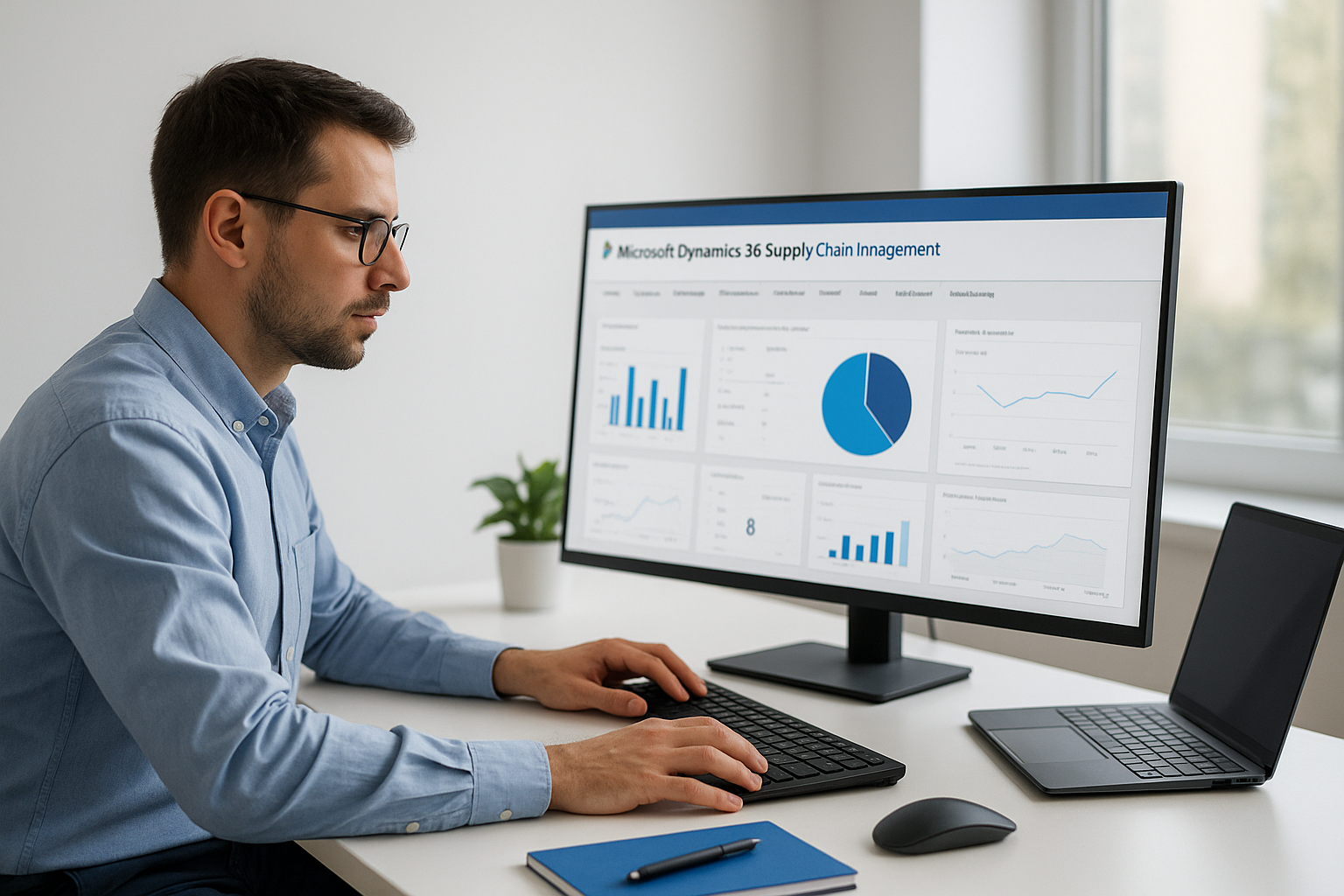
3. Microsoft Dynamics 365 Supply Chain Management
Microsoft Dynamics 365 Supply Chain Management is a cloud-based ERP solution built for manufacturers that need deep operational control across procurement, production, warehousing, and logistics. If your organization already runs on the Microsoft ecosystem, this platform offers a level of native connectivity that competing systems simply can’t match out of the box.
Best for
Dynamics 365 Supply Chain is best suited for mid-to-large manufacturers already invested in Microsoft tools like Azure, Teams, or Power BI. It performs especially well in discrete and process manufacturing environments where complex routing, capacity planning, and multi-site operations are standard requirements.
Inventory and manufacturing strengths
When evaluating the best inventory management software for manufacturing, Dynamics 365 stands out for its advanced warehouse management capabilities, including wave processing, slotting optimization, and real-time inventory tracking across multiple locations. The platform natively supports BOM management, production orders, and lean manufacturing workflows, giving your operations team accurate data at every production stage.
Dynamics 365 integrates directly with IoT sensors and Azure Machine Learning, which means your inventory and production data can trigger automated alerts before shortages disrupt your schedule.
Finance and reporting strengths
Your finance team gets built-in cost accounting, standard costing, and variance analysis tied directly to production and inventory activity. Power BI integration makes it straightforward to build custom financial dashboards without exporting data to a separate reporting tool.
Implementation and integration fit
Dynamics 365 integrates tightly with the broader Microsoft stack, which reduces integration risk if you already use Azure or Office 365. Implementation complexity is high, so selecting an experienced partner is critical to avoiding costly configuration mistakes.
Pricing and total cost notes
Microsoft licenses Dynamics 365 Supply Chain on a per-user, per-month model, with costs scaling based on user type and active modules. Total cost of ownership includes licensing, implementation, and ongoing customization as your operations evolve.
4. Infor CloudSuite Industrial
Infor CloudSuite Industrial (CSI) is a cloud ERP platform built specifically for industrial manufacturing environments. Unlike broader systems, CSI focuses on complex production scenarios where make-to-order, make-to-stock, and engineer-to-order processes run within the same operation, which eliminates the workarounds manufacturers typically need to bolt onto general-purpose ERP tools.
Best for
CSI works best for mid-to-large manufacturers in aerospace, defense, industrial equipment, and automotive components. Your operation gets the most out of the platform when you run:
- Multi-level, complex BOM structures across product families
- Mixed-mode manufacturing within a single facility
- High-volume production scheduling with tight capacity constraints
Inventory and manufacturing strengths
Among the best inventory management software for manufacturing options at this tier, CSI handles multi-level BOM management, shop floor control, and real-time inventory tracking natively. Every material movement updates your stock records as production moves through each work order stage, which removes manual reconciliation from your team’s daily workload.
CSI’s advanced planning and scheduling engine sequences production jobs based on real capacity and material availability, cutting scheduling conflicts before they disrupt your floor.
Finance and reporting strengths
Your finance team gets integrated cost accounting tied directly to each work order, covering labor, material, and overhead in a single view. Built-in reporting delivers variance analysis and margin tracking without requiring a separate business intelligence tool, so your close cycle stays lean.
Implementation and integration fit
The platform connects with Infor’s broader application suite and supports third-party integrations through its API framework. Implementation is complex, and your configuration must reflect your actual workflows rather than default settings to avoid costly rework post-launch.
Pricing and total cost notes
Infor prices CSI by module and user count, with total cost shaped by implementation scope and transaction volume. Budget accurately by including licensing, implementation services, and ongoing support to avoid surprises after go-live.
5. Epicor Kinetic
Epicor Kinetic is a cloud-based ERP platform purpose-built for discrete manufacturers who need deep production control without the bloat that comes with broader enterprise systems. It targets job shop, make-to-order, and repetitive manufacturing environments where production complexity runs high and real-time visibility into material and capacity constraints directly affects your bottom line.
Best for
Epicor Kinetic fits mid-market manufacturers in industrial equipment, electronics, fabricated metals, and automotive components. Your team gets the most value from this platform when your production environment involves complex routing, multi-level BOMs, and tight scheduling requirements that general-purpose inventory tools cannot handle without significant workarounds.
Inventory and manufacturing strengths
When looking at the best inventory management software for manufacturing at the mid-market level, Epicor Kinetic delivers native MRP, job order management, and real-time inventory tracking across your entire production floor. Material movements update automatically as work orders progress, so your stock records reflect what is actually happening in production without manual entry from your operations team.
Epicor Kinetic’s Advanced MES module connects shop floor machines directly to production data, giving you real-time output tracking that reduces material waste and unplanned downtime.
Finance and reporting strengths
Your finance team gets job costing and variance analysis tied directly to each work order, covering labor, material, and overhead in a single view. Standard and actual cost accounting methods are both supported, which gives your controllers clear margin visibility at the job level rather than just the company level.
Implementation and integration fit
Epicor Kinetic supports third-party integrations through its REST API, and the platform connects with common CRM and logistics tools. Implementation requires an experienced partner to configure routing rules and cost structures correctly from the start.
Pricing and total cost notes
Epicor prices by module and user count, and your total investment will include licensing, implementation services, and ongoing support aligned with your operational scope.
6. Fishbowl Inventory
Fishbowl Inventory is a standalone inventory and manufacturing management solution designed for small to midsized businesses that need more control than QuickBooks offers but aren’t ready to commit to a full ERP platform. It sits in a practical middle ground, giving your team structured manufacturing workflows without enterprise-level cost or complexity.
Best for
Fishbowl works best for small manufacturers and distributors running QuickBooks who need dedicated inventory and production tracking. Your operation benefits most from this platform when your workflows are relatively straightforward and your team needs better stock visibility without replacing your existing accounting software.
Inventory and manufacturing strengths
Fishbowl handles BOM management, work order tracking, and multi-location inventory within a single interface. When evaluating the best inventory management software for manufacturing at the small business tier, Fishbowl stands out for its accessible setup and its ability to track raw materials through finished goods without heavy configuration.
Fishbowl’s QuickBooks integration pushes inventory transactions directly into your accounting records, which removes duplicate data entry from your team’s daily routine.
Finance and reporting strengths
Your finance team gets inventory costing, purchase order tracking, and basic reporting built into the platform. Fishbowl syncs financial data with QuickBooks automatically, so your accounting records stay current without manual reconciliation after every production run.
Implementation and integration fit
Fishbowl connects with QuickBooks Online and Desktop, plus select shipping and e-commerce platforms. Implementation is relatively quick compared to full ERP systems, and your team can get operational without a long configuration period.
Pricing and total cost notes
Fishbowl uses a one-time license fee model rather than a subscription, which lowers your ongoing costs. Factor in setup fees and support costs when building your total budget to avoid underestimating the full investment.
7. Odoo Inventory and Manufacturing
Odoo is an open-source ERP platform that covers inventory, manufacturing, accounting, and sales within a modular suite. It appeals to budget-conscious midsized manufacturers who want an integrated system without the licensing costs that come with enterprise-tier platforms, and who have the internal technical capacity to configure and maintain it.
Best for
Odoo works best for small to midsized manufacturers that want a flexible, modular platform and are comfortable managing ongoing customization. Your team gets the most out of Odoo when your production environment is relatively straightforward and you have internal IT resources available to handle configuration and module updates.
Inventory and manufacturing strengths
When evaluating the best inventory management software for manufacturing at this price point, Odoo delivers native BOM management, work order tracking, and multi-warehouse inventory in a single connected platform. Material movements update across modules in real time, which keeps your production and stock records aligned without manual reconciliation.
Odoo’s manufacturing module links directly to your inventory and purchase modules, so material shortages trigger automatic replenishment requests before they delay production.
Finance and reporting strengths
Your finance team gets integrated cost tracking and automated journal entries tied to inventory and production activity. Standard reporting covers inventory valuation, landed costs, and margin summaries, which supports your close cycle without requiring a separate business intelligence tool.
Implementation and integration fit
Odoo’s modular architecture lets you activate only the applications your operation needs, which keeps your initial scope manageable. Implementation complexity grows with the number of modules you deploy, and third-party integrations require custom development in most cases.
Pricing and total cost notes
Odoo offers a community edition at no licensing cost and an enterprise edition priced per user. Your total investment must account for implementation, customization, and ongoing maintenance, which can close the cost gap with commercial ERP platforms faster than most buyers expect.
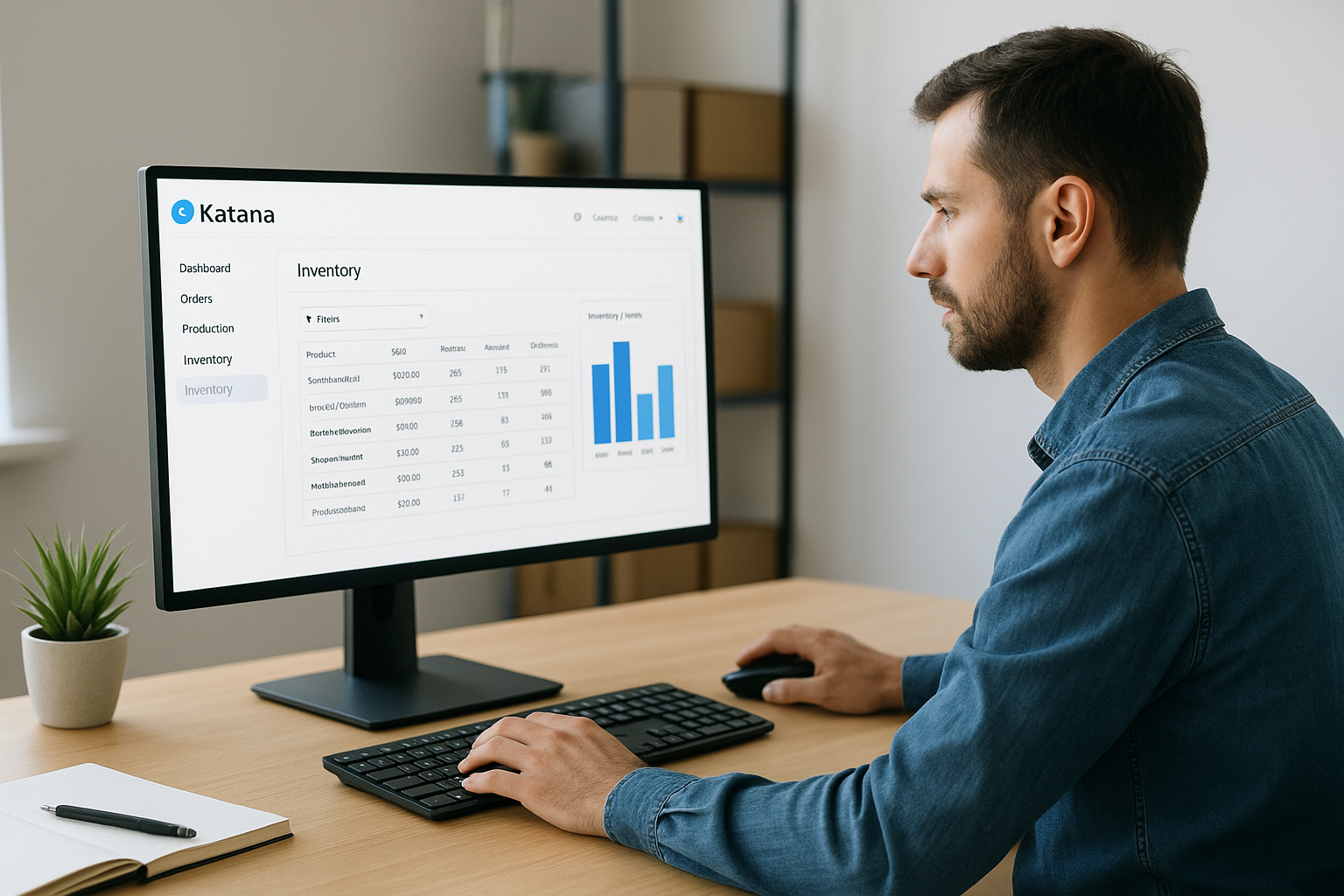
8. Katana MRP
Katana MRP is a cloud-based manufacturing resource planning tool built specifically for small manufacturers and product businesses that need real-time production and inventory control without the cost and complexity of a full ERP system. It targets direct-to-consumer and e-commerce-adjacent manufacturers who sell across multiple channels and need their inventory and production data to stay synchronized automatically.
Best for
Katana fits small manufacturers and makers running high-SKU product lines in industries like food and beverage, cosmetics, apparel, and consumer goods. Your team benefits most from this platform when production runs are frequent, order volumes vary, and you need live visibility into material availability before committing to a production schedule.
Inventory and manufacturing strengths
When comparing the best inventory management software for manufacturing at the small business tier, Katana stands out for its real-time inventory floor view, which shows you available stock, allocated materials, and production progress on a single screen. The platform handles multi-level BOM management and auto-allocates materials to open production orders as stock arrives.
Katana’s live inventory tracking updates your available-to-promise quantities the moment materials are received, which prevents overselling finished goods before production is complete.
Finance and reporting strengths
Your finance team gets basic cost tracking and production cost summaries built into the platform. Katana connects with accounting tools like QuickBooks and Xero to push production and inventory cost data into your books without manual entry.
Implementation and integration fit
Katana integrates with Shopify, WooCommerce, and major shipping platforms through native connectors, which makes it a practical fit for manufacturers selling directly online. Setup is fast and requires minimal technical support to get your team operational.
Pricing and total cost notes
Katana uses a monthly subscription model with pricing based on your plan tier. Your total cost remains predictable, though advanced features like multi-warehouse support are reserved for higher-tier plans.
9. MRPeasy
MRPeasy is a cloud-based MRP and inventory management platform designed specifically for small manufacturers that need structured production planning without the cost or configuration overhead of a full ERP system. It targets production-driven businesses with 10 to 200 employees that have outgrown spreadsheets but don’t yet need enterprise-level complexity.
Best for
MRPeasy works best for small manufacturers in industries like electronics, medical devices, food production, and consumer goods who need a dedicated MRP tool with inventory and production tracking built in. Your team gets the most value from this platform when your production environment involves defined routing steps, component tracking, and scheduled work orders that a general inventory tool cannot handle without constant manual workarounds.
Inventory and manufacturing strengths
When evaluating the best inventory management software for manufacturing at the small business tier, MRPeasy delivers BOM management, production scheduling, and real-time stock tracking in a single interface. Material allocations update automatically as production orders are released, so your stock records stay accurate without manual intervention from your operations team.
MRPeasy’s production scheduler maps your work orders to available capacity, which prevents you from committing to delivery dates your floor cannot realistically meet.
Finance and reporting strengths
Your finance team gets built-in cost tracking that ties material and labor costs to each production order. Standard reports cover inventory valuation, manufacturing cost summaries, and purchase order history, which gives your controllers clean data for monthly reporting without exporting to a separate tool.
Implementation and integration fit
MRPeasy connects with QuickBooks, Xero, and Shopify through native integrations, and your team can typically complete setup within a few weeks without outside implementation support.
Pricing and total cost notes
The platform uses a tiered monthly subscription model starting at an accessible price point for small teams, with higher tiers unlocking advanced features like customer portal access and API connections for third-party tools.
10. Zoho Inventory
Zoho Inventory is a cloud-based inventory management platform that sits within the broader Zoho ecosystem, making it a practical option for small manufacturers already using Zoho Books or Zoho CRM. It handles order management, stock tracking, and basic manufacturing workflows at a price point that keeps smaller operations competitive without overextending their software budget.
Best for
Zoho Inventory works best for small manufacturers and product businesses that operate light assembly or kitting workflows rather than complex, multi-stage production environments. Your team benefits most from this platform when your inventory needs are straightforward and you are already running other Zoho applications that connect natively without custom development.
Inventory and manufacturing strengths
When comparing the best inventory management software for manufacturing at the entry level, Zoho Inventory covers multi-warehouse tracking, BOM-based assembly orders, and serial and batch number tracking within a single interface. Your stock records update in real time as assembly orders are completed, which keeps your available quantities accurate across all sales channels.
Zoho Inventory’s composite item feature lets you bundle components into finished goods automatically, which removes manual stock adjustments after every assembly run.
Finance and reporting strengths
Your finance team gets inventory valuation reports, purchase order tracking, and cost summaries built directly into the platform. Zoho Inventory connects with Zoho Books to push inventory transactions into your accounting records automatically, which reduces the manual reconciliation work your team handles at month-end.
Implementation and integration fit
The platform connects with Shopify, Amazon, and eBay through native integrations, and setup typically requires minimal technical support. Your team can configure the core workflows without outside implementation help in most cases.
Pricing and total cost notes
Zoho Inventory uses a tiered monthly subscription model that scales with your order volume and the number of warehouses you manage. Advanced features like multi-currency support and higher-order thresholds are available on upper-tier plans.
Conclusion
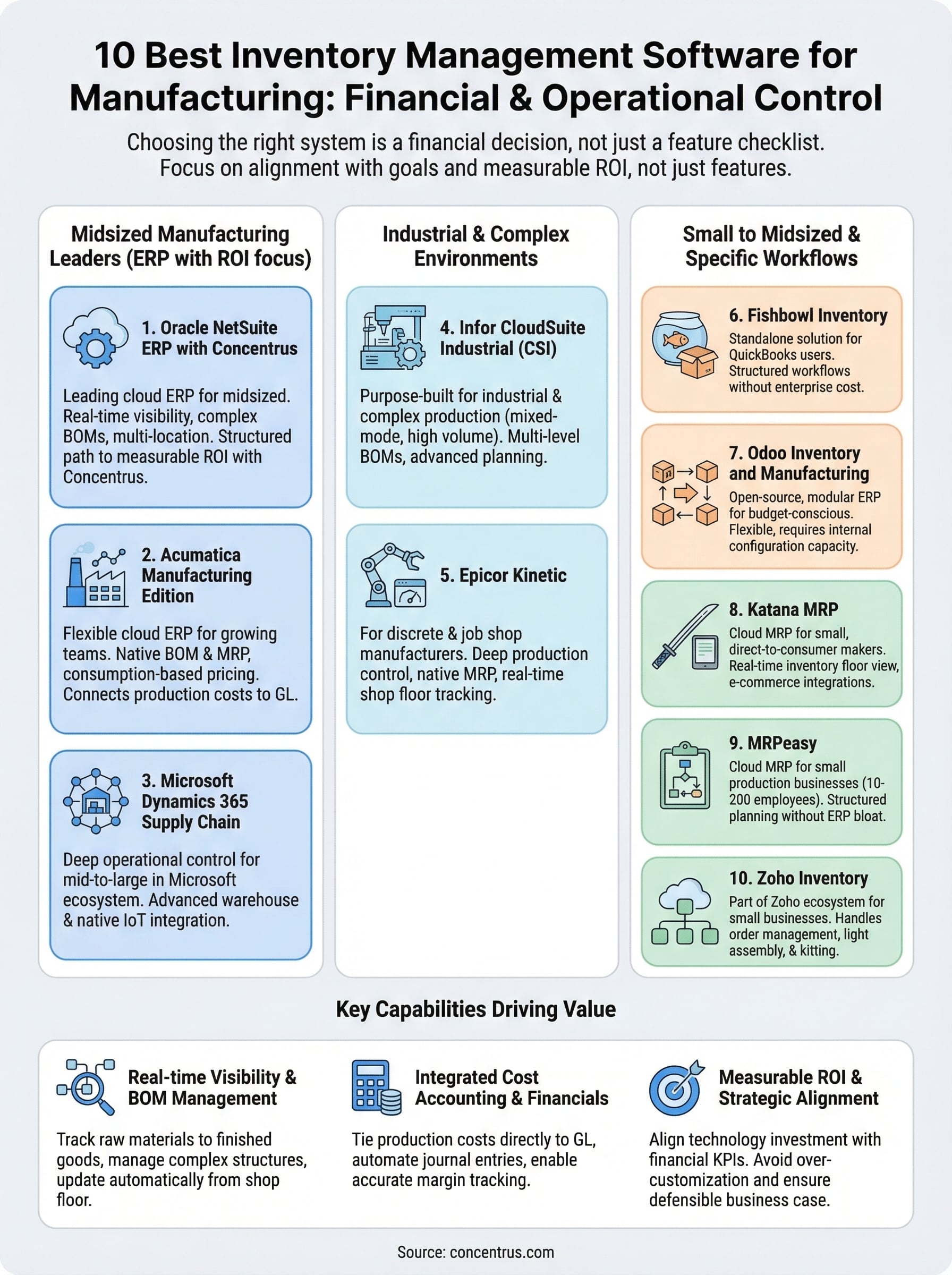
Every option on this list solves a different set of problems, and the best inventory management software for manufacturing depends entirely on the scale, complexity, and financial goals of your specific operation. Smaller teams may find that Katana or MRPeasy fits their current production workflows well. Larger, more complex manufacturers will get more traction from platforms like NetSuite, Acumatica, or Dynamics 365, where production control, cost accounting, and reporting operate inside a single connected system.
Your software decision should always connect back to measurable financial outcomes, not just feature counts. If you run a midsized manufacturing operation and want to make sure your ERP investment delivers a clear return, Concentrus can help you build that business case before you commit. The ROI Roadmap™ methodology ties every implementation decision to your actual KPIs and financial goals. Talk to an ERP and ROI expert at Concentrus to get started.