
Your team just went live on NetSuite, or maybe you’re six months in, and you’re still fielding questions like
What to know before you start NetSuite training
Before you enroll anyone in a course, understand that Oracle NetSuite training isn’t one-size-fits-all. NetSuite is a modular platform, and a controller running financial reports needs a completely different skill set than a warehouse manager processing fulfillment orders. Sending your whole team through the same generic curriculum wastes hours and leaves role-specific gaps that surface later as data entry errors or workarounds that quietly break your reporting.
Roles matter more than most companies realize when planning training. Map out who touches NetSuite and how before you pick a single course:
- Finance users (AP, AR, GL) need training on transaction workflows, period close, and financial reporting.
- Administrators need SuiteScript basics, role and permission management, and workflow configuration.
- Operations and sales teams need order-to-cash and inventory modules specific to their daily tasks.
- Executives need dashboard literacy, not deep configuration knowledge.
The biggest training mistake isn’t picking the wrong course, it’s skipping the step of defining who actually needs what.
Timing also shapes what training looks like. Companies still mid-implementation should focus training on the configuration decisions being made right now, since a wrong setup choice costs far more to fix later than any course costs upfront. Teams that are already live but struggling benefit more from targeted refreshers tied to the specific errors showing up in their data.
Oracle updates NetSuite twice a year, so whatever training your team completes has a shelf life. According to Oracle’s own release documentation, features and workflows shift with every release, which means training can’t be a one-time event. Plan for it as an ongoing budget line, not a single onboarding expense you check off and forget.
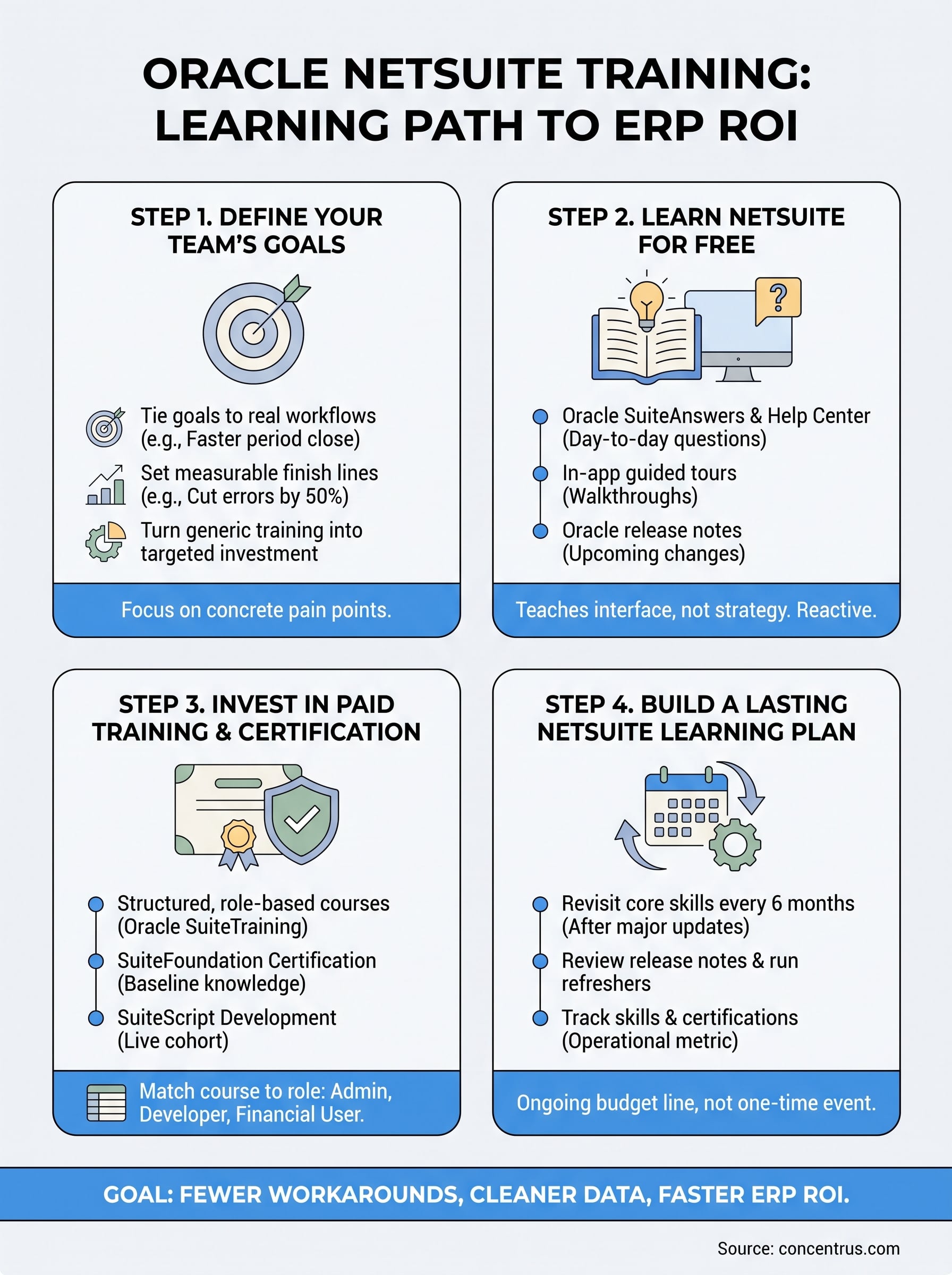
Step 1. Define your team’s NetSuite learning goals
Goals turn generic training into a targeted investment. Before you book a single course, write down what each role should be able to do inside NetSuite that they can’t do today. Specific goals beat vague ones like “get comfortable with the system.”
Tie goals to real workflows
Ask each department head to list the three tasks their team struggles with most. A controller might need faster period close, while a sales rep might need cleaner quote-to-order conversion. Concrete pain points point you straight to the right module or course.
Set a measurable finish line
Define what success looks like before training starts, not after:
- Close the books two days faster within one quarter
- Cut manual order entry errors by half
- Reduce support tickets for a specific module by a set percentage
Training without a measurable goal is just a scheduled meeting, not an investment.
Goals like these also make it easy to decide later whether free resources are enough or whether paid, certified training earns back its cost.
Step 2. Learn NetSuite for free
Oracle gives you real, no-cost starting points before you spend a dollar on outside training. Free resources work best for administrators and power users who already understand ERP logic and just need to learn NetSuite’s specific interface and terminology.

Start with Oracle’s own library
NetSuite’s SuiteAnswers knowledge base and its built-in help center cover most day-to-day questions, from setting up approval workflows to running saved searches. Pair that with the platform’s in-app guided tours, which walk new users through common transactions step by step.
Use free options strategically
Build a short list before you assign anything:
- SuiteAnswers articles for specific transaction questions
- In-app help and guided tours for new hires
- Oracle’s release notes for upcoming feature changes
- Peer knowledge from your implementation partner’s support team
Free training teaches the interface. It rarely teaches the strategy behind why your system was configured a certain way.
Free resources close knowledge gaps fast, but they lean reactive. Nobody gets certified from a help article, and nobody learns SuiteScript from a support ticket. Treat free learning as a supplement for quick fixes, not the entire plan for a growing team.
Step 3. Invest in paid NetSuite training and certification
Paid training earns its cost when roles need depth that free resources can’t provide, like SuiteScript development, complex workflow configuration, or formal certification for a resume. Oracle SuiteTraining offers structured, role-based courses covering everything from financial user basics to advanced administration, and courses run live online or self-paced depending on your team’s schedule.
Match the course to the role
Don’t buy the same bundle for everyone. A few starting points worth knowing:

| Role | Course focus | Format |
|---|---|---|
| Administrator | SuiteFoundation certification prep | Self-paced or live |
| Developer | SuiteScript and SuiteCloud development | Live cohort |
| Financial user | Financial user essentials | Self-paced |
Certification proves someone can configure NetSuite correctly, not just click through it.
Weigh the certification payoff
Oracle’s SuiteFoundation certification validates baseline platform knowledge, and it’s worth pursuing for any administrator who’ll own configuration decisions long-term. For a five-person team, certifying one or two administrators usually beats sending everyone through a general course. Budget for renewal too, since certifications tied to specific releases can lapse as the platform evolves twice a year.
Step 4. Build a lasting NetSuite learning plan
One-time training sessions fade fast once the platform changes underneath them. NetSuite training works best as a recurring habit tied to Oracle’s twice-yearly release cycle, not a box you check during onboarding. Build a simple calendar that revisits core skills every six months, right after each major update lands.
Schedule a short refresher window after every release:
- Review release notes with your administrator
- Flag any workflow or field changes affecting daily tasks
- Run a 30-minute team walkthrough of what’s different
- Log open questions for your implementation partner
Tracking skills matters just as much as scheduling them. Keep a simple spreadsheet of who’s certified, who needs a refresher, and which modules still have gaps. Skill tracking turns training from a vague good intention into something you can report on, the same way you’d track any other operational metric.
A learning plan only works if someone owns it, checks it, and updates it after every release.
New hires should slot into this same rhythm from day one, not get a separate crash course that ignores what your veteran users already learned the hard way.
Turning training into ERP ROI
Training only pays off when it moves a number you actually track, like days to close or error rates in order entry. Whether you lean on free resources, paid certification, or both, the goal stays the same: fewer workarounds, cleaner data, and a team that trusts what NetSuite tells them. Oracle NetSuite training works best when it’s tied to those outcomes from the start, not treated as a checkbox after go-live.
But training alone can’t fix a system that was configured wrong in the first place. If your team keeps hitting walls no amount of coursework explains, the problem usually sits upstream in the implementation itself. Concentrus builds ROI accountability into every NetSuite project from day one, so training reinforces a system designed to perform, not one working around its own flaws. If that sounds like your situation, talk to Concentrus about your NetSuite setup before you invest another dollar in training.