
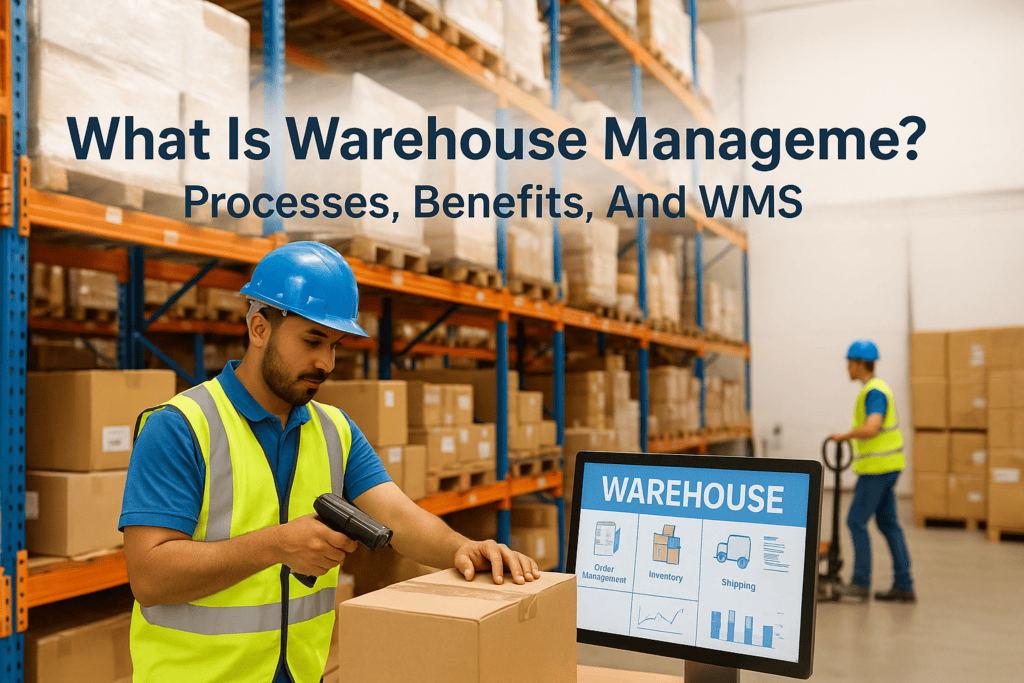
Warehouse management directly impacts cash flow, margins, and scalability. Poor processes create hidden costs through inventory errors, labor inefficiencies, and delayed fulfillment. With defined workflows, the right WMS, and ERP integration, companies gain real-time visibility, stronger inventory accuracy, faster order processing, and measurable financial returns across the business.
In this post...
Tags
If you’re a CFO or finance leader asking what is warehouse management, you’re likely looking beyond the textbook definition. You want to understand how warehouse operations directly affect your margins, cash flow, and ability to scale. The answer is simple: warehouse management touches nearly every financial metric that matters to a midsized company, from inventory carrying costs to order accuracy to customer retention.
Poor warehouse operations bleed money quietly. Misplaced inventory, slow fulfillment, inaccurate counts, and manual workarounds create compounding inefficiencies that erode profitability over time. On the other hand, well-managed warehouses become a competitive advantage, turning faster inventory, reducing labor costs, and giving leadership clear visibility into real-time stock levels and order status.
The key to getting there? A structured approach to warehouse processes, supported by the right technology. That’s where a Warehouse Management System (WMS), often integrated within an ERP platform like NetSuite or Acumatica, makes a measurable difference. At Concentrus, we help midsized companies connect their warehouse operations to broader financial goals through ERP implementations built around our ROI Roadmap™ methodology. We’ve seen firsthand how aligning warehouse management with enterprise-wide systems transforms operational performance.
This article breaks down the core processes of warehouse management, the business benefits of getting it right, and how a WMS fits into your technology strategy. Whether you’re evaluating a new system or trying to fix one that underdelivers, this guide gives you the foundation to make informed, financially sound decisions.
Why warehouse management matters to the business
When CFOs dig into what is warehouse management, they often find that the warehouse is quietly one of their largest cost centers and one of the most overlooked levers in the business. Inventory typically represents a significant portion of a midsized company’s working capital, meaning that how you manage it directly affects your cash position, carrying costs, and gross margins. If your warehouse runs on manual processes, spreadsheets, or a disconnected system, you’re likely absorbing hidden costs that only surface during audits or when a major order goes wrong.
The financial cost of poor warehouse operations
Poor warehouse management generates costs in ways that are easy to miss on a day-to-day basis. Inaccurate inventory counts lead to overstock situations that tie up cash or stockouts that cost you revenue and customer trust. Labor inefficiencies from manual picking routes, paper-based workflows, and rework from fulfillment errors add up fast, especially as order volumes grow. Organizations tracking supply chain performance consistently find that warehouse errors and returns rank among the top drivers of avoidable operational cost in distribution-focused businesses.
Fixing warehouse inefficiency is not a logistics problem, it is a financial problem that demands a financial leader’s attention.
Here are the most common financial impacts of poor warehouse management:
Excess inventory carrying costs: storage, insurance, and obsolescence charges
Order error rates: returns, reshipping, and customer credits that reduce net revenue
Labor cost overruns: overtime and rework caused by broken processes
Shrinkage and loss: undetected theft or damage from inadequate tracking
Delayed cash conversion: slow fulfillment extends the cycle between purchase and payment
How warehouse management connects to company-wide performance
Your warehouse does not operate in isolation. Every inefficiency in receiving, storage, or fulfillment creates ripple effects across finance, sales, and customer service. When inventory data is unreliable, your finance team struggles to produce accurate balance sheets and cost-of-goods-sold figures. When fulfillment is slow or error-prone, your sales team loses customers that took real budget to acquire.
Strong warehouse management gives you real-time visibility into stock levels, order status, and operational throughput. That visibility feeds directly into more accurate financial reporting, sharper demand forecasting, and confident procurement decisions. A well-run warehouse produces clean, consistent data that your entire organization can rely on, which means fewer surprises at month-end close, tighter inventory planning, and a clearer picture of where working capital is tied up and where it could be freed. For CFOs focused on scalable growth, that clarity is not a nice-to-have, it is a fundamental requirement.
The core warehouse management processes end to end
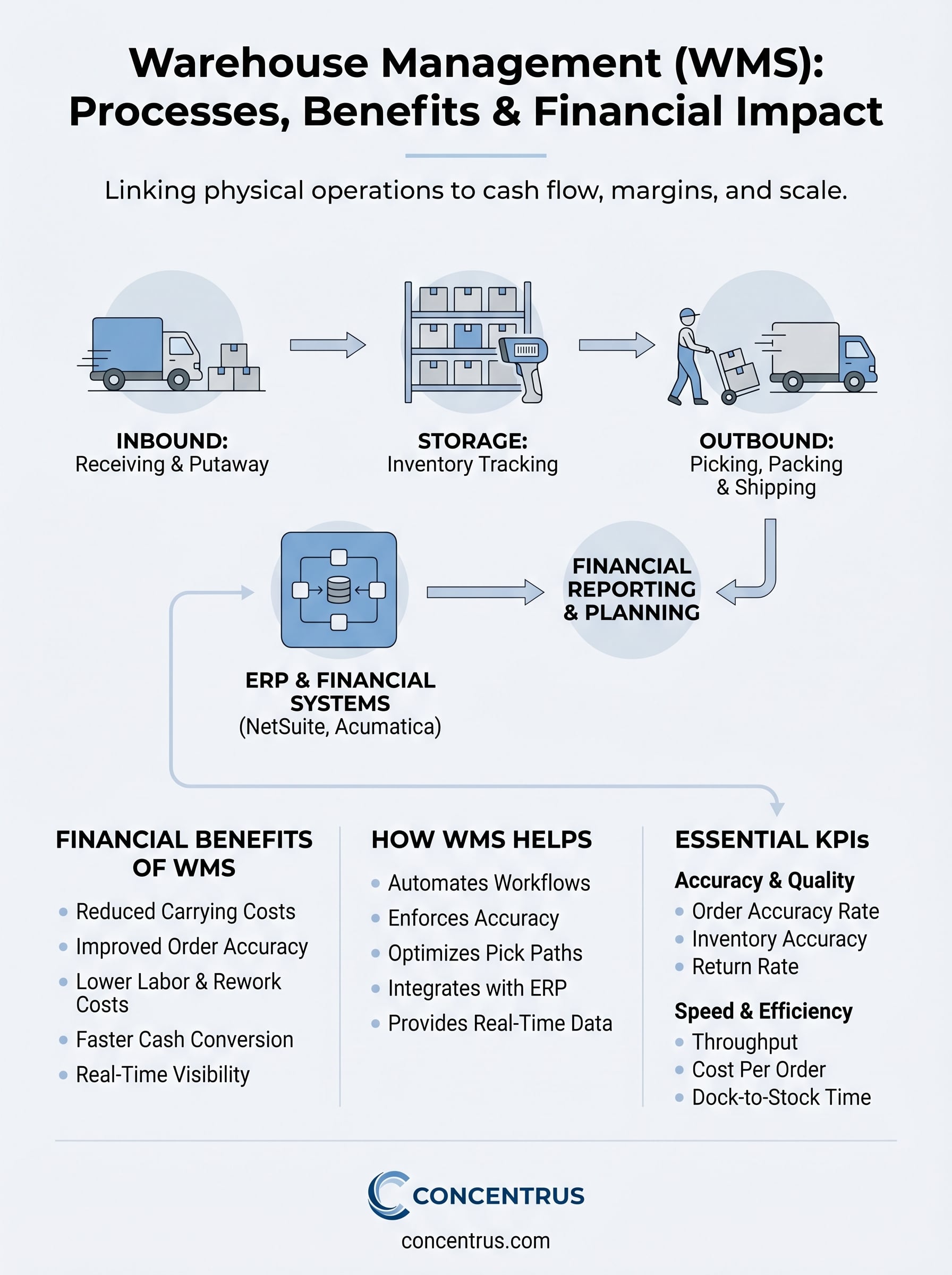
When you ask what is warehouse management, one of the most practical answers is a set of connected processes that move inventory through your facility from the moment it arrives to the moment it ships. Each step depends on the accuracy of the one before it, and a breakdown at any point creates delays, errors, and costs that ripple through your entire operation. Understanding these steps end to end gives you the visibility to identify exactly where your warehouse loses time and money.
Inbound: receiving and putaway
Inbound operations start the moment a shipment arrives at your dock. Your team verifies incoming quantities and condition against purchase orders, flags discrepancies immediately, and assigns stock to the correct storage locations. This step sets the accuracy of everything downstream. If your receiving process is slow or inconsistent, bad data enters your system from the start, and every downstream process inherits that error.

Receive and verify the shipment against the purchase order
Inspect goods for damage or quantity discrepancies
Label and assign items to designated storage locations
Update inventory records in real time
Outbound: picking, packing, and shipping
Outbound operations are where order accuracy and fulfillment speed become directly visible to your customers and your cash cycle. Once an order is confirmed, your team picks items from their assigned locations, packs them to the required specifications, and prepares shipments with the correct documentation and carrier labels.
The speed and accuracy of your outbound process directly determines your order-to-cash cycle and your customer retention rate.
Efficient picking routes and clear packing standards reduce both labor time and error rates significantly. Shipping confirmation closes the loop by updating your inventory records and triggering the next financial step, whether that is invoicing, revenue recognition, or a replenishment order. When each outbound step runs cleanly, you capture the full financial value of every sale without the drag of returns and re-shipments eating into your margins.
Warehouse management vs inventory management and logistics
When you’re trying to understand what is warehouse management, it helps to draw clear lines between three terms that often get used interchangeably: warehouse management, inventory management, and logistics. Each one describes a distinct scope of operations, and confusing them leads to gaps in accountability, misaligned technology investments, and blind spots in your financial reporting. Warehouse management focuses specifically on the physical operations inside your facility, from how goods are received and stored to how orders are picked, packed, and shipped out the door.
How inventory management differs
Inventory management zooms out from the warehouse floor and focuses on what you own, what it’s worth, and how much you need. It answers questions like how much stock to carry, when to reorder, and how inventory levels affect your balance sheet and cost of goods sold. Warehouse management answers the operational question of how that inventory moves through your facility accurately and efficiently. The two disciplines are deeply connected: poor warehouse processes produce unreliable inventory data, and unreliable inventory data undermines every financial decision tied to stock.
Inventory accuracy is the foundation that connects your warehouse operations directly to your financial statements.
Here is a quick comparison to make the distinction concrete:
Term
Primary Focus
Key Question It Answers
Warehouse management
Physical facility operations
How does inventory move through our warehouse?
Inventory management
Stock levels and valuation
What do we own, and how much should we carry?
Logistics
End-to-end supply chain movement
How do goods move from supplier to customer?
Where logistics fits in
Logistics covers a broader scope than either of the two terms above. It encompasses the entire supply chain, including transportation, supplier relationships, and last-mile delivery, not just what happens inside your four walls. Your warehouse is one node in that larger network. For CFOs deciding where to focus technology spending and process improvement, understanding these boundaries clarifies where each dollar of investment delivers the most measurable financial return.
What a warehouse management system does and how it helps
Once you understand what is warehouse management at the process level, the next question is what technology supports it. A Warehouse Management System (WMS) is software that automates, tracks, and optimizes the physical operations inside your facility. It handles everything from directing your team to the right storage location during putaway to generating the most efficient pick path for an outbound order. The result is fewer manual steps, fewer errors, and a real-time data layer that connects your warehouse floor directly to your financial systems.
Core functions a WMS handles
A WMS replaces manual, paper-based processes with system-driven workflows that enforce accuracy at each step. When a shipment arrives, the system validates quantities against the purchase order automatically. When an order ships, it updates inventory records instantly and triggers the next step in your order-to-cash cycle.

The more automated your warehouse workflows, the less your financial data depends on someone remembering to update a spreadsheet.
Here are the primary functions a WMS manages across your daily operations:
Receiving and putaway: validates inbound shipments and assigns storage locations based on rules you define
Pick path optimization: routes your team through the warehouse in the most efficient sequence to reduce travel time and labor cost
Packing and shipping: enforces packing standards, generates labels, and confirms shipments to close out orders
Inventory tracking: maintains real-time stock counts by location, lot, or serial number
Returns processing: logs returned items and routes them back into usable stock or flags them for disposal
How a WMS connects to your ERP and financial data
A WMS delivers its greatest value when it integrates directly with your ERP platform. In NetSuite or Acumatica, warehouse transactions flow automatically into your financial records, so your balance sheet reflects accurate inventory values and your cost-of-goods-sold figures stay current without manual reconciliation. That integration gives your finance team reliable data at month-end close and removes the guesswork from procurement decisions driven by stock levels.
Warehouse KPIs that show if it works and where to improve
Once you grasp what is warehouse management at both the process and technology level, the next step is measuring whether your operation actually performs. KPIs give you the objective data to distinguish a warehouse that runs well from one that quietly drains your margins. Without clear metrics, you’re making decisions based on gut feel, and gut feel doesn’t belong in a financial leader’s toolkit.
The KPIs you track in your warehouse should connect directly to the financial outcomes your organization is accountable for.
KPIs that measure accuracy and order quality
Order accuracy rate and inventory accuracy are the two metrics that matter most to your financial statements. Order accuracy measures the percentage of orders shipped without errors, which ties directly to your return rate, reship costs, and customer satisfaction. Inventory accuracy compares your system’s recorded stock levels against your physical counts. A low inventory accuracy rate means your balance sheet carries unreliable asset values and your procurement team makes reorder decisions on bad data.
Key accuracy KPIs to track regularly:
Order accuracy rate: target 99% or higher for most distribution operations
Inventory accuracy: measured through cycle counts, target above 97%
Return rate: percentage of orders that come back due to warehouse errors
Receiving accuracy: percentage of inbound shipments verified without discrepancy
KPIs that measure speed and cost efficiency
Throughput and cost per order tell you whether your warehouse operates at the efficiency level your business model requires. Throughput measures the number of orders your team processes in a given period. Cost per order calculates your total warehouse operating costs divided by total orders shipped, giving you a unit economics figure you can benchmark over time and use to justify technology investments. Dock-to-stock time tracks how quickly your team moves inbound inventory from the receiving dock into a usable storage location, which directly affects how fast new stock becomes available to fulfill demand.
Where to go from here
Understanding what is warehouse management at the process, technology, and metrics level gives you the foundation to make decisions that move the needle on your financial performance. The gap between a warehouse that drains margin and one that drives it almost always comes down to three things: defined processes, the right system to support them, and KPIs that connect daily operations to financial outcomes your leadership team can act on.
Your next step depends on where you are right now. If your warehouse runs on disconnected tools or manual workflows, the priority is getting accurate, real-time data flowing into a system your finance team can trust. If you already have a WMS but it isn’t integrated with your ERP, you’re leaving serious efficiency gains on the table. Either way, the path forward starts with aligning your warehouse operations to measurable ROI goals. Talk to an ERP and warehouse operations expert at Concentrus to find out where your biggest opportunities are.
If you're a CFO evaluating warehouse management technology, Manhattan WMS has probably landed on your shortlist. Manhattan Associates built its reputation on warehouse execution, and their platform powers some of the largest distribution operations in the world. But reputation alone doesn't answer the question that matters most: will this investment actually pay off for your business?
That's the question we help midsized companies answer every day at Concentrus. As NetSuite and Acumatica ERP implementation and rescue specialists, we've sat across the table from finance leaders who chose warehouse management tools without fully understanding how those tools fit, or don't fit, within their broader ERP ecosystem. The result is often disconnected systems, duplicated data, and ROI that never materializes. Whether Manhattan WMS is the right call or a costly detour depends entirely on your operational reality and how it aligns with your financial goals.
This guide breaks down what Manhattan WMS actually does, where it excels, where it falls short, and how to evaluate it against alternatives that may integrate more tightly with your existing ERP investment. We'll cover features, costs, competitor comparisons, and the ROI considerations that should drive your decision, so you can move forward with clarity instead of assumptions.
Why Manhattan WMS matters to CFOs in 2026
Supply chain disruption has not gone away. Tariff pressures, labor shortages, and rising customer expectations have pushed warehouse efficiency from an operational footnote to a board-level conversation. For CFOs at midsized companies, the question is no longer whether to invest in warehouse technology, it's whether a platform like Manhattan WMS justifies the cost and complexity it brings with it.
The supply chain pressure driving WMS adoption
Warehouse management systems have moved up the priority list because margins are thinner and order accuracy is now a competitive differentiator. Customers, whether they're retail buyers or B2B distributors, expect faster fulfillment with fewer errors. When your warehouse runs on spreadsheets, whiteboards, or a legacy ERP module, you absorb the cost of that gap through chargebacks, expedited shipping, and returns.
The warehouses that consistently outperform in 2026 are not the ones with the most square footage, they're the ones with the tightest connection between inventory data and financial reporting.
Manhattan Associates built their platform specifically for high-volume, high-complexity distribution. Retailers, third-party logistics providers, and large manufacturers have relied on it for decades because it handles multi-node fulfillment, labor management, and slotting optimization at a scale that most warehouse tools cannot match.
What Manhattan WMS actually costs at midsized scale
This is where many finance leaders get caught off guard. Manhattan WMS is an enterprise-tier platform, and its pricing reflects that. Implementation costs typically start in the high six figures and can climb well past seven figures depending on the complexity of your distribution network, the number of warehouse locations, and the level of customization required.
Annual licensing and support adds another significant line item to your budget. For a midsized company running two or three warehouse locations, this raises an immediate question: are you buying more platform than your operation actually needs? Manhattan is engineered for the Fortune 500 distribution center, not the 200,000-square-foot facility that ships 1,500 orders per day.
Why ERP integration is the real financial risk
Even if Manhattan WMS fits your warehouse complexity, the ROI picture shifts dramatically based on how well it connects to your ERP system. A WMS that runs as an island produces real-time inventory data that your finance team cannot act on. Purchase orders, landed costs, and demand signals stay siloed, which means your financial close takes longer and your inventory valuations stay unreliable.
For companies running NetSuite or Acumatica, this integration gap is a known cost driver. Middleware connectors and custom API builds require ongoing maintenance, and every system update on either side creates a regression risk. Before you commit to any WMS investment, your team needs to map exactly how warehouse transactions will flow into your financial statements without manual reconciliation.
How Manhattan WMS works in day-to-day operations
Manhattan WMS manages warehouse activity from the moment inventory arrives at your dock to the moment it ships out the door. The platform assigns receiving tasks, putaway locations, pick paths, and packing instructions to workers in real time based on order priority, inventory position, and labor availability. Every transaction gets logged, which gives warehouse managers a live view of what's happening on the floor without walking it.
What the system controls at the task level
Workers interact with Manhattan WMS through handheld scanners, mobile devices, or voice-directed equipment, depending on your facility setup. The system calculates the most efficient pick path for each order and adjusts dynamically when priorities change. If a high-priority shipment comes in mid-shift, the system re-sequences tasks automatically rather than waiting for a supervisor to intervene.
The real value of a well-configured WMS is not in the technology itself, it is in how quickly your team can execute without making decisions that should be handled by the system.
Labor management is one of the areas where Manhattan's platform separates itself from lighter WMS tools. It tracks engineered labor standards, measures individual worker productivity against those standards, and flags deviations before they compound into fulfillment delays or overtime costs.
How warehouse data reaches your financial team
This is the step that most implementation plans underestimate. Manhattan WMS generates transaction-level data, including inventory adjustments, cost-per-pick metrics, and shrinkage events, that your ERP system needs to produce accurate financial statements. When that data transfer runs on a scheduled batch sync, your finance team is always working with numbers that are hours behind reality, which creates problems during month-end close.
Real-time API connections between your WMS and ERP solve this, but they require deliberate planning and ongoing maintenance, not an afterthought integration bolted on after go-live.
How to tell if Manhattan WMS fits your business
Not every warehouse operation needs enterprise-grade WMS software, and buying the wrong tier of platform is just as costly as running no WMS at all. Before you commit budget to a full Manhattan WMS evaluation, run your operation through a set of honest fitness questions. The answers will tell you quickly whether you're looking at the right tool or spending evaluation time on a platform built for a scale you haven't reached yet.
Signs Manhattan WMS fits your operation
Manhattan WMS delivers its strongest ROI in high-volume, high-complexity environments where the cost of inefficiency is large enough to offset significant implementation and licensing expenses. If your warehouse ships tens of thousands of orders per day, manages multiple fulfillment nodes, or operates under strict retailer compliance requirements, the platform's labor management and slotting optimization features can generate measurable savings.
The fit question is not whether Manhattan WMS is capable, it clearly is. The question is whether your operational complexity justifies the investment relative to alternatives that integrate more cleanly with your ERP.
You also benefit most from Manhattan's feature depth if your workforce is large enough to see a return on engineered labor standards tracking. A facility with 20 pickers will not recoup that investment the same way a facility with 200 will.
Signs you need a different approach
If your company runs one or two warehouse locations and processes under 5,000 orders per day, a native WMS module inside NetSuite or a mid-market alternative will likely cover your needs at a fraction of the cost and integration risk. The implementation timeline alone for Manhattan can consume 12 to 18 months, and a midsized operation often cannot absorb that disruption without significant impact to customer service and cash flow.
Consider whether your ERP partner can extend your current platform before adding a standalone WMS to your technology stack.
How to plan ERP and automation integrations
Your ERP is the financial backbone of your operation, and any WMS you add sits downstream from it. Before you get deep into a Manhattan WMS evaluation, you need a clear picture of how warehouse transactions will flow into your general ledger, inventory valuation, and purchasing workflows. Integration planning is not a technical checkbox, it is a financial risk management exercise that directly determines whether your WMS investment produces the ROI you are targeting.
Map your data flows before you select a vendor
Inventory adjustments, receiving confirmations, and shipment confirmations all need to reach your ERP in a timeframe that supports accurate financial reporting. Start by documenting every transaction type your warehouse generates and identifying which ones trigger a financial event in your system of record. This exercise gives your ERP partner and your WMS vendor a shared integration map to work from before contracts are signed.
The integration architecture you build between your WMS and ERP will either compress your financial close or extend it, so design this correctly before you commit budget.
Skipping this step is the most common reason ERP and WMS projects miss their ROI targets. When data gaps appear after go-live, the cost to repair them escalates quickly because both systems are already in production and your team is already dependent on the outputs those systems generate.
Understand automation dependencies in your fulfillment stack
Modern warehouse operations rely on conveyor controls, dimensioners, and robotic picking systems that generate their own data streams. Each of those systems needs to connect to your WMS, and your WMS needs to pass that data upstream to your ERP without delays that distort your inventory position or force manual reconciliation at month-end.
If you run NetSuite or Acumatica, native connectors or certified middleware partners will reduce your integration maintenance burden compared to custom API builds that break during platform updates. Ask every vendor you evaluate to walk you through their specific integration architecture with your ERP before advancing them past the shortlist stage.
How to build an ROI case and avoid cost traps
Building an ROI case for any WMS starts with total cost of ownership, not just the licensing number a vendor puts in front of you. Manhattan WMS carries significant implementation, integration, and ongoing support costs that midsized finance leaders frequently underestimate when they first model the investment. Before you approve a budget, you need to account for every dollar the project will consume across its full lifecycle, including the productivity loss your team absorbs during a 12 to 18 month go-live cycle.
Calculate the true total cost of ownership
Software licensing and implementation fees are only the starting point for your cost model. Add middleware maintenance, training time, custom development for ERP integration, and the internal labor your finance and operations teams will dedicate to the project. For midsized companies evaluating Manhattan WMS, that full number often looks very different from the initial vendor quote.
If your cost model only includes what the vendor charges, you are missing half the picture before the project even starts.
Your cost model should also include a risk buffer for scope creep and integration rework, which are the two most common drivers of budget overruns in WMS projects. Build a realistic range, not a single number, and stress-test it against a scenario where go-live is delayed by six months.
Tie WMS metrics to financial outcomes
Every operational metric your WMS tracks needs a direct line to a financial KPI your CFO dashboard already measures. Pick-accuracy rates matter because they reduce chargebacks and returns. Labor productivity metrics matter because they compress overtime costs and improve margin. If you cannot draw that line clearly, the metric is noise.
Build your ROI model around three to five financial outcomes you can measure before and after implementation, such as inventory carrying costs, order fulfillment cycle time, and cost per shipment. That framework gives your board a credible payback timeline and gives your team a performance target to work toward from day one.
Next steps for a confident decision
Evaluating Manhattan WMS against your actual operational complexity and ERP environment is the work that separates a sound investment from an expensive mistake. You now have a framework to assess fit, model total cost of ownership, and tie warehouse metrics directly to financial outcomes your board cares about. Use that framework before you sign anything.
Your next move is to pressure-test your current ERP setup against the integration requirements any WMS will demand. If you run NetSuite or Acumatica and you're not certain your system is configured to support that kind of data flow, that gap needs to close first. A poorly integrated WMS will cost you more than no WMS at all, and the time to find that out is before go-live, not after.
Talk to a Concentrus ERP specialist to map your warehouse integration needs against your financial goals before you commit budget.
Inventory management is a financial lever, not an operational detail. For midsized companies, inventory often ties up 30–50% of total assets. Without real-time visibility, cash flow, margins, and forecasting suffer. This guide shows how modern ERP-driven inventory management turns stock into predictable ROI.
Inventory is one of the largest working capital investments on a midsized company’s balance sheet—and one of the easiest places for margin to quietly erode. NetSuite inventory management gives finance leaders real-time visibility into stock levels, costs, and fulfillment across the entire supply chain. This guide explains how NetSuite actually works end to end, how it impacts cash flow and margins, and what CFOs need to know to turn inventory from a cash drain into a strategic advantage.
We Are Experts at Generating ROI for our Clients Through Custom Integration of NetSuite and Acumatica ERP Software