


Your ERP system generates valuable data every second. How that data moves between systems, whether through real-time vs batch integration, directly impacts your financial visibility and operational speed. For CFOs managing midsized companies, choosing the wrong integration approach can mean delayed reporting, missed opportunities, and eroded ROI.
Both methods have legitimate use cases, and the right choice depends on your specific workflows, data volumes, and business priorities. Real-time integration delivers immediate data synchronization, while batch integration processes data in scheduled intervals. Understanding when to use each, and when to combine them, can significantly affect your ERP’s performance and the returns you see from your investment.
At Concentrus, we help finance leaders align their ERP architecture with measurable outcomes. This guide breaks down the key differences between real-time and batch integration, examines the pros and cons of each approach, and provides practical guidance for making decisions that support your ROI goals.
Why integration timing matters for ERP ROI
Your ERP system sits at the center of critical business processes, from order management and inventory tracking to financial close and reporting. Integration timing determines how quickly data moves between your ERP and other systems, which directly affects your ability to make informed decisions and respond to changing conditions. When you delay data synchronization by even a few hours, you create gaps in visibility that can lead to inaccurate forecasts, missed revenue opportunities, and operational bottlenecks.

The financial visibility factor
Data latency costs you money. If your sales orders sync to NetSuite or Acumatica only once per day, your finance team works with outdated information for most of their shift. This lag affects cash flow projections, inventory valuation, and revenue recognition accuracy. You might approve purchases based on yesterday’s demand or miss opportunities to optimize working capital because your accounts receivable data hasn’t updated yet.
Real-time integration eliminates these blind spots by keeping your financial data current throughout the day. Your team sees up-to-the-minute order volumes, payment statuses, and inventory levels, which translates to better planning and faster response times. The choice between real-time vs batch integration becomes a question of how much visibility you’re willing to sacrifice for simplicity or cost savings.
Poor integration timing turns your ERP into a rearview mirror instead of a windshield.
Operational efficiency and system performance
Integration timing affects more than just reporting. It influences how your teams work and how your systems perform under load. Batch processing consolidates data transfers into scheduled windows, which can reduce system strain and lower infrastructure costs. However, this approach forces your operations team to wait for the next sync cycle before they can act on new information.
Your warehouse might process orders based on stale inventory counts, leading to overselling or unnecessary expediting costs. Customer service representatives might quote shipping dates without knowing that a batch job hasn’t updated fulfillment status yet. These delays compound across multiple touchpoints, eroding the efficiency gains you expected from your ERP investment and frustrating teams who need immediate access to accurate data.
How real-time integration works in ERP environments
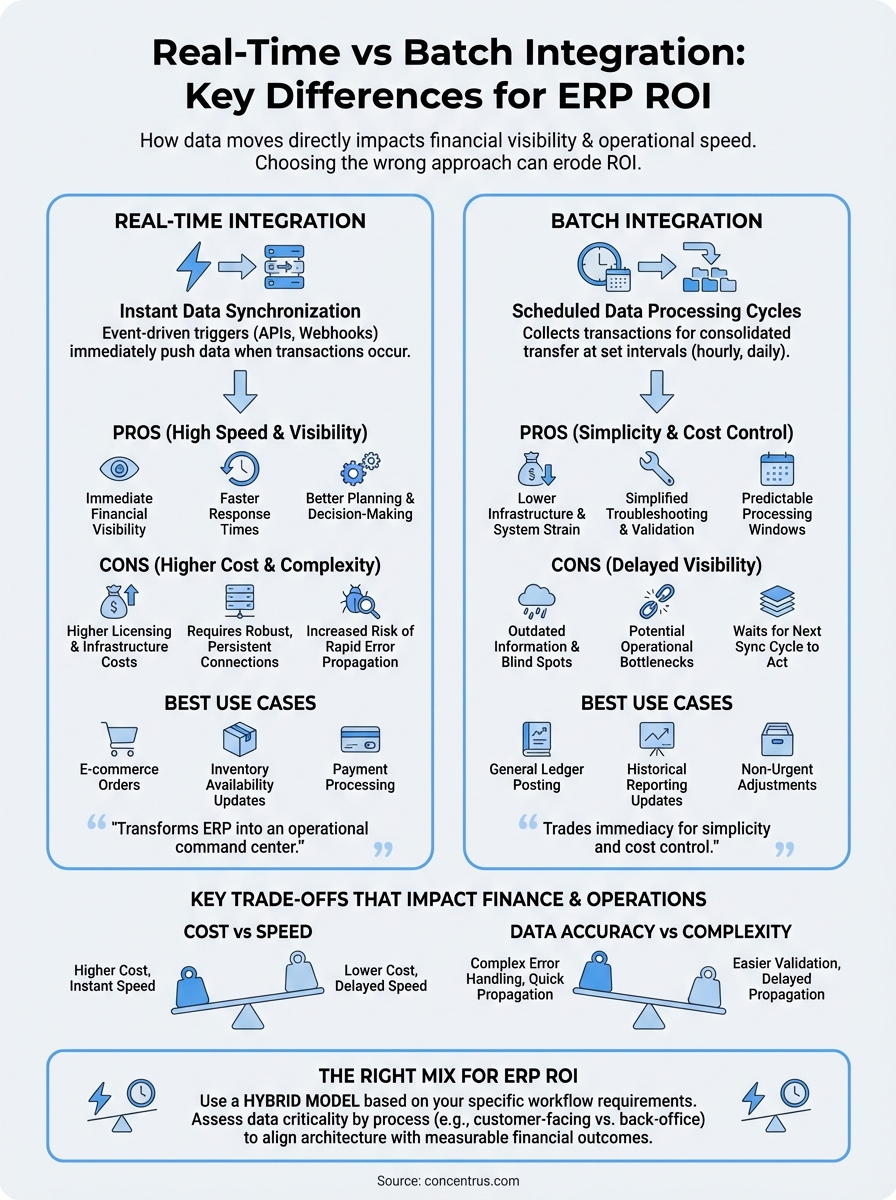
Real-time integration creates instant data synchronization between your ERP and connected systems through event-driven triggers. When a transaction occurs in one system, it immediately pushes that information to your NetSuite or Acumatica environment without waiting for a scheduled window. This approach relies on APIs, webhooks, and message queues that monitor for specific events and automatically initiate data transfers the moment those events happen.
Event-driven data synchronization
Your integration layer monitors specific triggers like new orders, payment confirmations, inventory adjustments, or customer updates. When these events occur in your e-commerce platform, CRM, or warehouse management system, they send an immediate signal to your ERP to create or update corresponding records. This continuous exchange keeps your financial and operational data current within seconds rather than hours.
The technical infrastructure for real-time integration typically involves API connections that maintain persistent communication between systems. Your ERP acts as either the data source or recipient, processing incoming transactions as they arrive. This constant connectivity requires stable network infrastructure and sufficient system resources to handle multiple simultaneous updates without performance degradation.
When real-time integration delivers maximum value
You gain the most from real-time integration when decision timing directly impacts revenue or customer experience. E-commerce order processing, inventory availability updates, and payment processing all benefit from immediate synchronization. Your customer service team can view current order status, your warehouse team works with accurate stock counts, and your finance team sees revenue as it happens rather than after the fact.
Real-time integration transforms your ERP from a record-keeping system into an operational command center.
How batch integration works and where it fits
Batch integration processes data transfers in scheduled intervals rather than continuously. Your systems collect transactions throughout a defined period, then send them to your NetSuite or Acumatica ERP in a single consolidated transfer. This approach creates predictable processing windows where data moves between systems at set times like hourly, daily, or weekly, depending on your operational needs and system architecture.
Scheduled data processing cycles
Your batch integration runs according to a predetermined schedule that you control. A typical setup might transfer sales data at midnight, update inventory levels every four hours, or sync financial transactions at the end of each business day. The system queues transactions as they occur, then executes the transfer when the scheduled time arrives, processing hundreds or thousands of records in one operation.
This consolidation approach uses fewer system resources than continuous real-time connections. Your ERP and connected systems don’t maintain persistent connections or process individual transactions one at a time. Instead, they handle bulk data transfers during specific windows, which can reduce infrastructure costs and minimize the impact on system performance during peak business hours.
Where batch integration makes operational sense
You get the most value from batch integration when immediate data synchronization isn’t critical to your operations. General ledger posting, historical reporting updates, and non-urgent inventory adjustments often work perfectly well with scheduled transfers. Your accounting close process might benefit from a single daily batch that consolidates all transactions rather than processing them individually throughout the day.
Organizations with high transaction volumes and limited budget for integration infrastructure often choose batch processing as their starting point. When evaluating real-time vs batch integration, consider whether your team needs second-by-second accuracy or if end-of-day synchronization supports your decision-making requirements without compromising operational efficiency.
Batch integration trades immediacy for simplicity and cost control.
Key trade-offs that impact finance and operations
Your choice between real-time vs batch integration involves balancing several competing priorities that directly affect your ERP’s financial performance. Each approach creates different demands on your infrastructure, team resources, and system complexity. Understanding these trade-offs helps you allocate your technology budget effectively and avoid costly mistakes that undermine your ROI goals.

Cost versus speed considerations
Real-time integration requires more robust infrastructure and ongoing maintenance than batch processing. You need to maintain persistent API connections, handle immediate error resolution, and ensure your systems can process transactions continuously without performance degradation. These requirements translate to higher licensing costs, increased bandwidth usage, and more specialized technical support.
Batch integration minimizes these expenses by consolidating data transfers into predictable windows. Your systems process larger volumes in fewer operations, which reduces API call costs and simplifies troubleshooting. However, this cost savings comes with delayed visibility that can affect your ability to respond to urgent financial or operational situations.
Lower integration costs mean nothing if data delays cost you revenue opportunities.
Data accuracy versus system complexity
Real-time synchronization creates more opportunities for errors to propagate quickly across your connected systems. A misconfigured integration or data validation issue can affect multiple transactions before your team notices the problem. You need stronger monitoring, error handling, and rollback capabilities to maintain data integrity.
Batch processing provides natural checkpoints where you can validate data quality before committing changes to your ERP. Your team can review exception reports and resolve issues before the next scheduled transfer, reducing the risk of widespread data corruption.
How to choose the right mix for NetSuite or Acumatica
Your integration strategy should match your specific workflow requirements rather than defaulting to one approach across all connections. Most successful ERP implementations use a hybrid model that applies real-time integration where immediacy matters and batch processing where scheduled synchronization provides sufficient visibility. The decision framework starts with your operational priorities and financial reporting needs.
Assess data criticality by process
Start by categorizing your integrations based on how timing affects business outcomes. Customer-facing transactions like order processing, payment confirmations, and inventory availability checks typically require real-time synchronization because delays directly impact revenue and customer satisfaction. Your back-office processes like general ledger posting, vendor invoice matching, and historical data archiving can usually run on scheduled batch transfers without compromising operational efficiency.
Map each integration to a specific financial or operational metric that your CFO tracks. When you can directly link data latency to lost revenue, increased costs, or reduced customer retention, you have a clear case for real-time integration.
Build flexibility into your architecture
Your NetSuite or Acumatica implementation should support multiple integration methods simultaneously rather than forcing a single approach. This flexibility allows you to optimize each connection based on its actual requirements and adjust as your business scales. You might start with batch integration for certain processes, then switch to real-time as transaction volumes grow or customer expectations change.
The right mix of real-time vs batch integration evolves with your business needs.
Next steps
Your integration strategy directly affects your ERP’s financial performance and operational efficiency. The choice between real-time vs batch integration isn’t about picking one method over the other. It’s about mapping each connection to your actual business requirements and building an architecture that supports measurable ROI outcomes.
Start by auditing your current integrations and identifying which processes demand immediate synchronization versus scheduled transfers. Document how data timing affects your cash flow, inventory accuracy, and decision-making speed. This analysis reveals where you’re overspending on unnecessary real-time connections or losing money due to batch delays.
Your NetSuite or Acumatica implementation should align with your financial goals from day one. At Concentrus, we help CFOs design integration architectures that deliver guaranteed ROI by connecting every technical decision to specific financial outcomes. When you’re ready to optimize your ERP integration strategy, we can show you exactly where real-time and batch processing fit within your unique operational framework.