


The NetSuite SuiteFoundation certification validates your understanding of NetSuite’s core functionality, navigation, and administrative features. Whether you’re an ERP administrator, a finance professional looking to deepen your platform knowledge, or part of a team preparing for a NetSuite implementation, passing this exam demonstrates foundational competency that employers and clients value.
Finding the right NetSuite SuiteFoundation training resources can feel overwhelming. Between official Oracle courses, third-party study guides, and practice exams, it’s hard to know where to focus your time and energy. The good news: with a structured approach and the right materials, you can pass this certification on your first attempt.
At Concentrus, we’ve guided hundreds of midsized companies through NetSuite implementations, and we’ve seen firsthand how certified team members accelerate project success and ROI. This guide breaks down exactly what to expect on the exam, which training options deliver results, and how to build a study plan that works.
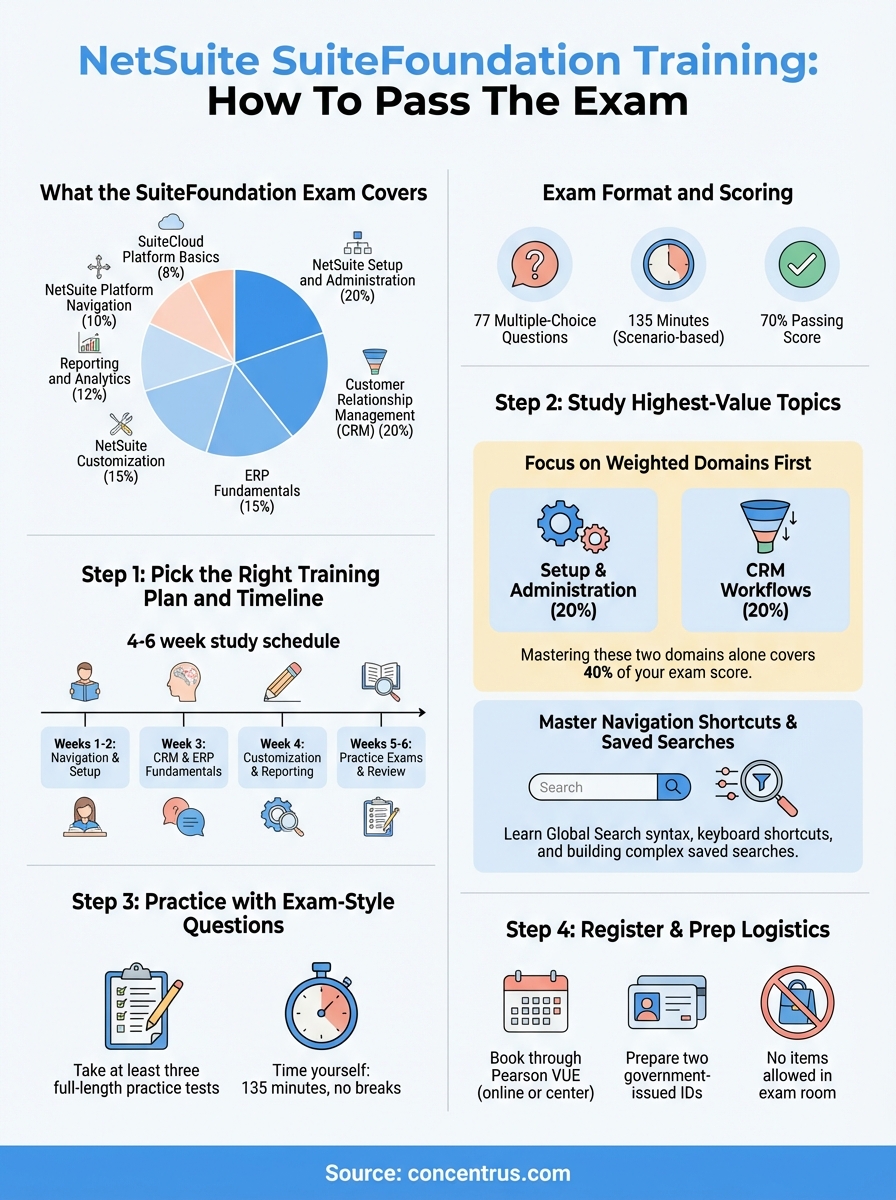
What the SuiteFoundation exam covers
The SuiteFoundation exam tests your ability to navigate NetSuite’s interface, understand core business processes, and apply foundational platform knowledge in real-world scenarios. Oracle structures the exam around seven functional domains that mirror how finance and operations teams actually use the system day to day.
Core functional areas tested
Your NetSuite SuiteFoundation training should prioritize these weighted exam domains:
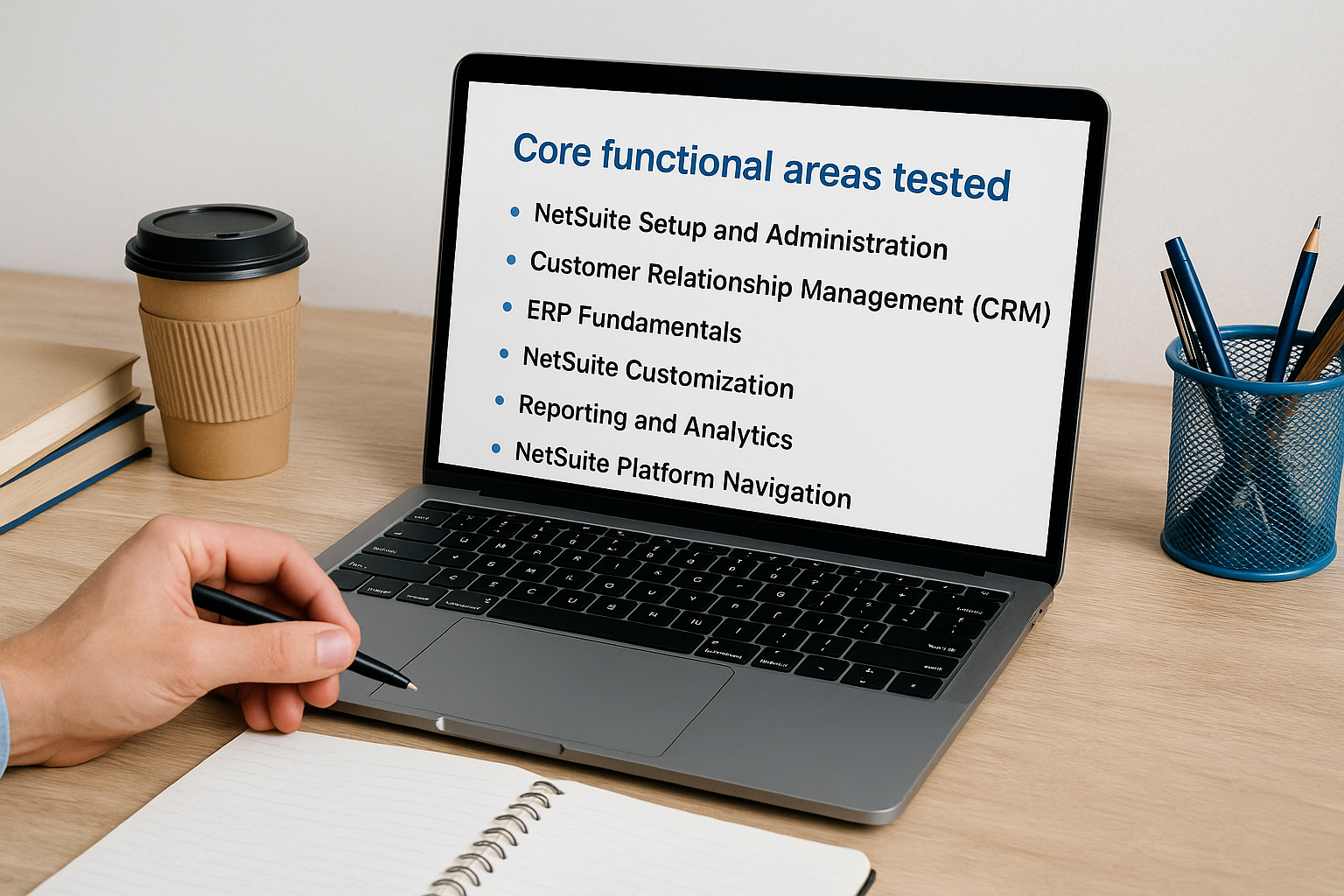
- NetSuite Setup and Administration (20%): Company settings, user roles, permissions, and account configuration
- Customer Relationship Management (CRM) (20%): Lead management, opportunity tracking, customer records, and sales processes
- ERP Fundamentals (15%): Accounting basics, financial reporting, inventory management, and order fulfillment workflows
- NetSuite Customization (15%): Custom fields, forms, saved searches, and basic SuiteScript concepts
- Reporting and Analytics (12%): Standard reports, dashboards, KPIs, and data visualization tools
- NetSuite Platform Navigation (10%): Global search, shortcuts, role-based interfaces, and system preferences
- SuiteCloud Platform Basics (8%): SuiteBuilder, SuiteFlow, and integration fundamentals
Understanding these domain weights helps you allocate study time where it matters most, focusing on setup, CRM, and ERP foundations before diving into advanced customization topics.
Exam format and scoring
You face 77 multiple-choice questions in 135 minutes, and Oracle requires a 70% passing score to earn certification. The exam uses scenario-based questions that present a business problem and ask you to identify the correct NetSuite solution or workflow. Expect questions that test both conceptual knowledge (what features exist) and applied understanding (when and how to use them). Oracle delivers the exam through Pearson VUE testing centers or online proctoring, giving you flexibility in scheduling. You receive immediate pass/fail results after completing the exam, with detailed performance feedback by domain to guide future learning.
Step 1. Pick the right training plan and timeline
Your NetSuite SuiteFoundation training approach depends on your learning style, NetSuite experience level, and exam deadline. Most candidates need 4-6 weeks of structured study to pass comfortably, but your timeline may shift based on whether you work in NetSuite daily or you’re starting from scratch.
Choose between self-study and instructor-led options
Self-study works best if you already use NetSuite regularly and need to fill knowledge gaps in specific domains. Oracle’s official SuiteAnswers documentation and the SuiteFoundation Study Guide provide comprehensive coverage, and you control your pace entirely. Instructor-led courses (offered through Oracle University) cost more but deliver structured curriculum, hands-on labs, and direct access to certified trainers who clarify complex topics like saved searches and workflow automation.
Combining both approaches gives you maximum flexibility: use instructor-led training for foundation concepts, then reinforce with self-paced practice in a NetSuite sandbox account.
Build your 4-6 week study schedule
Allocate 5-8 hours per week across these phases: Week 1-2 focus on navigation and setup (domains 1 and 6), Week 3 covers CRM and ERP fundamentals (domains 2 and 3), Week 4 tackles customization and reporting (domains 4 and 5), and Week 5-6 dedicate to practice exams and weak-area review. Block consistent study time on your calendar rather than cramming, as spaced repetition improves retention significantly for scenario-based questions.
Step 2. Study the highest-value NetSuite topics
Not all exam content carries equal weight. Your NetSuite SuiteFoundation training should prioritize high-scoring domains and the practical skills that appear repeatedly in scenario questions. Focus on mastering navigation, saved searches, and role-based permissions before diving into niche customization features that account for fewer exam points.
Focus on weighted exam domains first
Start with Setup and Administration (20% of exam) by memorizing user role hierarchies, permission management, and company preference locations. Practice creating custom roles, assigning permissions, and understanding how role restrictions affect record access. Next tackle CRM workflows (20%) by building sample customer records, opportunity pipelines, and case management flows in a sandbox account. Understanding how leads convert to customers and how sales orders connect to fulfillment processes answers multiple exam scenarios.
Mastering these two domains alone covers 40% of your exam score, making them your highest-ROI study investment.
Master navigation shortcuts and saved searches
Learn Global Search syntax and keyboard shortcuts that let you jump between records, lists, and reports without clicking through menus. Practice building saved searches with multiple criteria, calculated fields, and custom result columns since these appear in nearly every exam domain. Create searches that filter transactions by date range, customer type, and item category to understand how NetSuite query logic works. The exam tests your ability to identify which saved search configuration solves a specific business reporting need.
Step 3. Practice with exam-style questions and navigation
Practice exams reveal knowledge gaps and prepare you for Oracle’s scenario-based question format better than passive reading alone. Your NetSuite SuiteFoundation training should include at least three full-length practice tests taken under realistic conditions, each followed by detailed review of every missed question to understand why the correct answer works.
Use practice exams to identify weak areas
Take your first practice exam after completing domain study to establish a baseline score and identify which topics need additional review. Oracle University offers official practice questions that mirror actual exam scenarios, focusing on real-world business problems rather than memorization. Track your performance by domain to see if you’re consistently missing CRM questions, customization scenarios, or reporting challenges.
Scoring below 70% on a practice exam means you need at least two more weeks of focused study on your weakest domains before scheduling the real test.
Time yourself under exam conditions
Set a 135-minute timer and complete all practice questions without breaks, notes, or NetSuite access to simulate actual testing pressure. The exam gives you roughly 1.75 minutes per question, so practice moving quickly through familiar topics to bank extra time for complex scenarios. Flag difficult questions for later review rather than getting stuck, as most candidates struggle with time management on their first attempt. Review your flagged questions after completing the practice test to understand which question patterns consistently slow you down.

Step 4. Register, prep logistics, and avoid exam-day traps
Your NetSuite SuiteFoundation training pays off only if you execute flawlessly on exam day. Poor logistics planning like missing ID requirements, technical problems with online proctoring, or arriving late to a testing center can derail months of preparation. Oracle administers the exam through Pearson VUE, which enforces strict protocols that catch unprepared candidates off guard.
Book through Pearson VUE and verify requirements
Create your Pearson VUE account at least two weeks before your target exam date to secure your preferred time slot and testing format. The registration process requires your legal name exactly as it appears on government-issued ID, so double-check spelling before submitting payment ($150 exam fee). Choose between in-person testing centers or online proctoring based on your home workspace setup, knowing that online exams require a webcam, stable internet, and a private room free from interruptions.
Online proctoring fails more often than candidates expect due to background noise, poor lighting, or prohibited items visible in your testing space.
Prepare your exam-day checklist
Gather two forms of government-issued identification (one must include a photo) and arrive at your testing center 30 minutes early to complete check-in procedures. Testing centers prohibit phones, smartwatches, bags, and reference materials inside the exam room, so leave everything except your ID at home or in a locker.
Next steps
Passing your NetSuite SuiteFoundation certification requires structured preparation and consistent practice across all seven exam domains. Follow the four-step approach in this guide: select your training timeline, master high-value topics like setup and saved searches, complete multiple practice exams under realistic conditions, and handle exam-day logistics without surprises. Most candidates who allocate 5-8 hours weekly for 4-6 weeks pass on their first attempt.
Your SuiteFoundation certification proves foundational NetSuite knowledge, but real ROI comes from applying these skills within a well-planned ERP implementation. At Concentrus, we help midsized companies maximize their NetSuite investment through our proprietary ROI Roadmap™ methodology, ensuring every implementation delivers measurable financial outcomes. If your organization needs expert guidance beyond netsuite suitefoundation training to guarantee ERP success, explore how Concentrus aligns NetSuite implementations with your financial goals.