

Budgeting for inventory management software pricing requires more than a quick Google search and a vendor quote. For CFOs and finance leaders at midsized companies, the real challenge lies in understanding what drives costs, and whether those costs will actually translate into operational improvements worth the investment. Module fees, user licenses, implementation services, and ongoing support all factor into total cost of ownership, and the variance between providers can be substantial.
At Concentrus, we’ve guided hundreds of midsized companies through ERP decisions involving NetSuite and Acumatica, both of which include robust inventory management capabilities. What we’ve learned is that pricing transparency remains elusive in this market. Vendors structure their models differently, making apples-to-apples comparisons difficult without a clear framework. That’s precisely why finance leaders need concrete numbers and context before committing to a platform.
This guide breaks down the current market rates for inventory management software in 2026, including tiered pricing structures, per-user costs, and implementation expenses you should anticipate. We’ll compare specific providers, highlight hidden costs that catch buyers off guard, and give you the benchmarks needed to evaluate whether a quoted price reflects fair value. By the end, you’ll have the clarity to budget accurately and select software that delivers measurable ROI, not just promises.
What inventory management software pricing includes
Understanding inventory management software pricing means breaking down every component that contributes to your total cost. Vendors package their offerings differently, and what appears as a single line item often conceals multiple cost drivers that affect your budget over time. Core licensing fees, feature modules, user counts, and support tiers all play a role in determining what you’ll actually pay month after month. For finance leaders evaluating options, clarity on these components prevents budget surprises and helps you compare providers on equal footing.

Most inventory systems charge based on a combination of fixed platform fees and variable usage metrics like active users, transaction volumes, or storage capacity. A base subscription might cover fundamental inventory tracking, but advanced features such as multi-location management, demand forecasting, or serialized lot tracking often come as separate modules. You need to identify which capabilities your operations require today and which you’ll need as you scale, because pricing structures change dramatically when you add functionality mid-contract.
Core subscription and licensing fees
Your base subscription covers platform access and foundational inventory features, which typically include item management, stock level tracking, basic reporting, and mobile access for warehouse teams. Vendors price this tier differently: some charge a flat monthly fee per company, while others use a per-user model that scales with your team size. Entry-level plans for small businesses often start around $50 to $200 per month, but midsized companies with 10+ users and multi-location needs should expect base costs between $500 and $3,000 monthly depending on the provider.
User licensing adds another layer. You’ll encounter named user licenses, which assign access to specific individuals, and concurrent user licenses, which allow a set number of simultaneous logins regardless of total team size. Named licenses cost less per seat but require accurate forecasting of who needs system access. Concurrent licenses provide flexibility for shift-based operations but typically carry higher per-license fees. Cloud-based systems generally include hosting and infrastructure in the base price, while on-premise solutions may require separate server licensing and IT maintenance costs.
Vendors structure base pricing around user counts and feature access, so you need to map your current team size and growth projections before requesting quotes.
Feature modules and inventory capabilities
Standard subscriptions rarely include every capability you’ll need. Advanced inventory functions like demand planning, automated reordering, warehouse management system (WMS) integration, and barcode scanning often require add-on modules that increase your monthly costs. For example, a provider might charge an additional $100 to $500 per month for serial number tracking or $200 to $800 monthly for multi-warehouse management. These modular costs compound quickly when you need several advanced features.
You should also consider transaction limits and data storage caps embedded in pricing tiers. Some vendors impose monthly limits on orders processed, inventory adjustments, or SKUs managed. Exceeding these thresholds triggers overage fees or forces you into a higher-priced plan. Unlimited transaction models provide budget predictability but cost more upfront. Review your average monthly order volume, SKU count, and inventory movement patterns to determine which structure aligns with your operational reality.
Support, maintenance, and upgrades
Support costs often hide in the fine print. Basic email support typically comes included, but phone support, dedicated account management, and priority response times usually require premium support packages. These packages range from $100 to $1,000+ monthly depending on service level agreements and vendor size. For mission-critical operations where downtime directly impacts revenue, premium support becomes non-negotiable, making it a true cost of ownership rather than an optional expense.
Maintenance fees cover security patches, bug fixes, and platform updates, which cloud vendors generally include in your subscription. On-premise systems may charge annual maintenance at 15% to 25% of license costs. Major version upgrades sometimes incur separate fees, particularly for legacy on-premise platforms. Cloud systems eliminate upgrade costs by pushing updates automatically, but you sacrifice control over timing and potential compatibility disruptions with integrated systems.
Average costs in 2026 and market benchmarks
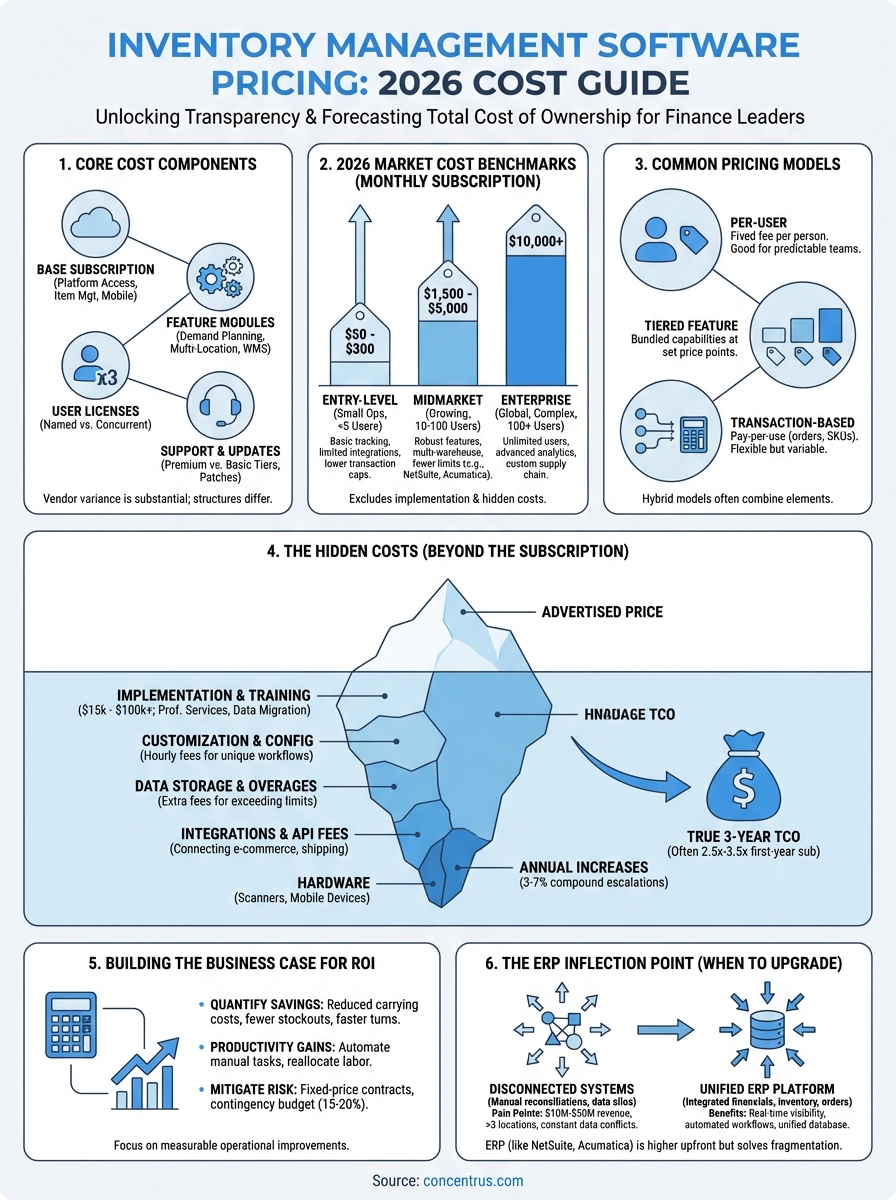
Actual inventory management software pricing in 2026 varies dramatically based on company size, feature requirements, and deployment model. CFOs evaluating quotes need concrete benchmarks to determine whether a vendor’s proposal reflects market standards or inflated estimates. Entry-level systems for businesses with basic inventory needs start around $50 to $300 monthly, while midsized companies with multi-location operations and advanced tracking requirements typically invest $1,500 to $5,000 per month. Enterprise platforms with comprehensive supply chain capabilities can exceed $10,000 monthly before implementation costs.
These ranges account for subscription fees only and exclude implementation, training, and integration expenses that often double your first-year investment. Understanding where your company fits within these tiers helps you set realistic budget expectations and identify vendors pricing outside reasonable bounds. Market data shows that per-user costs generally decrease as you add licenses, making scalability more affordable for growing teams.
Entry-level systems for small operations
Small businesses managing single-location inventory with fewer than five users can access cloud-based systems priced between $50 and $300 per month. These platforms provide basic stock tracking, purchase order management, and simple reporting suitable for startups or companies with straightforward inventory needs. Zoho Inventory and similar providers offer starter plans around $59 monthly for one user and 500 orders, while Fishbowl positions itself slightly higher at $329 monthly for its base package.
You should expect limited customization and integration options at this price point. Most entry systems support standard integrations with QuickBooks or Xero but charge additional fees for API access or custom connectors. Transaction limits become restrictive quickly as order volumes grow, forcing upgrades sooner than planned.
Midmarket solutions for growing companies
Companies with 10 to 100 users and multi-warehouse operations face monthly costs between $1,500 and $5,000 for inventory management capabilities. This tier includes more robust platforms like NetSuite and Acumatica, both of which bundle inventory management within broader ERP functionality. NetSuite’s inventory module typically costs $2,000 to $4,000 monthly depending on user count and feature selection, while Acumatica’s perpetual licensing model translates to roughly $1,800 to $3,500 monthly when amortized over three years.
Midmarket pricing reflects not just software access but the infrastructure needed to support complex workflows, multiple locations, and real-time data synchronization across your operations.
These platforms eliminate transaction limits and provide advanced capabilities like demand forecasting, lot tracking, and warehouse management. You gain flexibility to customize workflows and integrate with specialized tools for shipping, manufacturing, or e-commerce without constant overage fees eating into your budget.
Enterprise-grade platforms
Organizations managing inventory across dozens of locations or requiring industry-specific compliance tracking invest $10,000+ monthly in enterprise systems. SAP and Oracle NetSuite enterprise editions dominate this segment, offering unlimited users, global multi-currency support, and advanced analytics. Implementation timelines extend six to twelve months with costs often matching or exceeding annual subscription fees, making total first-year investments reach $200,000 to $500,000 for companies with complex requirements.
Common pricing models and plan structures
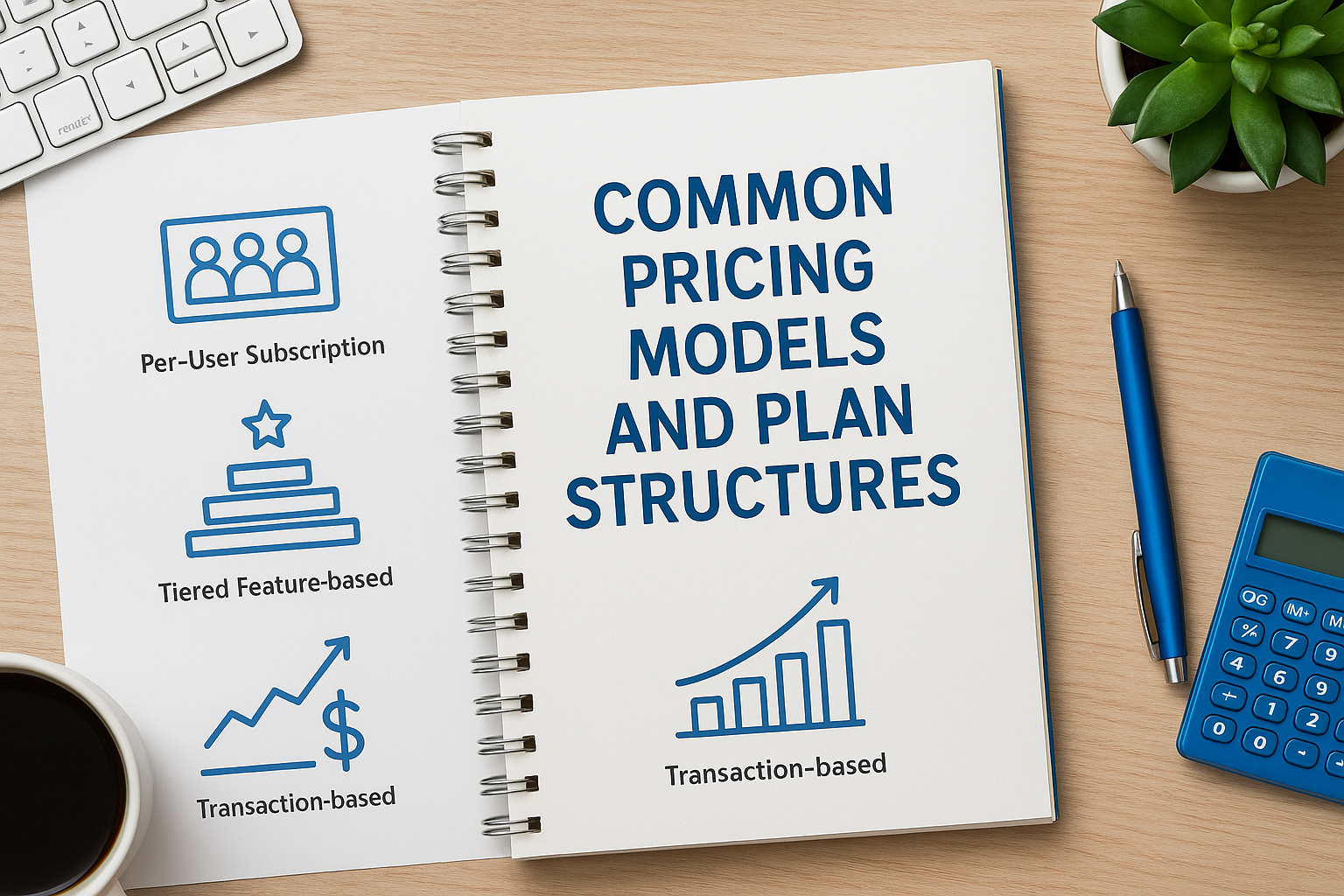
Vendors structure inventory management software pricing using different models that fundamentally change how costs scale with your business. Understanding these models helps you predict long-term expenses and identify which approach aligns with your growth trajectory. Per-user subscriptions, tiered feature packages, and transaction-based pricing each favor different business profiles, and choosing the wrong model can result in paying for capacity you don’t use or hitting costly thresholds sooner than expected. Finance leaders need to evaluate not just the initial monthly cost but how each model behaves as you add users, locations, or transaction volume.
Most vendors offer hybrid structures that combine elements from multiple pricing approaches, which adds complexity to comparison shopping. You might encounter a base platform fee plus per-user charges, or tiered plans where higher tiers unlock both more features and higher transaction limits. The key lies in mapping your current operational metrics against each model’s variables to project realistic three-year costs under different growth scenarios.
Per-user subscription models
Per-user pricing charges a fixed monthly or annual fee for each person who needs system access, making it straightforward to budget when you know your team size. Costs typically range from $30 to $150 per user monthly depending on the platform and feature set included. This model works well for companies with stable teams where headcount grows predictably, but it becomes expensive quickly if you need seasonal workers or have large teams where only a fraction requires full system access at any given time.
Vendors differentiate between full users and limited users within per-user structures. Full users get complete access to all purchased modules, while limited users might only view reports or enter data without editing permissions. Limited licenses cost 30% to 50% less than full licenses, providing savings for organizations with clear role distinctions. You should audit which team members truly need full access versus read-only capabilities before finalizing user counts in your contract.
Tiered feature-based pricing
Tiered plans bundle specific feature sets at different price points, such as Basic, Professional, and Enterprise levels. Each tier includes progressively more capabilities, with pricing jumps ranging from 50% to 200% between levels. For example, a Basic tier at $500 monthly might cover single-location inventory tracking, while a Professional tier at $1,500 adds multi-warehouse management and demand forecasting. This structure forces you to pay for the highest tier that includes any critical feature you need, even if other features in that tier remain unused.
Feature tiers work best when your required capabilities align cleanly with one tier, but they create cost inefficiencies when you need just one feature from a higher level.
Review each tier’s feature list carefully against your operational requirements. Some vendors allow feature add-ons that let you customize lower tiers by purchasing specific capabilities individually, providing better cost optimization than jumping to a higher tier solely for one function.
Transaction-based and usage pricing
Transaction-based models charge according to order volume, inventory movements, or SKU counts processed monthly. You might pay $0.50 to $2.00 per order or $5 to $20 per 1,000 transactions depending on the platform. This approach aligns costs directly with business activity, making it attractive for seasonal businesses or companies with fluctuating order volumes. However, rapid growth can trigger unexpected cost spikes that exceed fixed subscription alternatives as your volume scales.
Usage pricing provides flexibility but requires close monitoring of your metrics to avoid budget overruns. Some vendors cap transactions at certain thresholds before forcing tier upgrades, essentially combining usage-based and tiered models. Calculate your average monthly transaction volume and projected growth rate to determine whether usage pricing saves money long-term or simply delays higher costs until you hit volume thresholds.
The hidden costs that change your total bill
Quoted monthly fees rarely reflect what you’ll actually spend on inventory management software pricing over a multi-year contract. Vendors structure contracts to minimize advertised costs while embedding variable charges, escalation clauses, and service fees that compound significantly once you’re locked into the platform. CFOs who budget based solely on initial subscription quotes consistently underestimate total cost of ownership by 30% to 60% within the first two years. These hidden expenses appear gradually as your usage patterns evolve or when you need capabilities that weren’t obvious during initial vendor demos.
Identifying these costs before signing requires scrutinizing contract terms beyond the pricing summary page. Overage fees, support charges, and annual increases all impact your budget predictability, and vendors differ dramatically in how transparently they disclose these expenses. You need to pressure your account executive for complete cost scenarios under realistic growth assumptions, not just best-case pricing.
Data storage and bandwidth overages
Most cloud-based systems include baseline storage limits ranging from 10 GB to 100 GB depending on your subscription tier. Once you exceed these thresholds through accumulated transaction history, product images, or document attachments, vendors charge $0.10 to $1.00 per additional gigabyte monthly. Companies managing thousands of SKUs with detailed product photography or maintaining years of historical data hit these limits faster than anticipated, particularly when vendors count backup copies and archived records against your quota.
Bandwidth charges apply when you exceed data transfer limits, which becomes relevant if you frequently export large datasets or integrate with external systems that sync inventory levels continuously. Expect charges around $0.05 to $0.20 per gigabyte transferred beyond your plan’s included amount. These costs appear innocuous individually but accumulate to hundreds of dollars monthly for operations with heavy integration activity or frequent bulk reporting needs.
Customization and configuration fees
Standard workflow configurations rarely match your exact processes, forcing you to pay for custom field creation, automated workflow design, or specialized reporting dashboards. Vendors charge $100 to $250 per hour for configuration services, and seemingly simple customizations consume 10 to 40 hours of professional services time. Building a custom approval workflow or integrating with a niche shipping carrier can easily add $2,000 to $8,000 to your project cost.
Custom development requirements that emerge after go-live trigger change orders at premium hourly rates, often 20% to 40% higher than initial implementation pricing.
Some platforms allow no-code customization that you can handle internally, reducing reliance on billable vendor hours. Evaluate how much flexibility exists within the standard system before committing, because extensive customization signals you may need a different platform altogether.
Annual price increases and contract terms
Contracts typically include automatic renewal clauses with 3% to 7% annual price escalations that compound over multi-year periods. A system costing $2,500 monthly today reaches $2,888 monthly by year four under a 5% annual increase, adding nearly $5,000 annually to your budget without delivering additional value. Vendors justify these increases as covering infrastructure costs and feature enhancements, but you should negotiate caps on annual escalations during initial contracting to maintain budget predictability.
Multi-year contracts lock you into these escalation schedules while limiting your ability to downgrade or cancel without early termination penalties ranging from 25% to 100% of remaining contract value. You forfeit negotiating leverage once committed, making it critical to secure favorable terms upfront rather than assuming you’ll renegotiate later.
Implementation, onboarding, and data migration costs
Subscription fees represent only half the equation when budgeting for inventory management software pricing. Implementation costs often match or exceed your first-year software expenses, particularly for midsized companies migrating from spreadsheets or legacy systems with years of accumulated data. Professional services, training programs, and data migration work collectively determine whether your go-live happens in eight weeks or eight months, with corresponding cost implications. Finance leaders who underestimate these one-time expenses create budget shortfalls that delay projects or force compromises on critical setup activities.
Vendors structure implementation pricing differently based on whether they use fixed-fee projects, time-and-materials billing, or hybrid approaches. You need detailed cost breakdowns across each implementation phase before signing contracts, because vague estimates like “starting at $10,000” provide no useful planning value. Your actual costs depend on data quality, process complexity, and how many custom workflows you require to match operational reality.
Professional services and implementation fees
Implementation services consume $15,000 to $100,000 depending on system complexity and your internal readiness to manage configuration tasks. Basic setups for companies with straightforward inventory processes and clean data might cost $15,000 to $30,000 over six to eight weeks. Midsized operations requiring multi-location configuration, custom workflows, and extensive testing typically invest $40,000 to $75,000 across three to four months. NetSuite and Acumatica implementations for companies with manufacturing, lot tracking, or complex fulfillment needs regularly exceed $100,000 when you factor in data migration and integration work.
Consultants charge $150 to $300 per hour for implementation services, with rates varying by geographic location and consultant expertise level. You’ll work with project managers, solution architects, and technical developers throughout implementation, each billing at different rates. Senior resources cost more but complete work faster with fewer errors, making hourly rate comparisons misleading without considering efficiency differences.
Implementation quality directly impacts long-term operational efficiency, making this a poor area to cut corners through the cheapest vendor bid.
Training and user onboarding expenses
Training costs range from $5,000 to $25,000 depending on user count, role complexity, and delivery format. Vendors offer train-the-trainer sessions where you teach internal champions who then cascade knowledge to broader teams, or they provide direct end-user training across your entire organization. Train-the-trainer approaches cost less upfront, around $5,000 to $10,000, but require stronger internal resources capable of delivering effective training. Comprehensive end-user training for 20 to 50 users typically runs $15,000 to $25,000 when delivered on-site over multiple days.
Remote training reduces costs by eliminating travel expenses but often proves less effective for warehouse teams who need hands-on practice with mobile devices and barcode scanners. Budget for refresher training and ongoing support beyond initial go-live, because user turnover and feature updates require continuous education that many organizations overlook when building initial budgets.
Data migration and system integration work
Data migration from legacy systems costs $10,000 to $40,000 depending on data volume, quality issues, and how many source systems you’re consolidating. You’ll pay consultants to extract data from spreadsheets, aging ERP systems, or multiple disconnected databases, then clean and transform that data to match your new platform’s structure. Companies with poor data hygiene face higher costs as consultants spend additional hours resolving duplicates, correcting formats, and validating accuracy before import.
Historical transaction data, customer records, and vendor information all require careful mapping to prevent operational disruptions post-launch. Testing migration accuracy consumes significant time, with multiple test runs necessary to identify and fix data transformation errors before final cutover. You should expect two to four weeks of dedicated effort for data migration on typical midsized projects, translating to $15,000 to $30,000 in professional services.
Integrations, add-ons, and hardware expenses
Your base inventory management software pricing rarely accounts for the ecosystem of connected tools and physical equipment required to make the system functional in real operations. Integration costs, specialized modules, and barcode scanning hardware add thousands to tens of thousands of dollars to your total investment, yet vendors frequently gloss over these expenses during initial sales conversations. Finance leaders budgeting for inventory software need clear visibility into these supplementary costs because they’re not optional extras but operational necessities for most midsized companies. A system that can’t sync with your accounting platform or shipping carriers creates manual workarounds that eliminate the efficiency gains justifying the purchase in the first place.
Understanding which integrations your operations require and what those connections cost prevents budget surprises months into implementation. Third-party connector fees, API access charges, and hardware investments all contribute to your true cost of ownership and vary dramatically between platforms based on architecture and vendor partnerships.
Third-party integration fees
Connecting your inventory system to accounting platforms, e-commerce stores, and shipping carriers generates additional monthly costs that compound quickly. Pre-built integrations through platforms like Celigo or Boomi typically cost $200 to $800 monthly per connection depending on data volume and sync frequency. You might need five to ten integrations to connect QuickBooks, Shopify, Amazon, ShipStation, and a payment processor, pushing integration costs to $1,000 to $4,000 monthly beyond your base subscription.
API access itself may carry separate fees if your plan doesn’t include unlimited API calls. Some vendors charge $0.01 to $0.05 per API transaction, which accumulates to hundreds of dollars monthly when systems sync inventory levels continuously across multiple sales channels. Custom integrations built by developers cost $5,000 to $25,000 per connection depending on complexity, making middleware solutions more economical despite recurring subscription fees.
Pre-built connectors save implementation time and reduce ongoing maintenance burden compared to custom API integrations that require developer resources whenever either system updates.
Add-on modules and extended functionality
Specialized capabilities beyond core inventory tracking require add-on module purchases priced separately from base subscriptions. Advanced shipping management, quality control workflows, or production planning modules cost an additional $100 to $500 monthly each. Companies needing multiple add-ons easily spend $500 to $2,000 monthly on extended functionality that should factor into total budget planning from day one.
Some platforms bundle more features in higher subscription tiers rather than charging separately for add-ons, making tier comparisons important when evaluating total costs. You should map required capabilities against each vendor’s pricing structure to identify which approach delivers better value for your specific feature requirements.
Hardware and mobile device costs
Warehouse operations require barcode scanners, mobile computers, and label printers that integrate with your inventory system. Enterprise-grade mobile computers like Zebra or Honeywell devices cost $1,500 to $3,500 per unit, with most operations needing three to ten devices depending on warehouse size. Desktop barcode scanners run $200 to $800 each, while industrial label printers cost $500 to $2,000.
Budget $5,000 to $25,000 for initial hardware deployments across typical midsized warehouse operations. You’ll also need protective cases, charging cradles, and spare batteries that add 15% to 25% to hardware costs. Cloud-based systems eliminate server hardware expenses, but physical warehouse devices remain necessary regardless of deployment model.
Build a budget and business case for finance
Securing approval for inventory management software pricing requires more than presenting vendor quotes to your executive team. You need a complete business case that quantifies total investment against measurable returns, addresses implementation risks, and demonstrates how the platform aligns with broader financial objectives. CFOs building compelling business cases map software costs to specific operational improvements like reduced carrying costs, faster inventory turns, or eliminated stockouts that directly impact profitability. Your finance committee wants clarity on payback periods and confidence that the investment won’t balloon beyond initial projections.
Building this case demands gathering costs across every category discussed previously in this guide, then projecting those expenses over a realistic three to five year horizon. You should present multiple scenarios showing best-case, expected, and worst-case cost trajectories based on growth assumptions and feature expansion needs. Transparent cost modeling that acknowledges uncertainty builds more credibility than optimistic projections that ignore potential overruns.
Calculate three-year total cost of ownership
Your total cost of ownership calculation must capture subscription fees, implementation services, training expenses, integration costs, hardware purchases, and ongoing support charges across a minimum three-year period. Start by listing your base monthly subscription multiplied by 36 months, then add one-time implementation costs ranging from $15,000 to $100,000 depending on complexity. Include annual price escalations at 3% to 7% per year to reflect realistic contract terms rather than static pricing.
Factor in personnel costs for internal resources who will dedicate time to implementation, testing, and ongoing system administration. A part-time system administrator at 20 hours weekly costs $40,000 to $60,000 annually in fully loaded compensation. Add training refreshers, integration maintenance, and potential customization work that emerges after go-live. Most midsized companies should budget total three-year costs at 2.5x to 3.5x their first-year software subscription when accounting for all these factors comprehensively.
Document expected ROI and operational improvements
Quantify how inventory optimization reduces working capital tied up in excess stock or prevents lost sales from stockouts. Calculate your current carrying costs at 20% to 30% of inventory value annually, then model how improved demand forecasting could reduce inventory levels by 15% to 25% without impacting service levels. A company holding $2 million in inventory saves $60,000 to $120,000 annually by cutting stock 15% to 20%.
Better inventory visibility eliminates emergency orders and expedited shipping costs that erode margins, creating measurable savings you can track against software investment.
Include productivity gains from automated workflows that free staff from manual data entry or physical cycle counts. Converting 40 hours weekly of manual work to automated processes saves $80,000 to $100,000 annually in labor costs that you can redeploy to higher-value activities.
Present risk mitigation and cost control measures
Address implementation risks by securing fixed-price implementation contracts rather than open-ended time-and-materials agreements that expose you to cost overruns. Negotiate contract terms that cap annual price increases at 3% to 4% and include clear termination provisions if the vendor fails to deliver promised functionality. Building these protections into your business case demonstrates financial discipline and realistic planning.
Include contingency budget at 15% to 20% of total project costs to cover unexpected integration challenges or additional training needs without requiring supplemental budget requests mid-project. This buffer prevents project delays when minor scope expansions become necessary.
Inventory system vs ERP: when to step up
Standalone inventory management software pricing stops looking attractive when your operations bump against the limitations of point solutions that can’t talk to each other. You reach an inflection point where disconnected systems for inventory, accounting, order management, and purchasing create more problems than they solve. Finance leaders face this decision when manual data reconciliation between systems consumes hours daily, when inventory data conflicts with accounting records regularly, or when you can’t get real-time visibility into cash tied up in stock across locations. The question isn’t whether to upgrade but when the cost of inefficiency exceeds the investment in unified systems.
Most companies operate standalone inventory tools successfully until they hit $10 million to $50 million in revenue or expand beyond three locations. NetSuite and Acumatica both deliver inventory management as modules within broader ERP platforms, pricing these capabilities higher than dedicated inventory tools but delivering integrated financial management, purchasing, sales order processing, and reporting that eliminates data silos. You should evaluate ERP when the pain of system fragmentation outweighs the comfort of familiar tools.
Signs you’ve outgrown standalone inventory software
You know it’s time to consider ERP when your team manually exports inventory data to reconcile with accounting systems at month-end, creating multi-day close processes that delay financial reporting. Standalone inventory tools force you to maintain separate systems for sales orders, purchase orders, and general ledger transactions, with each handoff introducing errors and version control problems. Your inventory balances never match your books without constant adjustment entries because movements tracked in one system don’t automatically update the other.
Multi-location operations amplify these problems exponentially. You can’t get consolidated inventory views without building custom reports that pull from multiple databases, and inter-location transfers require manual journal entries to keep accounting aligned with physical movements. When you spend more time reconciling systems than analyzing the data they produce, you’ve crossed the threshold where ERP delivers clear ROI.
What ERP adds beyond inventory tracking
ERP platforms unify inventory, financials, purchasing, and order fulfillment in a single database where transactions automatically update all affected modules simultaneously. When you receive inventory against a purchase order, the system updates stock levels, records the accounts payable liability, and triggers payment workflows without manual intervention. Real-time financial impact visibility means you see how inventory decisions affect cash flow and profitability immediately rather than discovering variances weeks later during reconciliation.
ERP eliminates the data fragmentation that turns inventory management into an exercise in spreadsheet reconciliation rather than strategic decision-making.
You gain capabilities like automated landed cost calculation, multi-currency inventory valuation, and integrated demand planning that standalone tools can’t deliver effectively. These features matter most for companies managing complex supply chains, multiple warehouses, or international operations where inventory crosses borders and currencies regularly.
Cost implications of stepping up to ERP
ERP implementations cost $75,000 to $300,000 for midsized companies when you account for software, implementation services, training, and data migration from legacy systems. Monthly subscription fees run $3,000 to $8,000 depending on user counts and module selection, substantially higher than standalone inventory tools at $500 to $2,000 monthly. You should expect 12 to 24 month payback periods when you calculate savings from eliminated manual reconciliation, reduced inventory carrying costs through better planning, and faster financial closes that improve decision-making speed.
Next steps
You now have the framework to evaluate inventory management software pricing against real market benchmarks and identify costs that vendors bury in contract fine print. Your next move should focus on gathering quotes from three to five providers that match your operational requirements, then building total cost of ownership projections across three years using the components outlined in this guide. Request detailed implementation estimates and integration costs upfront rather than discovering them mid-project when you’ve lost negotiating leverage.
Compare these projections against the operational improvements you documented in your business case. Calculate how much you’ll save through reduced carrying costs, eliminated stockouts, and faster financial closes to determine realistic payback periods. If your analysis reveals that standalone inventory systems can’t deliver the integrated functionality you need or your current system fragmentation creates expensive inefficiencies, it’s time to explore how ERP platforms eliminate those gaps.
At Concentrus, we help midsized companies evaluate whether NetSuite or Acumatica delivers better ROI for their specific operations. Schedule a consultation to review your requirements and build a cost model aligned with measurable financial outcomes.