


If your finance team is still exporting Shopify orders to CSV and hand-keying them into NetSuite, you already know the problem. Every manual touch adds a chance for a mismatched SKU, a duplicate invoice, or a revenue number that does not reconcile at month end. A proper shopify integration netsuite setup removes that manual layer entirely, syncing orders, inventory, customers, and payments between the two systems automatically.
At its core, shopify netsuite integration connects your storefront’s transactional data to NetSuite’s financial and operational backbone, so what happens on the web store shows up in your general ledger, inventory counts, and fulfillment queue without someone retyping it. This article breaks down exactly how that connection works, what data actually flows between the platforms, and the main connector options available, from native tools to middleware like Celigo, so you can see what’s happening under the hood before you commit to a build.
We’ll also cover how to judge which integration approach fits your business, based on order volume, customization needs, and how tightly you need Shopify and NetSuite to stay in sync for accurate, real-time financial reporting.
Why Shopify-NetSuite integration matters
The real cost of manual order entry
Manual order entry doesn’t just waste time, it quietly erodes margin. Every hour your team spends copying Shopify orders into NetSuite is an hour not spent on cash flow forecasting or margin analysis. Worse, manual entry introduces errors that compound: a mistyped SKU triggers a fulfillment delay, a missed order becomes a customer service escalation, and a duplicated invoice throws off your accounts receivable aging report. For a company processing a few dozen orders a week, this is annoying. For one processing hundreds, it’s a structural risk that shows up in every reconciliation.
The financial payoff of automation
Once Shopify and NetSuite talk to each other automatically, the numbers your finance team relies on stop lagging behind reality. Orders post to the general ledger the moment they’re placed, inventory counts update across every sales channel in real time, and revenue recognition follows GAAP rules instead of a spreadsheet formula someone built three years ago. This is the difference between closing the books in three days versus twelve, and it’s why CFOs at growing ecommerce and wholesale companies treat this integration as a finance project first and an IT project second.
A NetSuite Shopify integration isn’t about convenience, it’s about making sure your financial data is trustworthy the moment a customer clicks buy.
Where the risk shows up without it
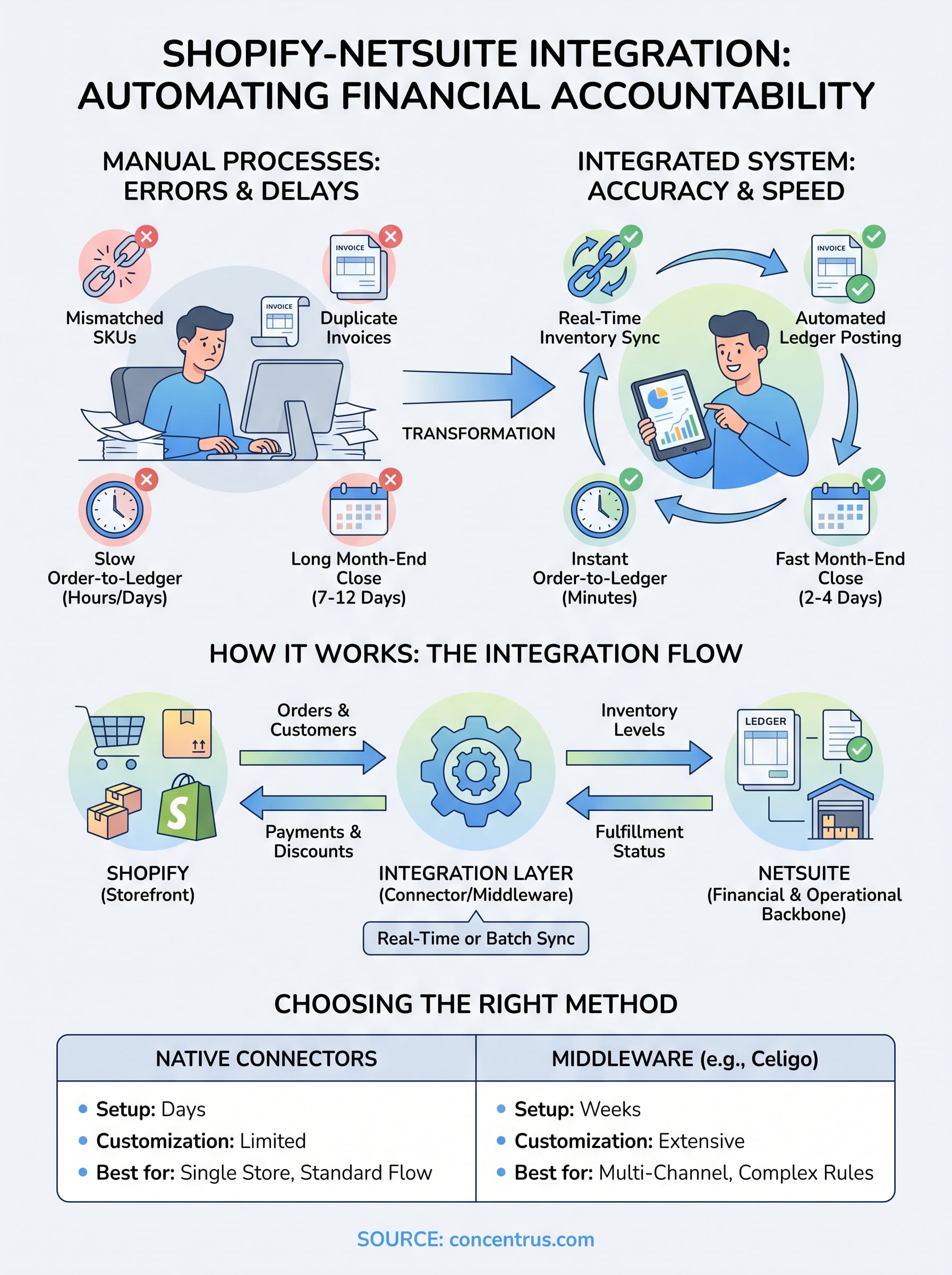
Without a reliable shopify to netsuite integration, the gap between your storefront and your books shows up in predictable ways. Here’s how the two approaches typically compare for a midsized retailer processing 500+ orders a month:
| Area | Manual Process | Integrated System |
|---|---|---|
| Order-to-ledger time | Hours to days | Minutes |
| Inventory accuracy | Frequent overselling | Synced in real time |
| Month-end close | 7-12 days | 2-4 days |
| Data entry errors | Common, hard to trace | Rare, auditable |
Delayed inventory syncing is the one that hurts most. Selling a product on Shopify that’s already out of stock in NetSuite means a canceled order, a refund, and a customer who probably won’t come back. Beyond the operational headache, that kind of gap makes it nearly impossible for a CFO to trust the numbers going into a board deck or a lender’s financial package, which is exactly the accountability problem Concentrus’s ROI Roadmap™ methodology is built to solve for ERP projects like this one.
How the Shopify-NetSuite integration works
What data actually moves between systems
At a technical level, a netsuite shopify integration works through API calls that push and pull specific data objects between the two platforms on a schedule or in real time. Orders, customers, inventory levels, product catalogs, payments, and shipping updates all travel through this pipeline, translated into a format each system understands. Shopify speaks in storefront terms like line items and discount codes, while NetSuite speaks in accounting terms like sales orders, item fulfillments, and GL postings. The integration layer’s job is to map one to the other without losing data along the way.
The typical data flow
Here’s what a standard sync usually handles, in the order it happens:
- New order created in Shopify triggers a sales order in NetSuite
- Inventory levels in NetSuite push back to Shopify so stock counts stay accurate across channels
- Payment capture in Shopify matches against the NetSuite invoice or cash sale record
- Fulfillment status updates flow from NetSuite’s warehouse management back to Shopify for customer tracking emails
- Customer records sync bidirectionally so support teams see the same purchase history in both systems
Real time versus batch syncing
Whether this happens instantly or on a delay depends entirely on your setup. Some connectors sync every few minutes, others run nightly batch jobs, and the difference matters more than most teams expect. A batch delay of even four hours can mean selling inventory that’s technically already gone, which is why higher-volume merchants almost always push for near-real-time syncing on orders and inventory specifically.
The value of a shopify integration with netsuite isn’t the connection itself, it’s how fast and accurately that connection reflects reality.
Zeroing in on which fields sync, how often, and in what direction is the real engineering work behind any integration project, and it’s where most implementation quality gets decided long before go-live.
Choosing the right integration method for your business
Not every company needs the same level of integration, and picking the wrong one wastes money either way. Some businesses genuinely need a lightweight, native connector that handles the basics. Others need custom middleware that can enforce complex pricing rules, multi-entity accounting, or B2B wholesale workflows. The right integration method depends less on your company’s size and more on your order complexity and how many sales channels feed into NetSuite.
Native connectors versus middleware
Getting this decision right starts with understanding the tradeoffs. Native or off-the-shelf connectors work well for straightforward, single-entity businesses with standard order flows and modest order volume. Middleware platforms like Celigo, part of the Concentrus Partner Network™, make more sense once you’re dealing with multiple Shopify stores, custom pricing tiers, or subsidiaries that each need their own accounting treatment inside NetSuite.
| Factor | Native Connector | Middleware (Celigo, etc.) |
|---|---|---|
| Setup speed | Fast, days | Slower, weeks |
| Customization | Limited | Extensive |
| Multi-entity support | Weak | Strong |
| Best for | Single store, standard flow | Multiple channels, complex rules |
The right shopify integration with netsuite isn’t the most powerful option, it’s the one that matches your actual order complexity.
Matching the method to your growth stage
Honestly assessing where your business is headed in the next 18 months matters more than what you need today. A netsuite integration with shopify built for 50 orders a day will strain badly at 500. Conversely, over-engineering a custom middleware build for a single-storefront retailer just adds cost and maintenance overhead nobody asked for. This is exactly the kind of decision Concentrus’s ROI Roadmap™ methodology is designed to pressure-test before a single line of code gets written, tying the integration choice back to measurable financial outcomes instead of guesswork.
Common integration pitfalls and how to avoid them
Mapping errors that break the sync
Getting the field mapping wrong is the single most common failure point in any shopify-netsuite integration. Tax codes, SKUs, and unit-of-measure conversions look simple until a bundled product on Shopify doesn’t match its NetSuite kit item, and suddenly your revenue recognition is off by a few percentage points nobody notices until quarter close. Testing every product type, discount rule, and shipping method before go-live catches most of these issues, but only if someone actually runs the test orders through both systems and checks the ledger entries line by line.
Most failed integrations don’t fail loudly, they fail quietly in the general ledger where nobody’s looking.
Underestimating multi-currency and tax complexity
Questions about tax jurisdiction and currency conversion trip up more projects than any technical bug does. A shopify to netsuite integration that works fine for a single US-dollar storefront can break completely once you add a Canadian or UK site, because tax engines and currency rounding rules don’t always translate cleanly between platforms. Bringing in a partner like Avalara through the Concentrus Partner Network™ before expansion, rather than after, saves weeks of reconciliation cleanup.
Treating go-live as the finish line
Running past the launch date without a monitoring plan is where a lot of integrations quietly degrade. Orders that sync fine in week one start dropping fields by month three, usually because Shopify or NetSuite pushed an update the connector wasn’t built to handle. Scheduling a recurring audit, monthly at minimum, of order counts, inventory variances, and GL postings keeps small drift from becoming a full reconciliation project. If an existing integration is already showing these symptoms, that’s a rescue scenario, not a patch job, and it’s worth evaluating through Concentrus’s NetSuite ERP Rescue Roadmap before the errors compound further.
Making the integration work for your finance team
A well-built shopify integration netsuite setup isn’t a technical convenience, it’s a finance control. When orders, inventory, and payments flow automatically between your storefront and your ledger, your close gets faster, your reconciliations get cleaner, and your CFO stops chasing down mismatched numbers before every board meeting. Getting there means choosing the right connector for your order complexity, mapping fields correctly the first time, and monitoring the sync long after go-live rather than assuming it stays healthy on its own.
Businesses that treat this as a financial accountability project, not just an IT ticket, get the ROI they expected from NetSuite in the first place. If your current integration is already showing cracks, or you’re planning one from scratch and want it tied to measurable outcomes instead of guesswork, talk to the team at Concentrus about building it right the first time.