

Ask any ERP consultant what kills a well-planned implementation, and you’ll hear the same answer: people. Not bad software. Not poor configuration. People who weren’t prepared for the shift. That’s exactly what change management addresses, the structured approach to moving individuals, teams, and entire organizations from how things work today to how they need to work tomorrow. And when an ERP system like NetSuite or Acumatica is involved, the stakes are significantly higher because you’re reshaping core business processes that touch every department.
At Concentrus, we’ve seen firsthand how even the most technically sound ERP projects stall when the human side gets ignored. Our ROI Roadmap™ methodology ties every phase of an implementation to measurable financial outcomes, but those outcomes depend on people actually adopting the new system. A faster monthly close means nothing if your accounting team is still running reports through spreadsheets out of habit. Stronger margins don’t materialize if warehouse staff bypass the new workflows because nobody explained why the old ones had to go.
This guide breaks down change management in practical terms for ERP teams, what it actually is, the core principles behind it, the most widely used frameworks, and the specific steps that move an organization through a transition without losing momentum. Whether you’re heading into a new ERP implementation or recovering a stalled one, understanding change management isn’t optional. It’s the difference between an ERP that delivers ROI and one that just runs in the background.
What change management really means in ERP work
When people ask what is change management, the standard answer is a structured approach to transitioning individuals and organizations from a current state to a desired future state. That definition holds, but ERP projects demand a more specific interpretation. An ERP implementation is not a software project with a human component added on; it is fundamentally an organizational change that happens to require software as the mechanism.
The difference between managing a project and managing change
Running an ERP project means tracking timelines, budgets, and configurations. Change management runs in parallel, but its focus is different: it addresses whether your people understand what is changing, why it matters, and how to work effectively in the new environment. Project management asks “are we on schedule?” Change management asks “are your people ready?” Both questions are necessary, and skipping the second is where most ERP projects run into serious trouble.
The technical go-live date is not the moment your ERP project succeeds. Adoption is.
Most ERP teams treat change management as a training session scheduled for the week before go-live. That approach consistently falls short. Preparing people for a new system is a continuous effort that starts at project kickoff and runs well past the launch date. The earlier you engage your users, the less resistance you encounter when it counts.
What actually changes in an ERP transition
In a typical ERP rollout, the visible change is the software interface, but the actual change runs much deeper. Workflows shift. Roles that previously owned certain manual tasks may need to operate differently. Approval paths, reporting cadences, and data entry habits all get restructured by a well-configured ERP. At Concentrus, we map these shifts early because you cannot help people adapt to changes you have not clearly defined yourself.
Understanding the full scope means looking across four dimensions: process, technology, organizational structure, and individual behavior. All four require deliberate attention, not just the technology layer. When your finance team sees that the new system cuts their close from ten days to five, they have a concrete reason to engage rather than resist.
Why change management makes or breaks ERP ROI
The connection between change management and ERP ROI is direct. When users don’t engage with the new system the way it was designed to be used, your financial outcomes suffer regardless of how well the software was configured. Understanding what is change management makes clear it isn’t a soft skill add-on to your project plan; it is the mechanism that converts a technically functional ERP into one that actually performs for your business.
The financial cost of poor adoption
Low adoption shows up fast in your financials. Teams that revert to old spreadsheets or manual workarounds introduce data gaps that compromise reporting accuracy, misalign inventory counts, and cause approval workflows to break down quietly over time.
A poorly adopted ERP does not just fail to deliver ROI; it actively introduces new risk into your financial operations.
Your ERP vendor delivered a working system. The gap between “working” and “delivering measurable ROI” is almost always a people problem, not a technology problem, and it widens with every week of incomplete adoption.
How change management accelerates your return
When you invest in structured change management from project kickoff, you compress the timeline between go-live and full adoption. That compression matters because ERP ROI is time-sensitive; every month your team operates below full productivity is a month of unrealized return on a significant investment. Concentrus builds adoption milestones directly into the ROI Roadmap™, which means you track people performance alongside system performance and catch adoption gaps before they cost you financially.
The core roles and responsibilities on an ERP change
No matter how well you understand what is change management, the concept only moves forward when specific people own specific responsibilities. An ERP transition needs a defined team structure for the human side of the project, not just the technical side. Without clear ownership, critical tasks like stakeholder communication and training coordination fall through the gaps.
The executive sponsor
Your executive sponsor sets the tone for the entire change effort. This is the senior leader, often a CFO or COO, who visibly champions the ERP initiative and communicates its strategic importance to the organization. When resistance surfaces at the department level, the executive sponsor’s public commitment is what keeps momentum from stalling.
Without a credible executive voice behind the change, skepticism spreads faster than adoption.
The change management lead
The change management lead is responsible for designing and executing the people-side plan: stakeholder analysis, communication schedules, training programs, and adoption tracking. This role works alongside your project manager but focuses exclusively on readiness and engagement rather than timelines and configurations. This person should be involved from day one, not brought in after go-live to clean up resistance.
Department champions and end users
Department champions are the bridge between the project team and your frontline staff. They understand how daily work actually flows in each business unit and can translate system changes into practical terms their colleagues understand. Equip your champions early with clear information and they become your most effective adoption accelerators. End users who feel informed and supported adopt faster and revert less.
How to run change management in an ERP project
Knowing what is change management gives you the framework; knowing how to run it inside a live ERP project is where the actual work happens. The sequence matters as much as the individual activities, and compressing or skipping early steps almost always creates larger problems at go-live.
Map the impact before you communicate
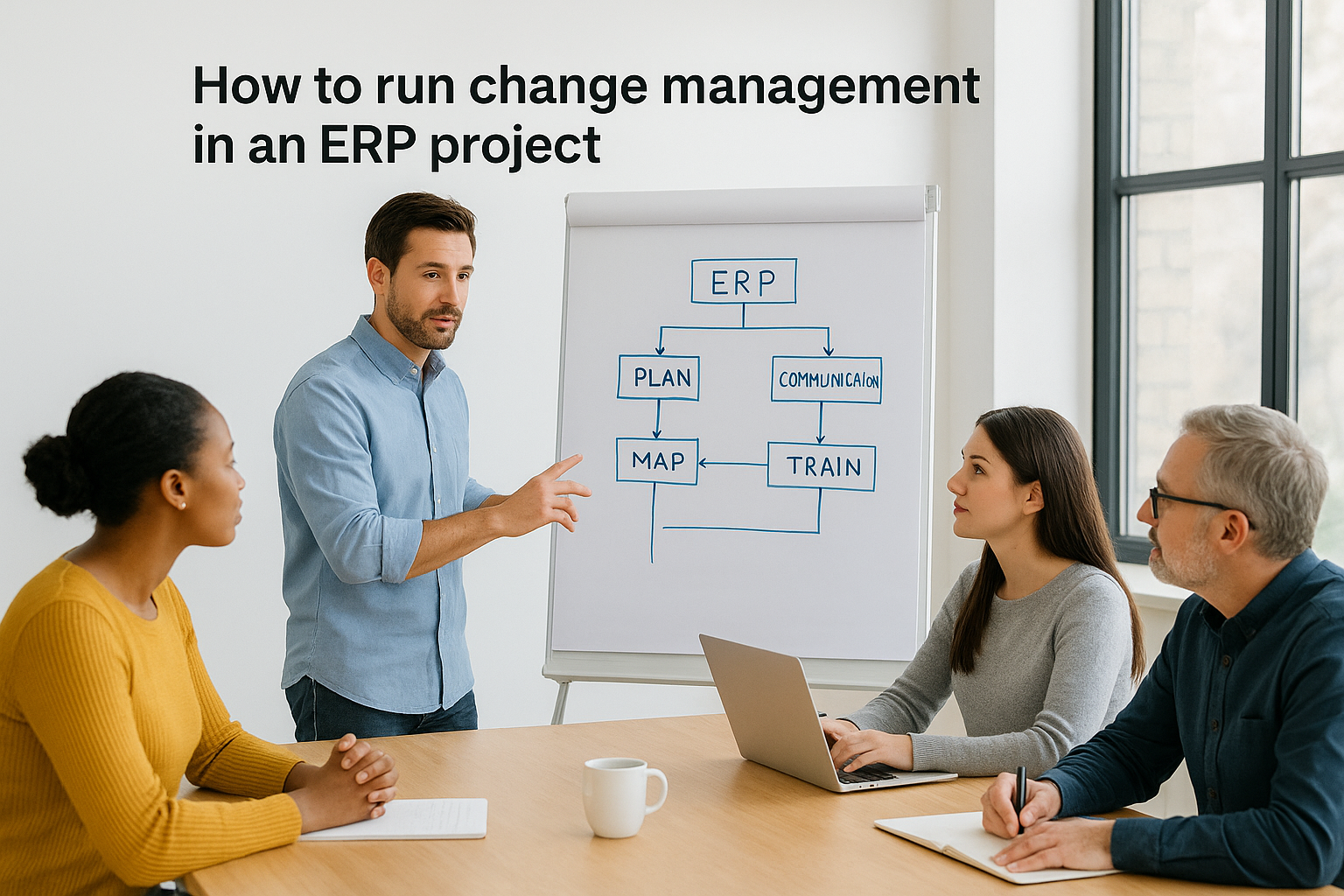
Your first move is a structured impact assessment that maps every process, role, and approval path the new system touches. Without this map, your communications stay vague and your training misses critical gaps. Document what is changing, who it affects, and how significantly, then use that data to prioritize your change effort by level of disruption rather than treating every group the same way.
Build communication in layers
Start with executive messaging that explains the strategic reason for the change, then move to department-level communication that addresses specific workflow adjustments. People support changes they understand, so your messaging needs to answer the “why” clearly and early rather than focusing only on the “what.”
Communication is not a one-time event; it runs from project kickoff through post-go-live stabilization.
Train by role, not by module
Generic system training produces generic adoption. Map each user group to the specific tasks they will perform in the ERP and build training directly around those workflows. Concentrus structures role-based training within the ROI Roadmap™ because users who practice real scenarios before go-live adopt faster and require significantly less support once the system is live.
Common ERP change pitfalls and how to avoid them
Even teams that understand what is change management in theory often fall into the same traps during execution. Recognizing these patterns early gives you the opportunity to correct course before they compound into adoption failures and lost ROI.
Starting change management too late
The most common mistake is treating change management as an afterthought, something to handle in the final weeks before go-live. By that point, resistance has already formed and workflows have been mentally rehearsed without the new system in mind. Start your people-side planning at project kickoff, and you create space to address concerns before they become obstacles.
Delaying your change effort also means your department champions receive critical information too late to prepare their teams. Give your internal advocates early access to process maps and system walkthroughs so they can reinforce your messaging from a position of real understanding rather than catching up alongside the people they are supposed to guide.
Resistance doesn’t appear at go-live; it builds quietly in the months before it.
Underestimating the communication gap
Many ERP teams send one announcement at the start of the project and assume the message landed. It didn’t. People need repeated, targeted communication that explains how their specific daily work will change, not just that a system is being implemented. Build a structured communication calendar that delivers relevant updates to each affected group throughout the entire project lifecycle, not just at launch.
Quick wrap-up and next steps
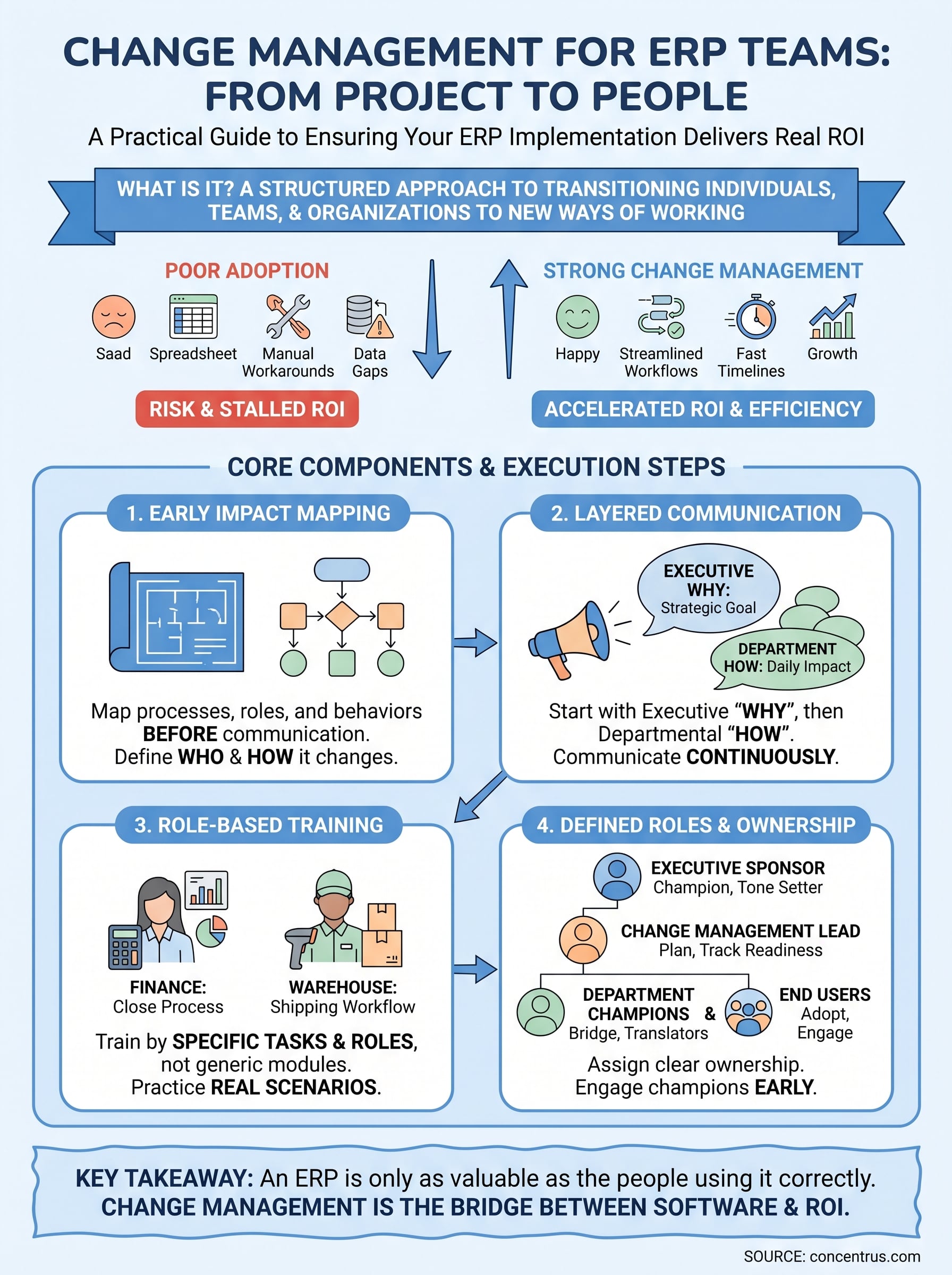
Understanding what is change management and applying it consistently throughout your ERP project is what separates implementations that deliver real financial returns from those that simply go live. The core principles are clear: start early, assign clear ownership, communicate in layers, train by role, and track adoption as rigorously as you track timelines. Miss any of these steps and your ERP investment pays back less than it should.
Your ERP is only as valuable as the people using it correctly. Concentrus builds change management directly into every ERP engagement through our ROI Roadmap™, so your adoption metrics and financial outcomes move together rather than in opposite directions. If you’re heading into a new implementation or trying to rescue one that stalled, we can help you build a people-side plan that matches your technical roadmap from day one. Talk to an ERP and ROI expert at Concentrus to get started.