


Hiring a NetSuite implementation consultant can mean the difference between an ERP system that drives measurable results and one that drains resources without delivering value. For CFOs and finance leaders at midsized companies, this decision carries significant weight, your ERP investment needs to improve cash flow, accelerate financial closes, and support scalable growth.
The challenge? Not all consultants are created equal. Some focus purely on technical configuration while ignoring your actual business outcomes. Others promise the world but lack the methodology to tie implementation work to ROI. Understanding what a NetSuite implementation consultant actually does, what skills to look for, and what costs to expect helps you make a smarter hiring decision.
At Concentrus, we’ve built our practice around ERP implementations that guarantee measurable returns. This article breaks down the consultant’s role, the qualifications that matter most, typical pricing structures, and how to evaluate whether a consultant or firm will actually deliver on their promises.
Why this role matters for ERP ROI
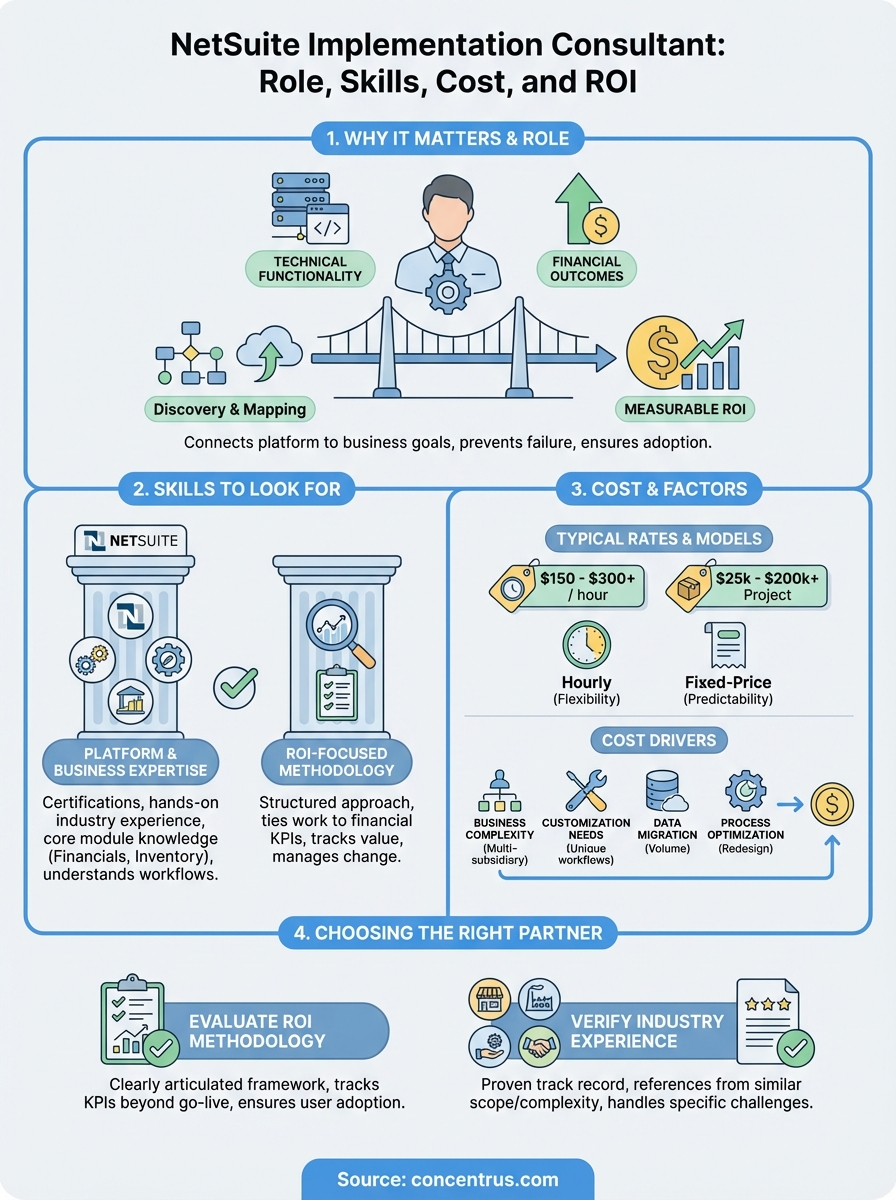
Your ERP system should deliver measurable financial returns, not just technical functionality. A skilled NetSuite implementation consultant connects platform capabilities directly to your business outcomes, ensuring every configuration choice, workflow design, and integration decision advances your financial goals. Without this expertise, you risk building a system that works technically but fails to improve your close cycle, increase margins, or give you the visibility needed to make confident decisions.
The cost of getting it wrong
Most ERP failures stem from implementation mistakes, not platform limitations. You might face endless customizations that create maintenance nightmares, data migrations that compromise accuracy, or workflows that slow down your team instead of accelerating processes. These problems compound over time, leading to cost overruns, delayed go-lives, and systems that never deliver the promised ROI.
Poor implementation also creates hidden costs that bleed resources for years. Your finance team spends hours manually reconciling data, you miss reporting deadlines because the system can’t pull the right information, and you watch potential efficiency gains evaporate as workarounds become standard practice.
The right consultant prevents these issues by building ROI accountability into every project phase, tying implementation work to specific financial KPIs from day one.
The ROI advantage of expert guidance
Expert consultants transform your NetSuite implementation from a technology project into a financial strategy. They map your unique processes to platform capabilities, eliminate unnecessary customizations that inflate costs, and design workflows that directly support your growth objectives. You gain a system that actually accelerates financial closes, improves cash visibility, and scales without requiring constant expensive adjustments.
This expertise also protects your investment by ensuring you avoid the common pitfalls that force companies into costly rescue projects later. You implement once, correctly, with clear ROI milestones that prove value throughout the process.
What a NetSuite implementation consultant does
A NetSuite implementation consultant translates your financial and operational requirements into a working ERP system that supports your specific business model. They handle everything from initial discovery and requirements gathering through configuration, data migration, testing, training, and go-live support. Their work extends beyond technical setup to include process optimization, change management, and ensuring your team actually adopts the system effectively.

Discovery and process mapping
Your consultant starts by analyzing your current workflows, pain points, and financial objectives. They document how your team handles core processes like order-to-cash, procure-to-pay, and financial close cycles, then identify where NetSuite’s native capabilities can replace inefficient manual work. This discovery phase determines which configurations will deliver the greatest ROI impact rather than just replicating existing processes in a new system.
The best consultants focus on outcomes, not features, ensuring every configuration decision connects directly to your financial goals.
Configuration and deployment
After mapping your requirements, your consultant configures NetSuite to match your business logic and reporting needs. They set up your chart of accounts, customize forms and fields, build workflows that automate approvals, and integrate third-party applications that extend platform capabilities. Throughout deployment, they focus on minimizing customizations that create future maintenance costs while ensuring the system delivers the specific functionality you need to hit your financial targets.
Skills to look for in a NetSuite consultant
Your NetSuite implementation consultant needs more than platform certifications. You need someone who understands how financial processes directly impact your business outcomes and can translate your requirements into configurations that drive measurable returns. The right skills balance technical knowledge with financial acumen, ensuring your ERP investment delivers real value instead of just technical functionality.
Platform expertise and business process knowledge
Look for consultants with proven NetSuite certifications and hands-on implementation experience in your industry. They should demonstrate deep knowledge of core modules like financials, inventory management, and revenue recognition, while also understanding how your specific business workflows need to function. Technical expertise matters, but it means little if your consultant can’t map platform capabilities to your actual operational challenges.
ROI-focused methodology
The best consultants bring a structured implementation approach that ties every configuration decision to your financial goals. They should explain how their methodology tracks ROI throughout the project, identifies which customizations truly add value versus creating maintenance costs, and ensures your team actually adopts the system effectively. Ask potential consultants how they measure success beyond just technical go-live.
A consultant who focuses only on technical deployment without connecting work to your financial KPIs will likely deliver a system that works but doesn’t improve your bottom line.
How much NetSuite implementation consulting costs
NetSuite implementation consulting fees vary widely based on project complexity, consultant experience, and your specific requirements. You can expect to pay between $150 to $300+ per hour for qualified consultants, while full implementation projects typically range from $25,000 for basic setups to well over $200,000 for complex, multi-subsidiary deployments with extensive customization and integration needs.
Hourly rates versus fixed-price projects
Most NetSuite implementation consultants charge either hourly rates or offer fixed-price packages for defined project scopes. Hourly billing gives you flexibility but creates uncertainty around total costs, especially if your requirements change during implementation. Fixed-price engagements provide budget predictability but require clearly defined scope upfront to avoid expensive change orders later.
Understanding how your consultant structures pricing and what deliverables each pricing model includes helps you compare proposals accurately and avoid unexpected costs.
Factors that drive implementation costs
Your final cost depends primarily on business complexity and how much customization you need. Companies with multiple subsidiaries, intricate revenue recognition requirements, or extensive third-party integrations pay significantly more than businesses implementing core financial modules alone. Industry-specific needs, data migration volume, and the level of process optimization work required also impact your total investment substantially.
How to choose the right consultant or firm
Selecting the right NetSuite implementation consultant requires evaluating more than just technical credentials and hourly rates. You need a partner who demonstrates a proven track record of delivering measurable ROI, not just successful go-lives. Start by examining their methodology for tying implementation work to your financial goals, reviewing case studies from companies similar to yours, and asking specific questions about how they handle scope changes, data migration challenges, and user adoption.
Evaluate their ROI methodology
Your consultant should articulate a clear framework for connecting NetSuite configuration to your specific financial objectives. Ask how they measure success beyond technical deployment, what KPIs they track throughout the project, and how they ensure your team actually adopts the system. Firms that focus exclusively on technical implementation without linking work to business outcomes rarely deliver the returns you need.
A consultant who can’t explain their ROI tracking process or provide specific examples of financial improvements they’ve delivered should raise immediate concerns.
Verify industry and complexity experience
Look for consultants with demonstrated experience in your industry and handling projects of similar scope. Request references from clients who faced comparable challenges, whether that’s multi-subsidiary consolidations, complex revenue recognition requirements, or extensive third-party integrations. The right firm brings relevant expertise that prevents costly mistakes and accelerates time to value.
Next steps
Choosing the right NetSuite implementation consultant determines whether your ERP investment delivers measurable returns or becomes another failed technology project that drains resources. You now understand the critical skills to evaluate, typical costs to expect, and the importance of selecting a partner who ties implementation work directly to your financial objectives rather than just completing technical deployment.
Your next move depends on where you stand today. If you’re planning a new implementation, start by documenting your specific ROI targets and the financial processes that need improvement most urgently. Companies facing underperforming NetSuite systems should assess whether their current setup can be rescued or requires a strategic realignment to recover lost value and prevent further resource waste.
At Concentrus, we specialize in NetSuite implementations that guarantee ROI through our proprietary methodology. Our approach ensures every configuration decision supports your growth objectives while avoiding costly customizations that create future maintenance nightmares. Learn how our ROI-focused ERP consulting delivers measurable results for CFOs who need systems that actually improve their bottom line, not just check technical boxes.