


Stockouts kill revenue. Excess inventory drains cash. For midsized companies trying to scale, the gap between what you think customers will order and what they actually order can quietly erode margins quarter after quarter. NetSuite demand planning addresses this problem head-on by giving finance and operations teams a data-driven framework for forecasting demand, managing inventory levels, and aligning purchasing decisions with actual sales trends.
But understanding what the module does and getting real value from it are two different things. Too many companies activate demand planning features without connecting them to the financial outcomes that matter, faster inventory turns, improved cash flow, and tighter cost control. That disconnect is exactly where ROI gets left on the table.
At Concentrus, we implement and optimize NetSuite for midsized companies with one goal: making every module deliver measurable financial results. This article breaks down NetSuite’s demand planning capabilities, from core features and practical benefits to real-world use cases, so you can evaluate whether it’s the right fit for your operations and how to get it working in your favor.
What NetSuite Demand Planning Is
NetSuite demand planning is a module within Oracle NetSuite’s supply chain management suite that helps you forecast future demand based on historical sales data, trends, and seasonality. Rather than relying on gut feel or static spreadsheets, it gives your team a structured, automated way to predict what customers will need and when, so purchasing and production decisions stay grounded in real data.
How It Fits Within the NetSuite Platform
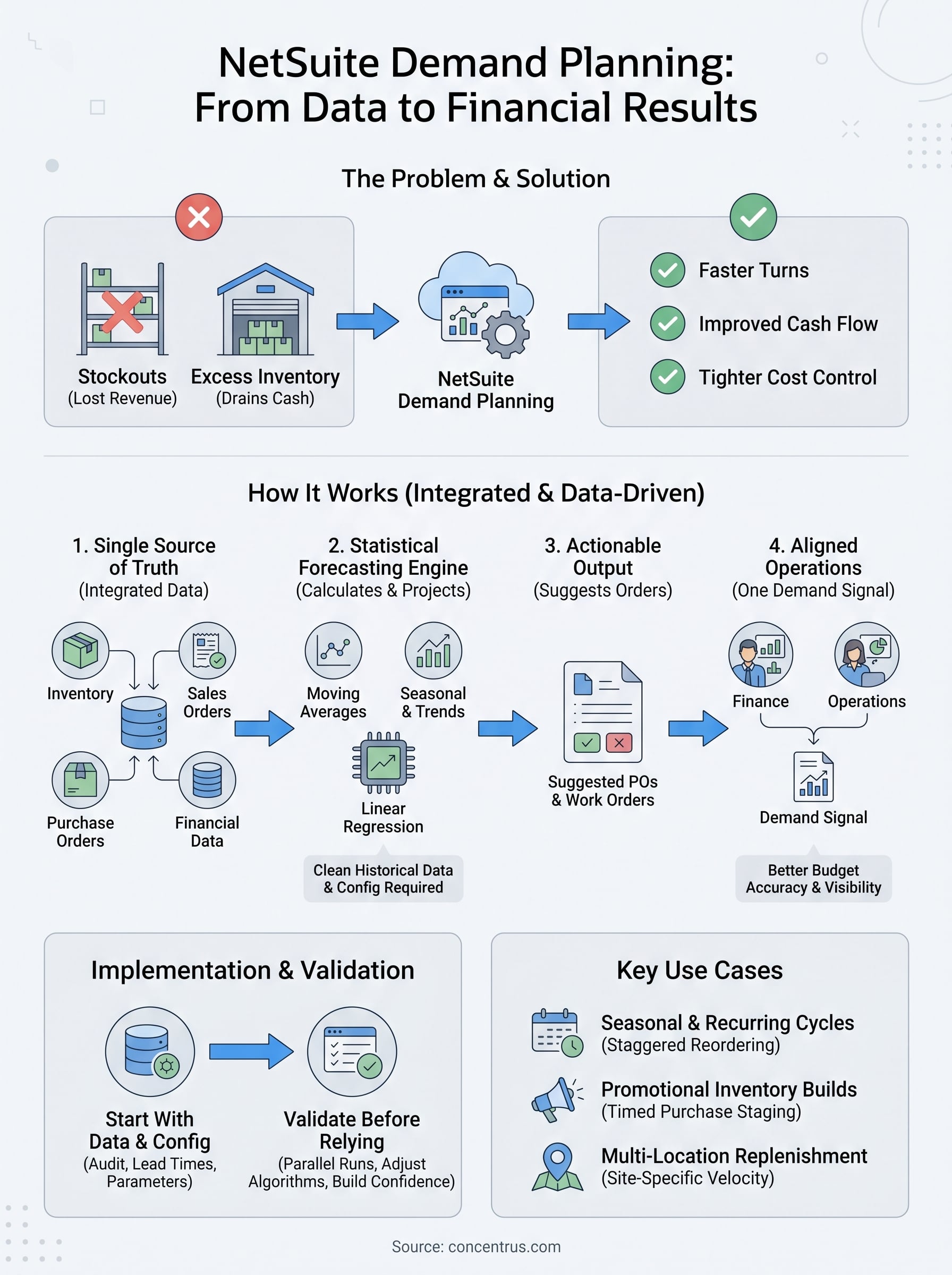
NetSuite demand planning does not operate in isolation. It connects directly to your inventory, sales orders, purchase orders, and financial data within the same system, which means forecasts automatically reflect what is actually happening across your business. When a sales order closes or a stock level shifts, the planning engine picks that up. You are not reconciling data from three different tools; everything flows through a single source of truth.

This tight integration is what separates NetSuite’s approach from standalone forecasting tools that require constant manual syncing with your ERP.
What It Actually Calculates
The module uses statistical forecasting methods, including moving averages and seasonal adjustment algorithms, to project future demand at the item and location level. You can set planning horizons, adjust safety stock rules, and define reorder points based on lead times from specific suppliers. The system then generates suggested purchase orders or work orders that your team can review and approve before anything is committed.
This means your finance and operations teams work from the same forward-looking numbers. A controller reviewing cash flow projections and a warehouse manager planning replenishment orders are both pulling from the same demand signal, which reduces the internal miscommunication that leads to either overstocking or running short at the worst possible time.
Why NetSuite Demand Planning Matters
For midsized companies, inventory imbalances rarely show up until they hit the income statement. Carrying too much stock ties up working capital and inflates carrying costs. Running short means lost sales and emergency purchases at premium prices. Both outcomes trace back to the same root cause: decisions made without reliable demand data.
The Financial Cost of Getting It Wrong
Poor forecasting creates a compounding problem. Overstock drives write-downs and cash flow strain, while stockouts force reactive buying at higher unit costs. NetSuite demand planning gives you a structured way to break that cycle by replacing guesswork with data-backed purchasing decisions that align inventory levels to actual business needs.
When demand planning connects directly to your financial reporting, every inventory decision carries a measurable dollar impact.
Aligning Operations With Financial Goals
Your finance and operations teams need to work from the same forward-looking numbers, not separate spreadsheets with conflicting figures at month-end. A single demand signal flowing through one system improves budget accuracy and variance reporting.
Tighter alignment between purchasing plans and financial forecasts also gives leadership cleaner visibility into cash flow, which means fewer surprises and stronger confidence in the numbers going into board-level conversations.
Core Features in NetSuite Demand Planning
NetSuite demand planning brings several interconnected tools into one environment, so you can move from historical sales data to actionable purchasing decisions without jumping between systems or manually reconciling exports from separate platforms.
Statistical Forecasting Engine
The module applies multiple forecasting algorithms to your transaction history, including moving averages and seasonal adjustment methods. You select the approach that best fits each product’s demand pattern, and the system calculates item-level projections across your defined planning horizon. Common methods you can apply include:

- Moving average for stable, consistent demand
- Seasonal decomposition for products with recurring demand cycles
- Linear regression for items with a clear growth trend
Matching the right algorithm to your specific product mix is often what separates a forecast your team trusts from one that consistently misses by a wide margin.
Safety Stock and Reorder Automation
From those projections, NetSuite demand planning calculates safety stock levels and reorder points tied directly to your supplier lead times and target service levels. When inventory is projected to fall below threshold, the system generates suggested purchase orders or work orders for your team to review before releasing. That keeps your procurement decisions grounded in current demand signals rather than static rules set months ago.
How to Implement NetSuite Demand Planning
Getting NetSuite demand planning running takes more than flipping a switch. You need clean historical data, clearly defined planning parameters, and alignment between your finance and operations teams before the system can generate forecasts your team will actually trust and act on.
Start With Data and Configuration
Your first step is auditing your transaction history for completeness and consistency. Gaps or duplicate records in your sales order data will skew every forecast the system produces. Once your data is clean, you configure item-level planning parameters, including supplier lead times, safety stock targets, and the forecasting method that best fits each product’s demand pattern.
Setting these parameters correctly upfront determines whether your forecasts drive better purchasing decisions or just add noise to your workflow.
Validate Before You Rely On It
Run your first forecasts in parallel with your existing process before fully committing to system-generated suggestions. Compare outputs against actual demand over a short review period and adjust the algorithms where projections miss consistently. This validation step builds team confidence in the numbers and surfaces any configuration gaps before they affect live purchasing decisions.
Common use cases and workflows
NetSuite demand planning fits naturally into several operational workflows that midsized companies run into repeatedly. Knowing where it adds the most impact helps you prioritize configuration effort rather than activating every feature at once without a clear plan.
Seasonal and Recurring Demand Cycles
Companies with predictable seasonal patterns use NetSuite demand planning to set staggered reorder points months in advance, keeping procurement ahead of supplier lead times instead of reacting when peak season hits. You can also apply it to slower-moving or cyclical SKUs that spreadsheet-based planning consistently gets wrong. Common scenarios where the module delivers clear value include:
- Seasonal product lines tied to retail or agricultural calendars
- Promotional inventory builds requiring timed purchase order staging
- Multi-location replenishment with different velocity rates per site
Aligning your planning horizon to at least one full supplier lead cycle before peak demand keeps you out of emergency purchasing situations that inflate unit costs.
Each scenario benefits from setting item-level parameters rather than applying blanket rules across your entire catalog, which is where most teams see the biggest jump in forecast accuracy after moving off manual planning methods.
Next Steps
NetSuite demand planning works when it connects your historical data, item-level configuration, and purchasing workflows to the financial outcomes your team is actually tracking. The features are there. The value comes from setting it up with the right parameters, validating your forecasts before you rely on them, and making sure your finance and operations teams work from the same demand signal.
Getting there on your own takes time most midsized finance teams do not have. Working with an implementation partner who ties every configuration decision to measurable ROI milestones cuts down the trial-and-error and gets your team to accurate, actionable forecasts faster.
If you want a clearer picture of what demand planning can deliver for your specific business, Concentrus helps midsized companies implement and optimize NetSuite with a direct focus on financial results. Talk to our NetSuite ERP experts to find out where your current setup is leaving ROI on the table.