

Inventory sitting in your warehouse isn’t just taking up space, it’s quietly draining your margins. Between storage fees, insurance, depreciation, and tied-up capital, inventory carrying costs typically range from 20% to 30% of total inventory value annually. For CFOs at midsized companies, that’s a significant line item that directly impacts cash flow and profitability.
The challenge? Most finance leaders know they’re overspending on inventory but lack the visibility and tools to pinpoint exactly where the inefficiencies live. Spreadsheets and disconnected systems make it nearly impossible to forecast demand accurately, optimize reorder points, or identify slow-moving stock before it becomes obsolete.
This is where the right ERP system becomes a financial lever, not just an operational one. At Concentrus, we’ve helped CFOs transform their inventory management by implementing NetSuite and Acumatica solutions that deliver measurable ROI, including dramatic reductions in carrying costs. When your ERP aligns with your financial goals, inventory stops being a cost center and starts contributing to stronger margins and healthier cash flow.
Here are seven proven strategies to reduce your inventory carrying costs this year, with practical steps you can implement whether you’re optimizing an existing system or considering an ERP upgrade.
1. Rebuild inventory controls in NetSuite or Acumatica
Your ERP system should be the foundation for how to reduce inventory carrying costs, not a reporting tool that tells you about problems after they’ve already hurt your margins. Most midsized companies inherit default inventory settings that were never configured for their specific business model, industry, or product mix. When your NetSuite or Acumatica implementation lacks proper inventory controls, you’re essentially flying blind with purchase orders, safety stock buffers, and replenishment triggers.
Why it works
Proper inventory controls transform your ERP from a passive database into an active cost management engine. When you configure NetSuite or Acumatica with the right item classifications, reorder rules, and approval workflows, the system automatically prevents over-purchasing and flags slow-moving stock before it becomes obsolete. You gain real-time visibility into stock levels across multiple locations, including in-transit inventory that often gets overlooked in manual tracking systems.
Rebuilding your inventory controls creates a single source of truth that connects purchasing decisions directly to demand signals and financial KPIs.
The financial impact shows up immediately. CFOs who invest in proper ERP inventory configuration typically see 15% to 25% reductions in total inventory value within six months, which translates directly to lower carrying costs and improved cash flow. Your purchasing team stops making emotional decisions based on fear of stockouts and starts following data-driven reorder points that balance service levels with capital efficiency.
How to execute in 2026
Start by auditing your current item master records in NetSuite or Acumatica. Verify that every SKU has accurate lead times, preferred vendors, and correct ABC classifications. Work with your implementation partner to configure bin management, lot tracking, and serialization based on your actual warehouse operations rather than theoretical best practices.
Next, activate automated reorder point calculations using your ERP’s built-in inventory planning modules. Configure minimum and maximum stock levels for each item based on historical demand patterns, not gut instinct. Set up approval workflows that require finance sign-off on purchase orders exceeding specific dollar thresholds or quantities that deviate from forecasted demand.
Finally, enable cycle counting routines that validate inventory accuracy weekly rather than relying on annual physical counts. Your ERP can automatically generate count schedules based on item velocity and value, ensuring your financial reporting reflects actual on-hand quantities.
KPIs to track
Monitor your inventory accuracy percentage weekly, targeting 95% or higher across all locations. Track inventory turnover ratio monthly to identify items sitting too long on shelves. Measure days inventory outstanding (DIO) to quantify exactly how many days of cash you have tied up in stock, with a goal of reducing this metric by at least 10% quarter over quarter.
2. Calculate your true carrying cost and report it monthly
Most CFOs track inventory value on their balance sheet but fail to quantify the full financial burden of holding that stock. Your true carrying cost includes storage fees, insurance premiums, depreciation, obsolescence risk, opportunity cost of tied-up capital, and handling expenses. When you don’t measure this aggregate cost monthly, you can’t accurately assess whether your inventory levels are financially sustainable or identify which product lines are quietly destroying profitability.

Why it works
Measuring carrying costs transforms inventory from an abstract asset into a concrete financial metric that directly impacts your P&L. When you calculate and report this number monthly, your purchasing and operations teams suddenly have skin in the game because they see exactly how their decisions affect cash flow. Visibility creates accountability, and accountability drives behavioral change across your entire supply chain.
Quantifying your true carrying cost turns inventory optimization from a warehouse problem into a finance-driven strategic initiative.
This is fundamental to how to reduce inventory carrying costs because you cannot improve what you don’t measure. CFOs who implement monthly carrying cost reporting typically see inventory levels drop 12% to 18% within the first year as teams become cost-conscious about what they order and how long they hold it.
How to execute in 2026
Build a monthly dashboard in NetSuite or Acumatica that calculates total carrying cost as a percentage of average inventory value. Include all cost components: warehouse rent allocated per square foot, insurance premiums, estimated obsolescence based on aging reports, and weighted average cost of capital for funds tied up in stock.
Configure your ERP to automatically pull these data points and publish the report to your finance team by the fifth business day of each month. Schedule a standing inventory review meeting where purchasing, operations, and finance discuss the trend line and specific actions to reduce exposure.
KPIs to track
Monitor total carrying cost as a percentage of inventory value, targeting a reduction from industry averages of 25% down to 18% or lower. Track month-over-month change in absolute carrying cost dollars to measure progress. Measure cost per SKU to identify which products are the most expensive to hold relative to their sales velocity.
3. Tighten demand planning with one forecast and one cadence
Multiple departments creating their own forecasts is one of the fastest ways to bloat inventory levels and inflate carrying costs. When sales projects optimistic growth, operations builds in safety buffers, and finance creates a third version for budgeting, you end up with purchasing decisions based on whichever forecast screams loudest. This disconnected approach creates systematic over-ordering because nobody wants to be responsible for a stockout, so everyone pads their numbers defensively.
Why it works
Consolidating to a single forecast eliminates the internal conflict that drives excess inventory. When every department works from the same demand signal, your purchasing decisions align with actual expected consumption rather than inflated projections from competing spreadsheets. This unified approach is critical for how to reduce inventory carrying costs because it removes the buffer-on-buffer mentality that multiplies safety stock across your entire product catalog.
A single forecast with disciplined monthly reviews cuts inventory bloat by forcing cross-functional accountability for demand assumptions.
How to execute in 2026
Establish a monthly Sales and Operations Planning (S&OP) process where sales, operations, and finance jointly own one forecast in your ERP system. Designate a single owner, typically a demand planner or operations manager, who updates the forecast based on consensus inputs. Lock this forecast into NetSuite or Acumatica as the master planning driver for all purchase orders and production schedules.
KPIs to track
Monitor forecast accuracy by comparing projected demand to actual sales monthly, targeting 80% accuracy or higher. Track forecast variance in dollar terms to quantify how over-forecasting inflates your inventory investment.
4. Reset safety stock, reorder points, and order cycles
Your inventory parameters were likely set years ago based on outdated assumptions about lead times, demand variability, and service level targets. Since then, your product mix has evolved, supplier performance has shifted, and customer expectations have changed, but your ERP replenishment settings remain frozen in time. These stale parameters force you to hold excess inventory as insurance against problems that may no longer exist or protect against stockouts for products that now move predictably.
Why it works
Recalculating these core inventory parameters based on current data patterns eliminates the hidden buffers that accumulate over time. Most midsized companies discover they’re holding 30% to 40% more safety stock than statistically necessary when they analyze actual demand volatility and supplier reliability from the past 12 months. This excess directly inflates your carrying costs without improving service levels.
Resetting your inventory parameters transforms historical buffers into freed cash while maintaining the same customer fill rates.
How to execute in 2026
Pull 12 months of historical demand data from NetSuite or Acumatica for each SKU and calculate the standard deviation of monthly consumption. Use this variance to set safety stock levels that achieve your target service level, typically 95% to 98%, without over-protecting. Update supplier lead times based on recent performance rather than vendor promises, then recalculate reorder points accordingly.
Evaluate your order cycles to determine if weekly or bi-weekly replenishment reduces total inventory more effectively than monthly bulk orders. Configure your ERP to automatically suggest order quantities based on economic order quantity (EOQ) formulas that balance ordering costs against holding costs.
KPIs to track
Measure safety stock as a percentage of total inventory, targeting reductions of 5% to 10% without increasing stockout frequency. Track service level percentage weekly to ensure parameter changes don’t compromise customer satisfaction.
5. Renegotiate supplier terms to avoid excess inventory
Your supplier contracts often lock you into minimum order quantities and payment terms that force you to hold more inventory than financially optimal. When vendors require bulk purchases to hit price breaks or mandate long lead times that push you toward safety stock buffers, they’re essentially transferring their inventory risk onto your balance sheet. These rigid terms directly contradict how to reduce inventory carrying costs because you’re prioritizing vendor convenience over your own cash flow efficiency.
Why it works
Renegotiating supplier agreements shifts the financial burden of inventory holding back toward the party that can manage it more efficiently. When you secure smaller order quantities with more frequent deliveries, you convert static warehouse stock into just-in-time flow that reduces your days inventory outstanding. Vendors often agree to revised terms when presented with data showing your purchasing volume justifies flexible arrangements, especially if you consolidate spend with fewer suppliers in exchange for better conditions.
Flexible supplier terms transform your inventory from a static asset into a dynamic flow that responds to actual demand rather than contractual obligations.
How to execute in 2026
Analyze your top 20 suppliers by spend volume and identify where minimum order quantities or payment terms force excessive inventory levels. Schedule renegotiation meetings armed with 12 months of purchase history showing your reliability as a customer. Request smaller batch sizes with weekly or bi-weekly deliveries, extended payment terms to offset holding costs, or consignment arrangements for high-value items. Offer longer-term contracts or increased wallet share in exchange for inventory-friendly terms.
KPIs to track
Monitor average order quantity by supplier monthly, targeting reductions of 20% to 30% on renegotiated contracts. Track supplier lead time variance to ensure new terms deliver promised flexibility without introducing delivery unpredictability.
6. Cut slow movers with ABC and lifecycle inventory rules
Not all inventory deserves equal treatment, yet most midsized companies manage every SKU with the same replenishment logic and storage priority. Your slow-moving products quietly consume warehouse space, insurance premiums, and capital while contributing minimal revenue. When you lack formal classification rules, these underperformers accumulate year after year because nobody has clear authority or methodology to discontinue items that no longer justify their carrying costs.
Why it works
ABC classification separates your inventory into value-based tiers where A-items represent your top 20% of SKUs generating 80% of revenue, B-items cover the middle 30%, and C-items comprise the bottom 50% of slow movers. This segmentation allows you to apply differentiated inventory policies where high-value A-items get tight controls and frequent replenishment while low-value C-items operate with minimal safety stock and longer review cycles. Lifecycle rules automate the identification of items that haven’t sold in 90, 180, or 365 days, triggering clearance actions before obsolescence destroys residual value.
Systematic classification and lifecycle rules transform inventory rationalization from an annual cleanup project into an ongoing discipline that prevents bloat.
How to execute in 2026
Configure your NetSuite or Acumatica system to automatically classify items based on trailing 12-month sales volume and margin contribution. Establish lifecycle rules that flag C-items with zero sales in the past 90 days for discount pricing and items exceeding 180 days without movement for liquidation or write-off. Schedule quarterly SKU rationalization reviews where finance and operations jointly decide which slow movers to discontinue, ensuring you’re not replenishing inventory that destroys cash flow.
KPIs to track
Monitor percentage of inventory in C-classification, targeting reductions from typical levels of 50% down to 35% or lower. Track inventory turns by ABC category separately, ensuring A-items turn at least 8 times annually while C-items justify their existence with acceptable margins despite lower velocity.
7. Reduce storage, handling, and shrink with warehouse discipline
Physical warehouse operations directly impact your carrying cost calculations through storage expenses, labor inefficiency, and inventory loss. Poor warehouse discipline creates a triple financial drain: you pay for excess square footage because disorganized storage inflates space requirements, your labor costs spike from inefficient picking and putaway processes, and inventory shrinkage from damage, theft, or miscounts erodes the value of stock you’re already paying to hold. These operational inefficiencies often represent 3% to 8% of total inventory value annually, making warehouse discipline a critical component of how to reduce inventory carrying costs.
Why it works
Structured warehouse operations transform your facility from a cost center into an efficiency engine that reduces the per-unit cost of holding inventory. When you implement proper slotting strategies, cycle counting routines, and material handling standards, you compress the physical footprint required for the same inventory volume while accelerating throughput. This operational tightening directly reduces rent, utilities, and labor allocated to inventory management.
Warehouse discipline eliminates the hidden operational waste that inflates carrying costs beyond the obvious storage and capital components.
How to execute in 2026
Start with a warehouse layout audit that identifies dead space, inefficient picking paths, and improper slotting of fast-moving items. Reorganize your facility to place A-items in the most accessible locations with B and C-items in secondary zones. Implement strict receiving and putaway protocols that require immediate system updates when inventory arrives, eliminating the lag between physical receipt and ERP visibility. Establish locked inventory areas with access controls to reduce theft exposure. Schedule weekly cycle counts for high-value items and monthly counts for slower movers to catch discrepancies before they compound.
KPIs to track
Monitor shrinkage percentage monthly, targeting reductions below 1% of total inventory value. Track warehouse space utilization by measuring inventory value per square foot, aiming to increase density by 15% to 20% through better organization. Measure inventory accuracy weekly with a goal of maintaining 98% or higher across all locations.
What to do next
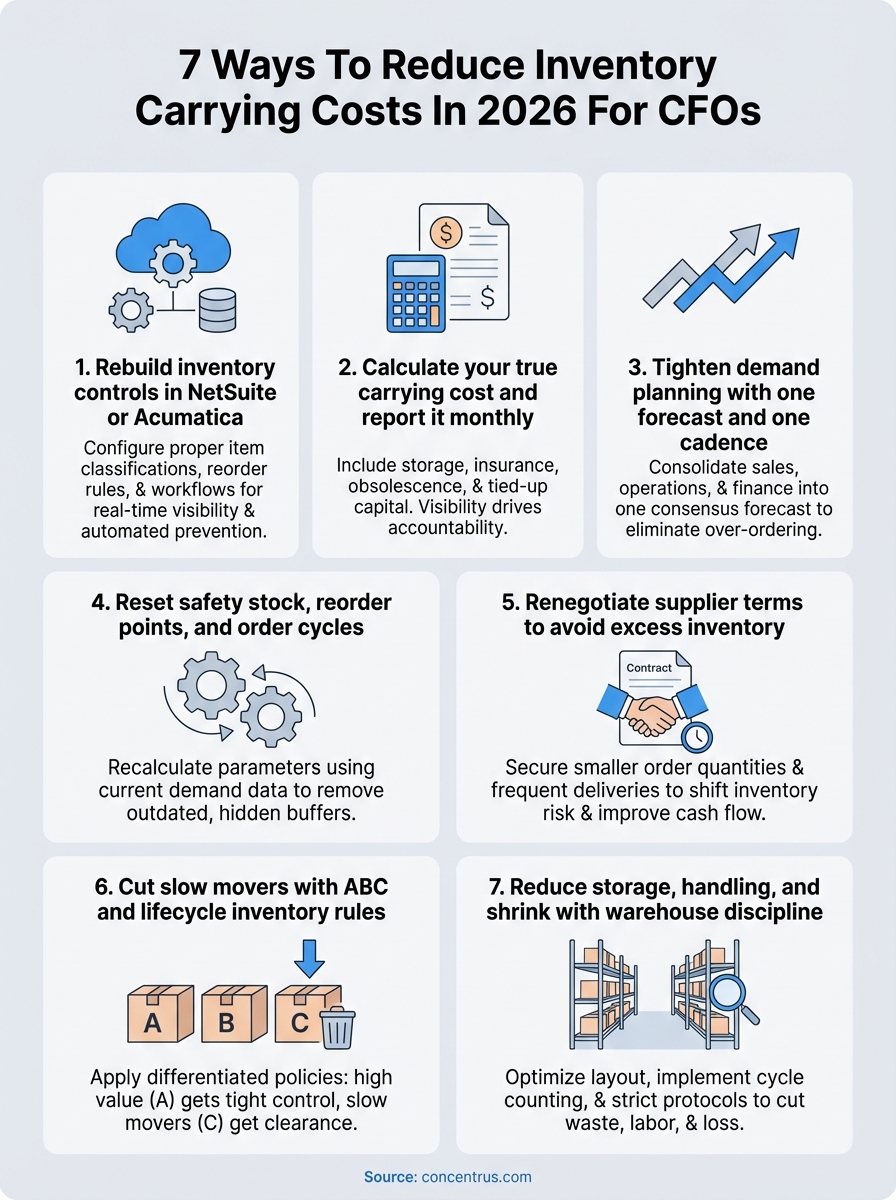
These seven strategies show you how to reduce inventory carrying costs by transforming your ERP system from a reporting tool into an active financial management platform. Each approach targets a specific component of your carrying cost calculation, from physical warehouse efficiency to supplier term optimization, giving you multiple levers to pull based on where your biggest opportunities live. The CFOs who see the fastest ROI typically start with rebuilding their inventory controls (strategy #1) because it creates the data foundation that makes every other strategy more effective.
Your next step is deciding whether your current NetSuite or Acumatica implementation can support these strategies or if you need an ERP optimization to unlock the full financial benefit. At Concentrus, we help CFOs implement inventory management solutions that deliver measurable reductions in carrying costs within the first quarter. If you’re ready to turn your ERP into a cash flow engine, explore how our ROI-driven approach transforms inventory from a cost center into a competitive advantage.