

Every business decision carries a price tag. The question that separates smart investments from expensive mistakes is straightforward: did you get back more than you put in? Knowing how to measure return on investment gives you a concrete way to answer that question, whether you’re evaluating a marketing campaign, a capital expenditure, or an ERP implementation that’s supposed to transform your operations.
The ROI formula itself is simple. Applying it well is where things get nuanced. You need to account for the right costs, measure the right gains, and interpret the results within the context of your specific business goals. Skip any of those steps, and you’ll end up with a number that looks good on a slide deck but means nothing in practice.
At Concentrus, we built our entire ERP consulting methodology, the ROI Roadmap™, around this principle. Every NetSuite and Acumatica project we deliver ties directly to measurable financial outcomes because we’ve seen what happens when companies invest millions without a clear framework for tracking real returns. This article breaks down the ROI formula, walks through how to calculate it step by step, and shows you how to apply it across different business scenarios so you can make investment decisions with confidence.
Why ROI matters to finance leaders
As a finance leader, you face pressure from multiple directions at once. Boards want growth, operations teams want new tools, and your job is to make sure every dollar spent moves the company forward in a measurable way. ROI gives you a standard unit of comparison that cuts through the noise. Instead of debating which project feels more valuable, you can line up the numbers and make the call based on evidence.
ROI as a decision-making filter
Most organizations have more potential projects than available capital. You need a consistent way to rank competing priorities, and ROI is the most direct tool for that job. A marketing team pitching a new campaign, a warehouse manager requesting automation equipment, and a CFO evaluating an ERP upgrade are all making cases for investment. Without a shared measurement framework, those conversations become political rather than analytical.
When every investment request goes through the same ROI filter, you replace gut-feel decisions with a process that leadership can defend to the board.
Understanding how to measure return on investment across different project types also keeps your team honest. It forces project sponsors to define upfront what success looks like in financial terms, not just activity metrics. That clarity pays off long after the project kicks off because everyone is working toward the same measurable target.
The cost of skipping ROI measurement
When companies skip formal ROI tracking, the consequences show up later and they’re rarely cheap. Underperforming ERP systems are a clear example. Organizations invest six or seven figures in new software, go live, and then six months later the finance team is still running manual processes in spreadsheets because no one defined what success looked like in financial terms at the start.
The same pattern plays out in marketing, capital expenditure, and hiring decisions. Without clear baseline metrics and defined expected returns, you have no way to know whether an investment is working or slowly draining resources you could deploy elsewhere. By the time the problem becomes obvious, you’ve already absorbed months of underperformance.
ROI and stakeholder confidence
Finance leaders who track ROI consistently build a different kind of credibility inside their organizations. When you can show the board a direct line between an investment and a financial outcome, you earn more autonomy to make future decisions quickly. That trust shortens the decision-making cycle and reduces the back-and-forth that slows projects down.
Your ability to quantify past returns also strengthens your position when requesting budget for new initiatives. Rather than asking for approval based on projections alone, you’re presenting a track record that demonstrates your team’s ability to generate documented value from every capital allocation decision.
The ROI formula and what to include
The standard ROI formula is the same regardless of what you’re measuring. Net gain divided by total cost, multiplied by 100 gives you a percentage that tells you how much you returned relative to what you spent. The real work isn’t in the math; it’s in defining what belongs on each side of that equation before you run a single calculation.
The basic ROI formula
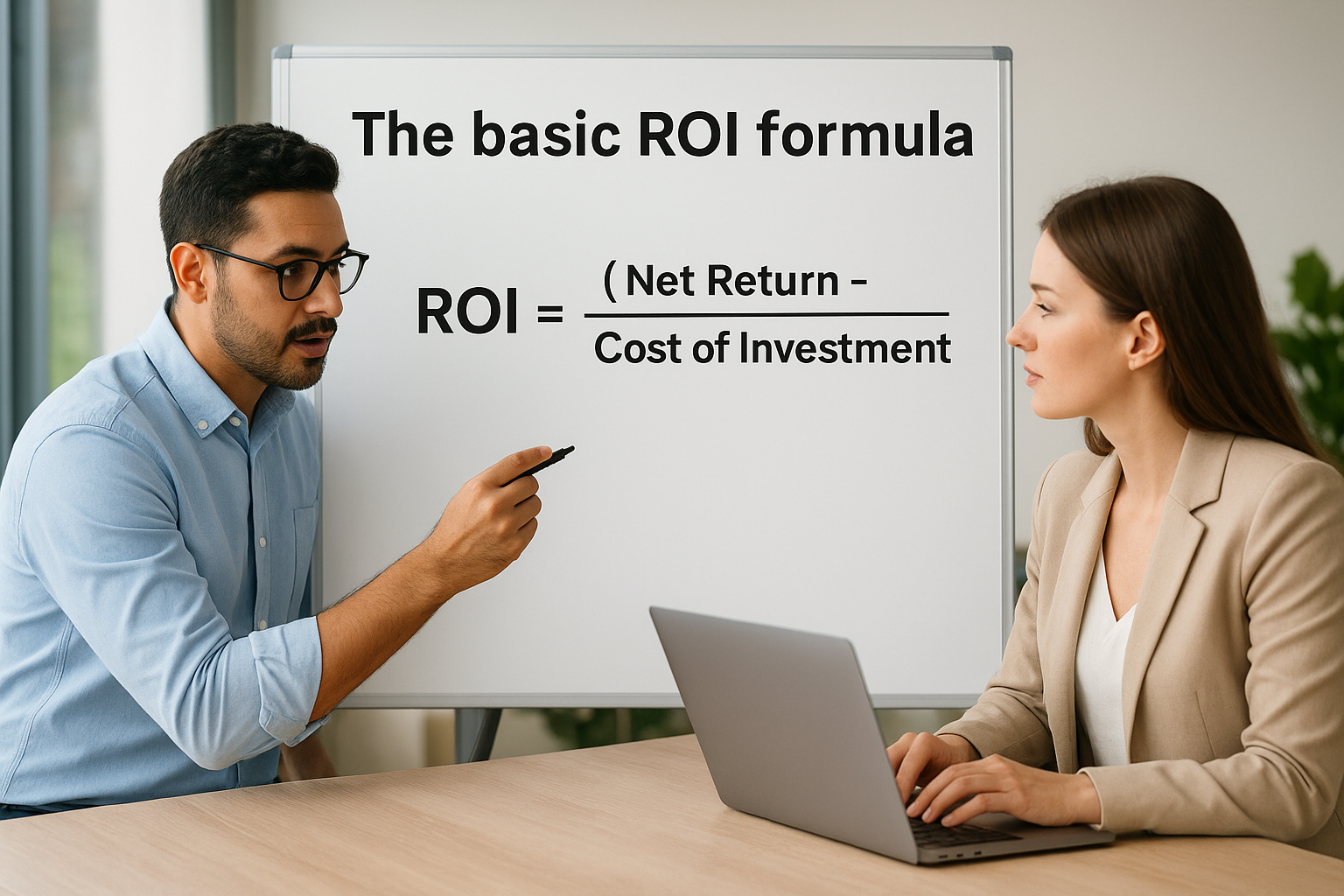
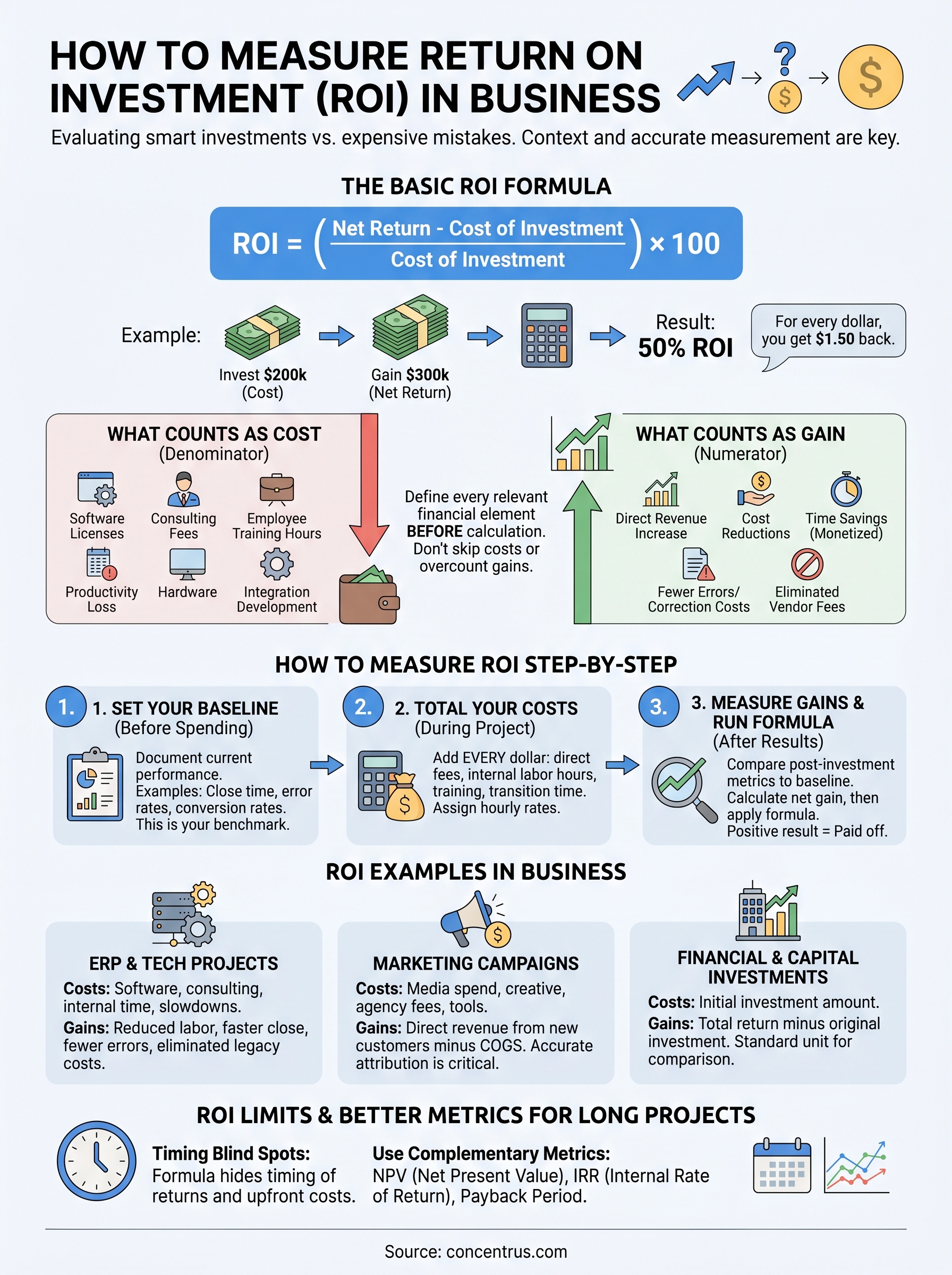
Most finance teams already know the formula, but it’s worth stating clearly so everyone on your team is working from the same definition. ROI = ((Net Return – Cost of Investment) / Cost of Investment) × 100. If you invested $200,000 in a new system and it generated $300,000 in measurable gains, your ROI is 50%. That means for every dollar you put in, you got $1.50 back.
The formula only tells you something useful if the numbers you feed into it are accurate and complete.
What counts as cost and what counts as gain
This is where most ROI calculations break down. Teams either undercount costs or overcount gains, and both errors produce numbers that create false confidence. When you’re working through how to measure return on investment for a real project, every relevant cost needs to make it into the denominator, including implementation fees, internal labor, training time, productivity loss during transition, and ongoing maintenance.
On the gain side, you need to be equally disciplined. Direct revenue increases, cost reductions, and time savings that translate into dollar figures all qualify. Gains that are difficult to quantify, like improved team morale or better data visibility, should be noted separately rather than forced into the formula with speculative numbers.
Here’s a breakdown of what belongs on each side:
- Costs to include: software licenses, consulting fees, employee training hours, productivity loss during rollout, hardware, and integration development
- Gains to include: reduced labor costs, higher revenue from faster fulfillment, fewer errors and their correction costs, eliminated vendor fees, and faster financial close cycles
How to measure ROI step by step
Once you know what belongs in the formula, you can work through the calculation in a structured sequence. Skipping steps or estimating loosely at any point will undermine the reliability of your final number. The process below gives you a repeatable framework for how to measure return on investment across any type of project or spend.
Step 1: Set your baseline before spending begins
Before you commit capital, document your current performance metrics in writing. If you’re evaluating an ERP upgrade, record your current month-end close time, error rates, and labor hours spent on manual processes. If it’s a marketing campaign, capture your current conversion rate and cost per acquisition. These baseline numbers become the benchmark that your post-investment results will be compared against.
Without a clear baseline, you’re comparing your results to nothing, which means you can’t actually prove the investment worked.
Without this step, any gains you measure later are estimates at best and guesses at worst. Write the baselines down and date them before the project starts.
Step 2: Total your costs completely
Add up every dollar connected to the investment. Direct costs like software fees and consulting charges are obvious, but internal costs are just as real. Count the hours your team spends in training, in meetings, and in transition. Assign an hourly rate to that time and include it in your total. Incomplete cost totals are the single most common reason ROI calculations produce inflated results that fall apart under scrutiny.
Step 3: Measure your gains and run the formula
After the investment has had enough time to produce results, measure the same metrics you captured in Step 1. Calculate the dollar value of the improvement, subtract your total costs, divide that net gain by total costs, and multiply by 100. The result tells you the exact percentage return you generated.
A positive number means the investment paid off; a negative number signals that you need to investigate whether the project was scoped correctly, executed properly, or simply needs more time to deliver its full impact.
ROI examples in business, marketing, and investing
Knowing how to measure return on investment is more useful when you can see it applied to real scenarios. The formula works the same way across industries, but the specific costs and gains you track will change depending on what you’re evaluating. These three examples show you how to define each side of the equation in different business contexts.
ERP and technology projects
When you implement an ERP system, your costs include software licensing, consulting fees, internal training hours, and productivity slowdowns during the rollout. On the gain side, you measure reductions in labor time, faster financial close cycles, fewer manual errors, and eliminated legacy system costs. If your company spends $400,000 on an ERP implementation and the system generates $600,000 in documented savings over two years through reduced headcount, faster reporting, and fewer write-offs, your ROI lands at 50%.
Tie every technology investment to specific operational metrics before the project starts, or you’ll have no credible way to measure what the system actually returned.
Marketing campaign ROI
For a marketing campaign, your costs cover media spend, creative production, agency fees, and any tools or software used to run the campaign. Your gain is the revenue directly attributed to that campaign, minus the cost of goods sold on those sales. If you spent $50,000 running a campaign that generated $120,000 in gross profit from new customers, your ROI is 140%. Tracking attribution accurately is critical here because inflated revenue figures will make a weak campaign look like a winner.
Financial and capital investment ROI
For traditional financial investments, the calculation is straightforward. Your cost is the amount you invested, and your gain is the total return minus that original amount. If you put $100,000 into equipment that increased production capacity and generated $160,000 in additional net revenue over three years, your ROI is 60%. Investors and finance teams use this same structure to compare asset purchases, acquisitions, and capital projects against each other with a consistent standard.
ROI limits and better metrics for long projects
ROI is a powerful filter, but it has real blind spots that can mislead you if you treat it as the only number that matters. The formula compresses everything into a single percentage, which works well for short-term investments with clear start and end points. When you’re evaluating a multi-year ERP implementation or a long-term infrastructure upgrade, that compression hides information you actually need to make good decisions.
When ROI gives you a misleading picture
The most common problem with standard ROI calculations on long projects is that they ignore the timing of returns. A project that returns 80% over five years looks identical in the formula to one that returns 80% in 18 months, but those are completely different outcomes from a cash flow perspective. You also run into issues when upfront costs are heavy and gains arrive slowly, which makes early-stage ROI calculations look negative even for investments that will eventually perform well.
When you’re deciding how to measure return on investment on a project that spans multiple years, the standard formula alone will not give you the full picture.
Better metrics to use alongside ROI
Net Present Value (NPV) and Internal Rate of Return (IRR) both account for the time value of money, which makes them far more accurate for long-horizon investments. NPV tells you the present dollar value of all future returns minus your initial cost, so you’re comparing apples to apples regardless of when the gains actually land. IRR gives you the annualized growth rate your investment generates, which lets you benchmark it against your cost of capital or other available opportunities.
For operational projects like ERP implementations, payback period is another metric worth tracking alongside ROI. It tells you exactly how long it takes to recover your initial investment, which matters for cash flow planning. Using these three metrics together gives you a complete view that no single number can provide on its own.
Wrap-up and next steps
Knowing how to measure return on investment is only useful if you apply the framework consistently before spending begins, not after the money is gone. The ROI formula, combined with NPV, IRR, and payback period, gives you a complete picture of whether an investment is worth making and whether it delivered what you expected. That combination of metrics removes guesswork from budget decisions and gives your leadership team a defensible basis for every capital commitment.
For ERP projects specifically, measurement needs to start at the project kickoff, not at go-live. Defining your baseline metrics, expected financial outcomes, and tracking checkpoints from day one is what separates implementations that generate documented returns from ones that stall out with no clear story to tell. If you want a consulting partner who builds ROI accountability into every phase of your ERP project, explore how Concentrus connects ERP investment to measurable financial outcomes.