

Your Acumatica ERP holds enormous potential, but that potential stays locked until your systems actually talk to each other. Disconnected data between your ERP, CRM, e-commerce platform, and financial tools creates manual workarounds, reporting delays, and costly errors that chip away at your margins. The right Acumatica integration services can eliminate these gaps and turn your ERP into the single source of truth your finance team needs.
At Concentrus, we’ve guided midsized companies through ERP implementations and rescues for years, and we’ve seen firsthand how integration strategy separates high-ROI deployments from expensive disappointments. The difference isn’t just technical, it’s financial. CFOs who prioritize integration from day one close faster, forecast more accurately, and scale without the chaos of disconnected workflows.
This guide breaks down seven Acumatica integration services worth evaluating in 2026. We’ll cover what each offers, where they fit best, and how to assess them through a CFO-grade ROI lens, because every integration decision should tie directly back to measurable business outcomes. Whether you’re mid-implementation or rescuing an underperforming system, these options can help you reclaim the value your ERP investment should deliver.
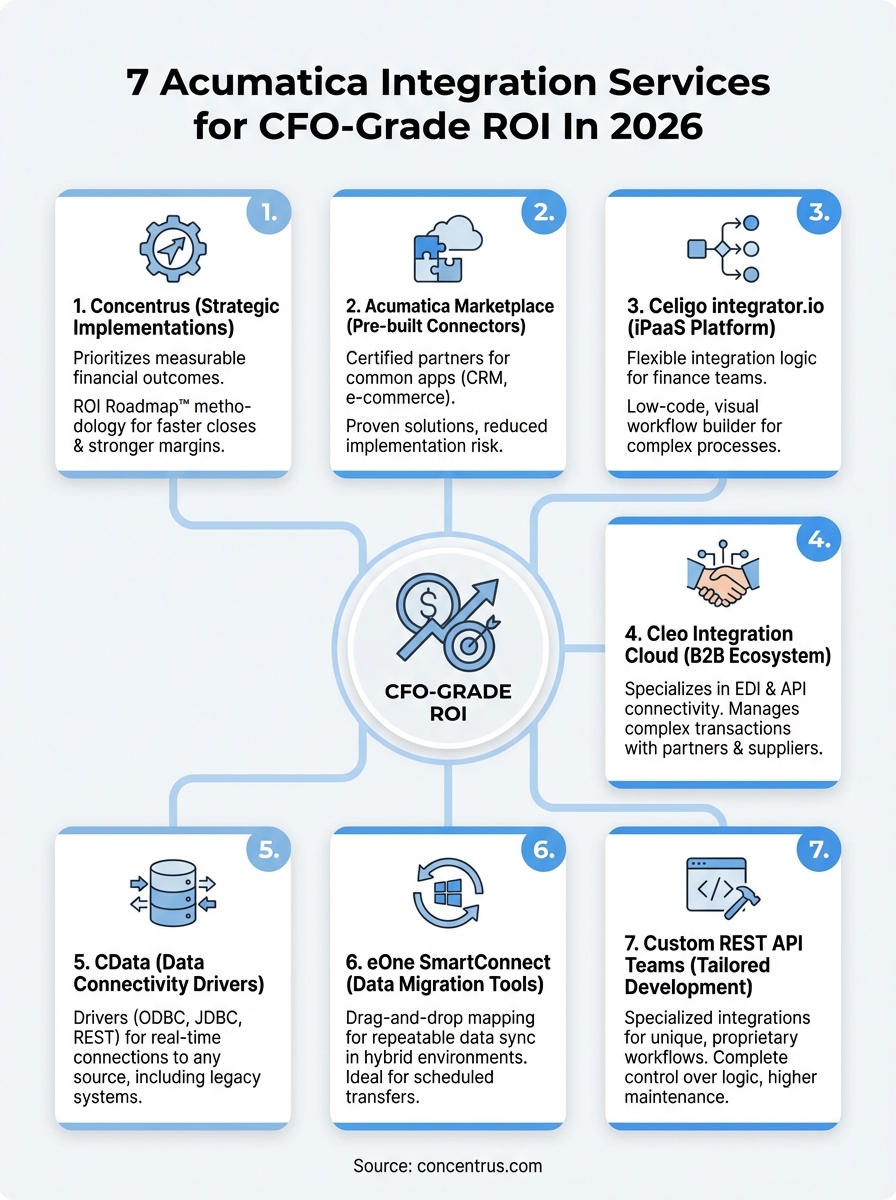
1. Concentrus
Concentrus specializes in Acumatica ERP implementations that prioritize measurable financial outcomes over technical checkboxes. Unlike traditional integrators who focus on feature deployment, we build your integration architecture around the specific ROI milestones your CFO needs to hit. Our ROI Roadmap™ methodology ensures every connection between Acumatica and your existing systems directly supports faster closes, stronger margins, or improved cash flow visibility.
What Concentrus delivers
We handle end-to-end Acumatica integration strategy, from initial discovery through post-go-live optimization. Our team maps your current data flows, identifies the highest-impact connections, and designs an integration blueprint that eliminates manual reconciliation and duplicate data entry. You get a partner who understands both the technical side of Acumatica integration services and the financial metrics that matter to your board.
The work includes API configuration, third-party connector selection through our Concentrus Partner Network™, custom workflow automation, and ongoing performance monitoring tied to your KPIs. We don’t hand you a system and walk away. Instead, we stay accountable to the ROI targets we set together at the beginning.
Where Concentrus fits in an Acumatica stack
Concentrus operates as your strategic integration partner before you commit to specific tools or vendors. We evaluate which connectors make sense for your business model, whether that means leveraging native Acumatica APIs, deploying pre-built marketplace integrations, or building custom solutions where off-the-shelf options fall short. Our role is to ensure every integration decision aligns with your financial objectives and scales as you grow.

The best integration strategy starts with ROI mapping, not technology selection.
CFO-grade ROI outcomes to target
Focus on these measurable impacts when evaluating our work: days to close reduction (typically 30-50% faster monthly close cycles), elimination of manual data entry hours (often 15-20 hours per week recovered), improved forecast accuracy through real-time data visibility, and reduced audit risk from automated reconciliation. You should also track inventory turns, order-to-cash cycle time, and supplier payment optimization as integration unlocks better working capital management.
Typical pricing and engagement model
Our engagements follow a fixed-fee structure tied to specific ROI milestones. You pay based on defined deliverables and performance outcomes, not hourly rates that incentivize dragging out timelines. Typical projects range from $50,000 to $250,000 depending on integration complexity, number of systems involved, and customization requirements. We include quarterly ROI reviews to ensure you’re hitting the financial targets we committed to.
Implementation timeline and governance
Plan for 12 to 24 weeks from kickoff to full production, with weekly steering committee meetings that include your CFO or controller. We use a phased rollout approach that prioritizes high-ROI integrations first, so you start seeing financial impact before the entire project completes. Each phase includes specific KPI checkpoints that must be met before moving forward.
Questions to ask before you sign
Ask these before committing to any engagement:
- What specific ROI metrics will you track and report on throughout the project?
- How do you handle integrations that fail to deliver promised outcomes?
- What governance structure ensures our CFO stays informed and in control?
- Can you show case studies with verified financial impact, not just technical success?
2. Acumatica Marketplace partners
The Acumatica Marketplace offers pre-built integrations from certified partners who specialize in connecting specific business applications to your ERP. These partners provide tested connectors that handle common integration needs without custom development. You gain access to proven solutions that other Acumatica customers have already deployed, reducing implementation risk and accelerating time to value.
What Marketplace partners typically deliver
Marketplace partners provide pre-configured connectors that link Acumatica to platforms like CRM systems, e-commerce sites, payment processors, and warehouse management tools. You get documented APIs, support resources, and often industry-specific workflows built into the integration. These solutions eliminate the need to build connections from scratch, though you still need proper configuration to match your specific business processes.
Common integration categories to prioritize
Focus on integrations that directly impact your financial close process: CRM-to-ERP for automated revenue recognition, e-commerce platforms for real-time order syncing, payment gateways for faster cash application, and shipping systems for accurate COGS tracking. Your AP automation and bank reconciliation tools should also sit high on the priority list if manual entry currently slows your monthly close.
CFO-grade ROI outcomes to target
Track days to close reduction, elimination of duplicate data entry hours, improved working capital visibility through real-time inventory updates, and reduced error rates in revenue recognition. You should also measure the impact on forecast accuracy as synchronized data eliminates version control issues across systems.
The right marketplace integration turns hours of manual reconciliation into minutes of automated validation.
Typical pricing and engagement model
Most marketplace partners charge annual subscription fees ranging from $3,000 to $25,000 based on transaction volume and feature complexity. Implementation typically adds another $5,000 to $15,000 for configuration and testing. You pay separately for the connector license and the partner’s setup services.
Implementation timeline and governance
Expect 4 to 12 weeks from contract signature to production launch. Your controller or finance manager needs to participate in weekly checkpoints to validate data mapping and approve workflow changes before go-live.
Questions to ask before you sign
Ask these questions: How many Acumatica customers currently use this integration in production? What specific financial processes will this automate? Who handles ongoing support when issues arise? Can you provide references from companies with similar integration complexity?
3. Celigo integrator.io
Celigo provides an iPaaS (integration platform as a service) designed to connect Acumatica with other cloud applications through pre-built connectors and customizable workflows. The platform targets finance teams who need flexible integration logic without relying on developers for every change. You get a visual workflow builder that lets your team modify data mappings and business rules as your processes evolve.
What Celigo delivers
Celigo offers pre-built Acumatica integrations for platforms like Salesforce, Shopify, Amazon, and other commonly used business applications. The platform includes error handling, data transformation tools, and monitoring dashboards that give your finance team visibility into integration performance. You can build custom workflows using their low-code interface when pre-built templates don’t match your specific requirements.
Where Celigo fits in an Acumatica stack
Deploy Celigo when you need complex data transformations or multi-step workflows between Acumatica and other systems. The platform works best for organizations running multiple SaaS applications that require synchronized data but have unique business rules that standard connectors can’t handle.
Celigo’s strength lies in giving finance teams control over integration logic without waiting on IT resources.
CFO-grade ROI outcomes to target
Measure order-to-cash cycle time reduction, elimination of manual data mapping hours, improved inventory accuracy through real-time syncing, and faster month-end close from automated revenue recognition. Track error rates in data transfers as Celigo’s monitoring tools should catch and flag issues before they impact your financial reports.
Typical pricing and engagement model
Celigo charges annual subscription fees starting around $15,000 for basic integrations, scaling based on transaction volume and complexity. Implementation services typically add $10,000 to $30,000 depending on customization needs.
Implementation timeline and governance
Plan for 6 to 12 weeks from kickoff to production. Your finance manager needs to participate in weekly workflow reviews to validate data mappings and business rule configurations.
Questions to ask before you sign
Ask these questions: What happens when integration errors occur outside business hours? How do you handle API rate limits across connected systems? Can you demonstrate a similar acumatica integration services deployment in our industry?
4. Cleo Integration Cloud
Cleo specializes in B2B ecosystem integration, focusing on EDI, API connectivity, and supply chain data exchange. The platform targets organizations that need to connect Acumatica with trading partners, suppliers, and logistics providers through standardized data formats. You get a managed integration service that handles the complexity of B2B transactions without requiring your team to become EDI experts.
What Cleo delivers
Cleo provides pre-built connectors for EDI transactions, API integrations, and file-based data transfers between Acumatica and external partners. The platform includes trading partner onboarding, data transformation tools, and monitoring capabilities that track transaction success rates across your supply chain network. Your team gains visibility into order acknowledgments, advance ship notices, and invoicing flows that previously required manual tracking.

Where Cleo fits in an Acumatica stack
Deploy Cleo when your business depends on high-volume B2B transactions with multiple trading partners who require EDI or API connectivity. The platform sits between Acumatica and your external ecosystem, handling protocol translation and data mapping so your ERP receives standardized information regardless of partner requirements.
CFO-grade ROI outcomes to target
Track order processing time reduction, elimination of manual EDI entry hours, improved supplier payment accuracy through automated invoice matching, and reduced chargebacks from shipping errors. Measure the impact on days sales outstanding as faster order confirmations accelerate billing cycles.
Typical pricing and engagement model
Cleo charges annual subscription fees starting around $20,000, scaling based on transaction volume and trading partner count. Implementation typically adds $15,000 to $40,000 for partner onboarding and workflow configuration.
B2B integration directly impacts your working capital velocity through faster, error-free transactions.
Implementation timeline and governance
Expect 8 to 16 weeks from contract signature to full production, with each trading partner requiring individual onboarding and testing cycles.
Questions to ask before you sign
Ask these questions: How many trading partners can you onboard simultaneously? What happens when a partner changes their EDI requirements? Who manages ongoing partner relationship issues?
5. CData connectivity and integration tools
CData provides data connectivity drivers and integration tools that create real-time connections between Acumatica and virtually any data source through standardized protocols. The platform offers pre-built drivers for databases, SaaS applications, and legacy systems that your finance team can use to build custom data flows without extensive coding. You get flexibility to connect Acumatica with specialized applications that lack native integrations or marketplace options.
What CData delivers
CData delivers ODBC, JDBC, and REST API drivers that treat external data sources as if they were native Acumatica tables. Your team can query CRM data, pull in spreadsheet information, or sync with legacy accounting systems using standard SQL syntax. The platform includes data replication tools that maintain synchronized copies of critical information across systems for reporting and analytics purposes.
Where CData fits in an Acumatica stack
Deploy CData when you need to connect Acumatica with niche applications or legacy systems that other acumatica integration services don’t support. The platform works best for reporting scenarios where your finance team needs to combine Acumatica data with information from specialized industry tools or homegrown systems.
CData’s driver approach gives you integration flexibility when pre-built connectors don’t exist for your specific systems.
CFO-grade ROI outcomes to target
Track reporting automation hours saved through direct data access, improved forecast accuracy from consolidated data sources, and reduced IT dependency for standard data queries. Measure the elimination of manual export/import cycles that currently delay your financial analysis.
Typical pricing and engagement model
CData charges annual subscription fees starting around $2,000 per driver, with enterprise packages ranging from $10,000 to $50,000 based on the number of connections needed.
Implementation timeline and governance
Expect 4 to 8 weeks for initial driver setup and testing, with each additional data source requiring separate configuration cycles.
Questions to ask before you sign
Ask these questions: Which specific Acumatica data objects can your drivers access? How do you handle API version changes? What performance impact occurs with large data volumes?
6. eOne SmartConnect
eOne SmartConnect offers data integration and migration tools originally built for Microsoft Dynamics but now extended to support Acumatica connectivity. The platform provides drag-and-drop mapping interfaces that let your finance team build and maintain integrations without deep technical expertise. You get a Windows-based application that handles both one-time data migrations and ongoing scheduled integrations between Acumatica and other business systems.
What eOne delivers
SmartConnect provides pre-built data adapters for common business applications, databases, and file formats that connect directly to Acumatica. The platform includes field mapping tools, data transformation capabilities, and scheduling features that automate recurring data transfers. Your team can configure integrations that move customer records, sales orders, inventory updates, or financial transactions between systems based on time-triggered or event-driven workflows.
Where eOne fits in an Acumatica stack
Deploy SmartConnect when you need repeatable data synchronization between Acumatica and on-premise systems or legacy applications that other acumatica integration services struggle to reach. The platform works best for organizations with hybrid IT environments that require connections to both cloud applications and local databases.
SmartConnect’s desktop architecture gives you control over data flows that traverse both cloud and on-premise environments.
CFO-grade ROI outcomes to target
Measure data entry elimination in hours per week, improved customer master data accuracy through automated synchronization, and reduced month-end close time from scheduled financial data transfers. Track error rates in manual imports that SmartConnect’s validation rules should eliminate before data reaches your ERP.
Typical pricing and engagement model
eOne charges perpetual license fees starting around $6,000 for basic configurations, with annual maintenance adding 18-20% of license cost.
Implementation timeline and governance
Plan for 4 to 10 weeks from purchase to production deployment, depending on integration complexity and testing requirements.
Questions to ask before you sign
Ask these questions: Does your platform support both real-time and batch integration modes? How do you handle Acumatica API updates? What happens when source data fails validation rules?
7. Custom Acumatica REST API integration teams
Custom development teams build specialized integrations using Acumatica’s REST API when pre-built connectors can’t handle your unique business processes. These teams write custom code that connects your ERP to proprietary systems, industry-specific applications, or complex workflows that standard acumatica integration services don’t address. You gain complete control over integration logic at the cost of higher upfront investment and ongoing maintenance responsibility.
What custom API integration delivers
Custom API work creates tailored connections between Acumatica and systems that lack marketplace integrations or require unique data transformations. Development teams build middleware applications that handle authentication, data mapping, error handling, and business rule enforcement specific to your financial workflows. You get integrations that match your exact requirements rather than adapting your processes to fit pre-built tools.
Where custom API work fits in an Acumatica stack
Deploy custom API integrations when your competitive advantage depends on proprietary workflows that off-the-shelf solutions can’t support. These solutions work best for organizations with internal IT resources who can maintain custom code long-term or businesses where process differentiation justifies the investment.
Custom API integration makes sense when your unique workflows create measurable competitive value that standard tools eliminate.
CFO-grade ROI outcomes to target
Track process automation hours saved, elimination of manual workarounds that custom integration replaces, and competitive advantages gained from proprietary data flows. Measure the financial impact of unique capabilities that drive customer retention or operational efficiency unavailable through standard integrations.
Typical pricing and engagement model
Custom development charges project-based fees ranging from $25,000 to $150,000 depending on complexity and scope. Budget additional 10-20% annually for ongoing maintenance and updates as Acumatica’s API evolves.
Implementation timeline and governance
Expect 12 to 24 weeks from requirements gathering to production deployment, with monthly technical reviews involving your IT leadership and finance stakeholders.
Questions to ask before you sign
Ask these questions: Who owns the code after project completion? How do you handle Acumatica API version changes? What documentation will you provide for future maintenance?
Next steps for picking the right partner
Choosing the right acumatica integration services partner starts with defining your CFO-grade ROI targets before evaluating vendors. Document the specific financial outcomes you need, whether that means faster monthly close cycles, eliminated manual hours, or improved forecast accuracy. Then map each potential partner against those outcomes rather than comparing feature lists or technology stacks.
Your next move should focus on vendor accountability. Ask each partner how they measure success, what happens when integrations fail to deliver promised results, and who owns ongoing performance tracking. The best partnerships include quarterly ROI reviews where your finance leadership validates actual outcomes against committed milestones.
If you need a partner who builds integration strategy around measurable financial impact rather than technical capabilities, Concentrus delivers Acumatica implementations designed for CFO accountability from day one. Our ROI Roadmap™ methodology ensures every integration decision ties directly to the KPIs your board expects you to hit.