Most ERP projects don’t fail because of the software. They fail because the organization wasn’t ready for the change that comes with it. That’s exactly why the Kotter Change Model matters, especially if you’re a CFO or finance leader about to invest in (or rescue) a major technology initiative. John Kotter’s 8-step framework gives you a structured approach to moving people through organizational transformation, from building initial momentum to making changes stick long after go-live.
Kotter developed this model after studying over 100 organizations going through large-scale change. What he found was consistent: companies that skipped steps or underestimated the human side of transformation struggled to sustain results. Companies that followed a deliberate sequence of leadership actions had a far better chance of reaching their goals. For midsized companies implementing or optimizing NetSuite or Acumatica ERP systems, that insight is worth its weight in gold.
At Concentrus, we see this play out constantly. Our ROI Roadmap™ methodology succeeds in part because it addresses the same core challenge Kotter identified, aligning people around measurable outcomes, not just deploying technology. Understanding his framework can sharpen how you lead your next ERP initiative and protect the ROI you’re counting on.
This article breaks down all eight steps of the Kotter Change Model, walks through real-world examples, and shows you how to apply each phase to drive lasting organizational change. Whether you’re planning a new implementation or recovering a stalled one, these principles will give you a practical playbook to lead the transition with confidence.
What the Kotter change model is
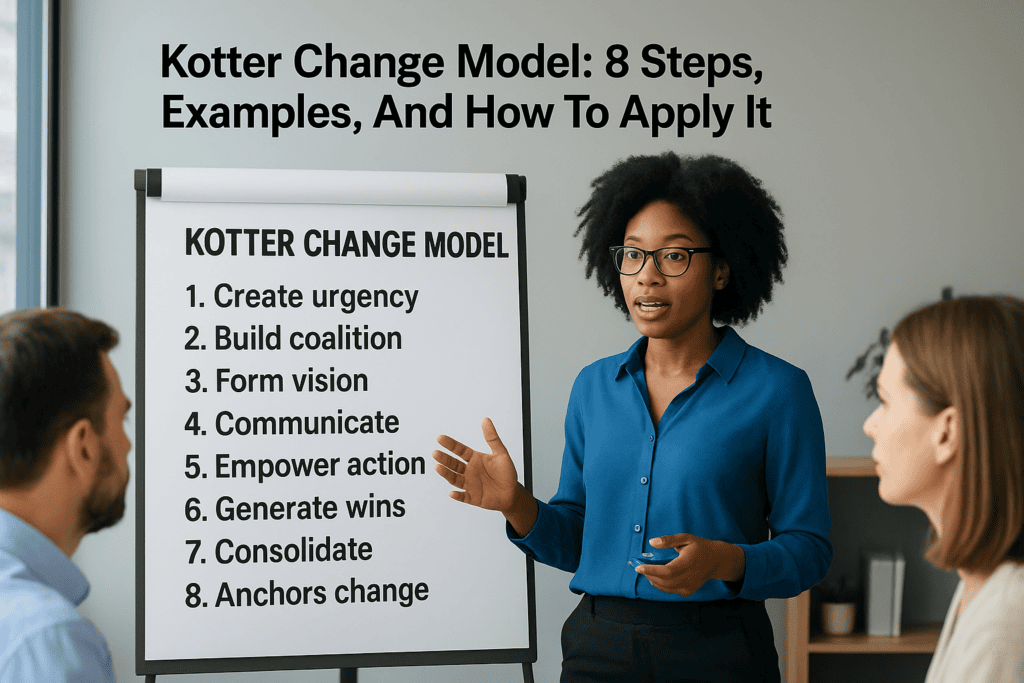
The Kotter Change Model is an 8-step framework for leading organizational transformation, developed by Dr. John Kotter, a professor at Harvard Business School. Kotter introduced it in his 1996 book Leading Change after studying more than 100 companies that had attempted large-scale change initiatives. His research identified consistent patterns in why some transformations succeeded while others failed, and the model translates those patterns into a clear, sequential process that any organization can follow.
The origin and purpose of the model
Kotter published his foundational research in a 1995 Harvard Business Review article before expanding it into a full book. His central observation was that most change efforts fail not because of flawed strategy, but because leaders consistently underestimate how much work it takes to shift human behavior and organizational culture. The model was designed to give leaders a roadmap that addresses both the strategic and psychological dimensions of change, making it one of the most widely cited change management frameworks in business literature.
The Kotter change model treats people as the core variable in any transformation, not the technology or the process.
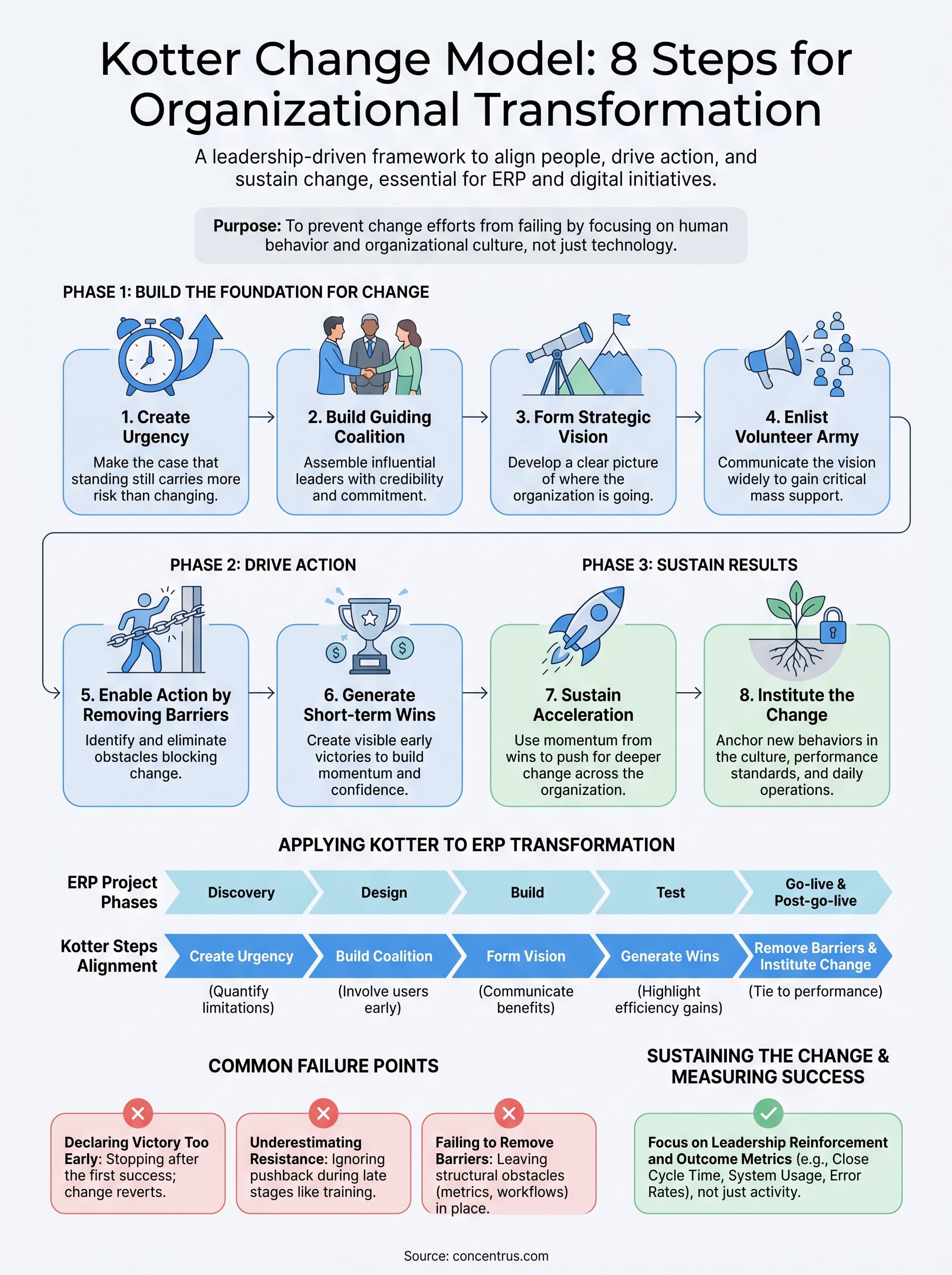
The model organizes change into three broad phases: building the foundation for change (steps 1 through 4), enabling and driving action (steps 5 through 7), and sustaining the transformation (step 8). Each step is intentionally sequential because Kotter found that skipping ahead, particularly moving to execution before you have alignment and momentum, is one of the leading causes of failed change efforts. When you treat the steps as optional or interchangeable, you risk losing the organizational buy-in that holds the entire initiative together.
The core logic behind the 8 steps
What makes the framework distinctive is its emphasis on leadership behavior over project management mechanics. Many change models focus on process milestones and deliverables. Kotter focuses on what leaders need to do at each stage to keep people engaged and moving forward. Urgency, coalition, and shared vision do more work in this model than timelines and task lists, because Kotter recognized that transformation is fundamentally a social process, not a logistical one.
Each step also builds on the one before it, which means momentum compounds as you progress. You create urgency to motivate people to join a guiding coalition. That coalition develops a vision. The vision gets communicated to generate broader support. Broader support empowers people to act and remove obstacles. Early wins from that action fuel confidence for deeper change. And that deeper change eventually becomes embedded in the culture and daily behavior of the organization. Remove any link in that chain, and the whole process becomes fragile.
For CFOs and finance leaders, this logic has direct implications for how you structure and lead an ERP implementation. The most common reason ERP projects stall or fail is not a technical deficiency; it’s a failure to bring the organization along at every stage. When you apply Kotter’s sequential thinking to your ERP initiative, you shift from managing a technology project to leading a business transformation with measurable outcomes at the center, which is a fundamentally different and far more effective approach to protecting the ROI you’re counting on.
When Kotter works best and when it doesn’t
The Kotter change model is a powerful tool, but like any framework, it has a defined range of problems it solves well and situations where it isn’t the right fit. Understanding where it thrives and where it struggles helps you apply it more effectively and avoid forcing a methodology onto a challenge it wasn’t designed to handle.
Where the Kotter change model performs well
Kotter’s framework was built for large-scale, complex transformations where organizational culture and human resistance are the primary obstacles to success. It works best when the change is significant enough to require broad adoption across multiple departments or leadership levels. If you’re deploying a new ERP system, restructuring a finance function, or overhauling a core operational process, the sequential, leadership-driven approach that Kotter prescribes fits the challenge directly.
The model is most effective when leaders are willing to invest in alignment before they invest in execution.
It also performs well in organizations where senior leadership has the authority and commitment to drive each phase actively. Because the model depends on visible coalition-building and consistent communication from the top, it rewards environments where executives lead from the front. If your executive team is aligned on the goal and willing to stay engaged throughout the process, Kotter gives you a structured way to convert that alignment into measurable outcomes.
Where it falls short
The model is less suited to situations that require rapid iteration or short decision cycles. If your organization is responding to a fast-moving market shift or needs to test and adjust quickly, the sequential nature of Kotter’s steps can slow you down. Each phase builds on the last, which is a strength in deliberate transformations but a bottleneck when speed and flexibility matter more than thoroughness.
Kotter also relies heavily on top-down leadership engagement, which can create friction in organizations with flat hierarchies or strong autonomous teams. If decision-making in your company is distributed and leadership is more facilitative than directive, the guiding coalition structure may feel forced. In those environments, models that emphasize individual-level change or peer-driven adoption tend to generate faster buy-in and more durable results than a framework built around centralized leadership momentum.
The 8 steps in the Kotter change model
The Kotter change model organizes transformation into eight sequential steps that build on each other progressively. Skipping or rushing any step weakens the stages that follow it, which is why the sequence itself matters as much as the individual actions within each phase. These steps give you a concrete structure to follow rather than relying on intuition alone during a high-stakes initiative.
Steps 1-4: Build the foundation for change
The first four steps focus on creating the conditions for transformation before you move into execution. Without this foundation, even well-designed initiatives lose momentum the moment they encounter organizational resistance, and that resistance is almost always present in large-scale change.
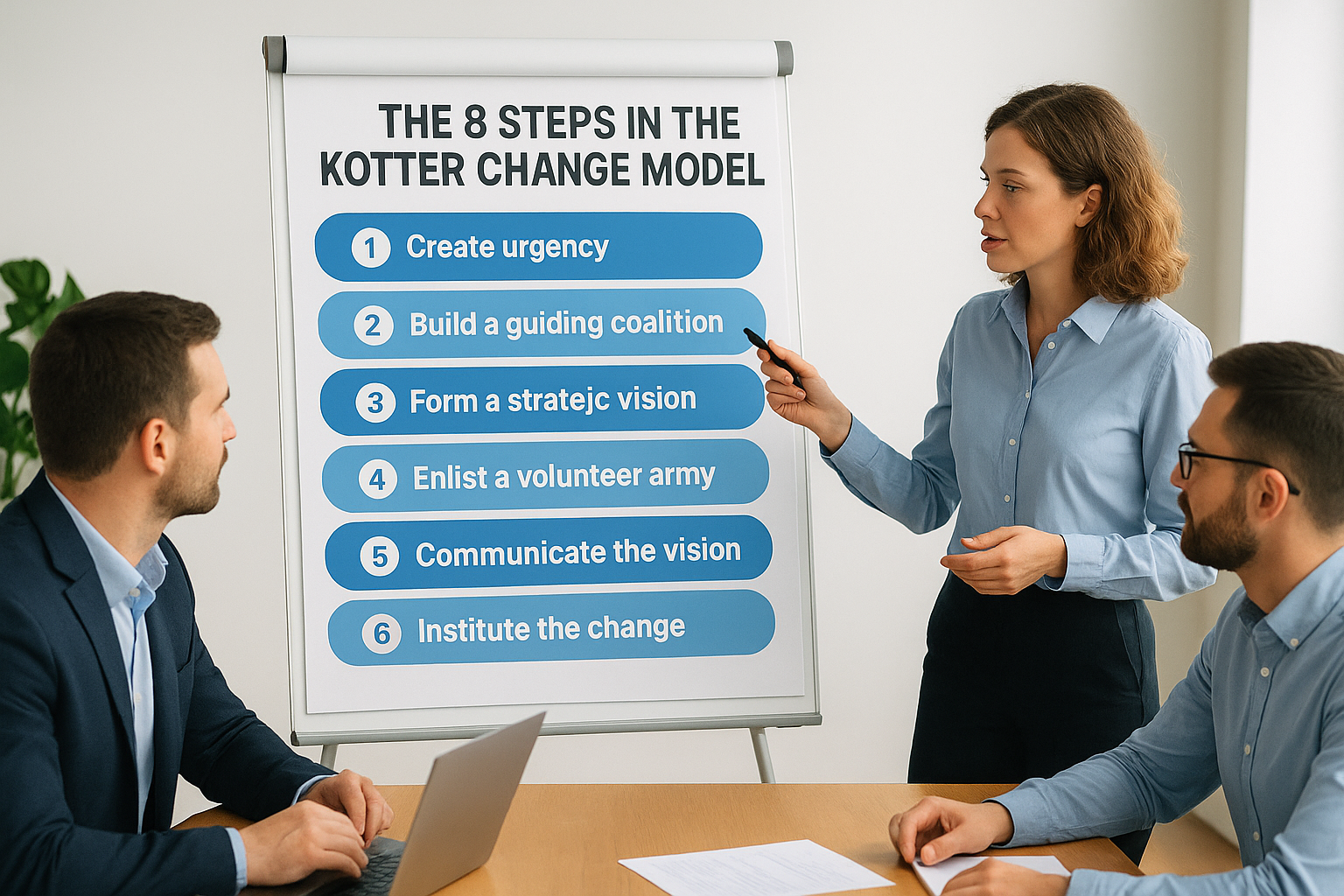
- Create urgency. Make the case that standing still carries more risk than changing. Use data, financial exposure, and competitive pressure to help your leadership team feel the need to act now, not eventually.
- Build a guiding coalition. Assemble a group of influential leaders across departments who have the credibility and commitment to drive the initiative forward together.
- Form a strategic vision. Develop a clear, concise picture of where the organization is going and what the change will deliver in concrete terms.
- Enlist a volunteer army. Communicate the vision widely and consistently so that a critical mass of people understands, believes in, and actively supports the direction.
A guiding coalition without a clear vision is just a committee. The vision is what gives the coalition its power to move people.
Steps 5-8: Drive action and sustain results
Once the foundation is in place, the next four steps shift from alignment to execution and reinforcement. These steps are where the real work of transformation happens, and where most organizations lose ground by declaring victory too early.
- Enable action by removing barriers. Identify and eliminate the structural, cultural, or process obstacles that block people from contributing to the change effort.
- Generate short-term wins. Create visible early victories that build confidence and demonstrate that the change is producing real results.
- Sustain acceleration. Use the momentum from early wins to push deeper changes across more of the organization rather than slowing down after initial success.
- Institute the change. Anchor new behaviors in the culture by tying them to performance standards, hiring practices, and daily operations so the transformation outlasts the original project team.
How to apply Kotter to an ERP transformation
Applying the Kotter change model to an ERP project requires you to treat the eight steps as a parallel track to your technical implementation, not something you handle after the system is live. Most ERP timelines focus heavily on configuration, data migration, and testing, but those milestones don’t account for the organizational work that determines whether people actually use the system the way you need them to. Running the Kotter framework alongside your technical project plan gives you a structured way to build adoption at the same pace as deployment.
Map each step to your ERP project phases
Your ERP project already has phases: discovery, design, build, test, and go-live. Each of those phases maps naturally to specific Kotter steps, which means you don’t have to create a separate change management project. You embed the Kotter actions into the work you’re already doing, keeping change leadership and technical execution moving in the same direction at the same time.
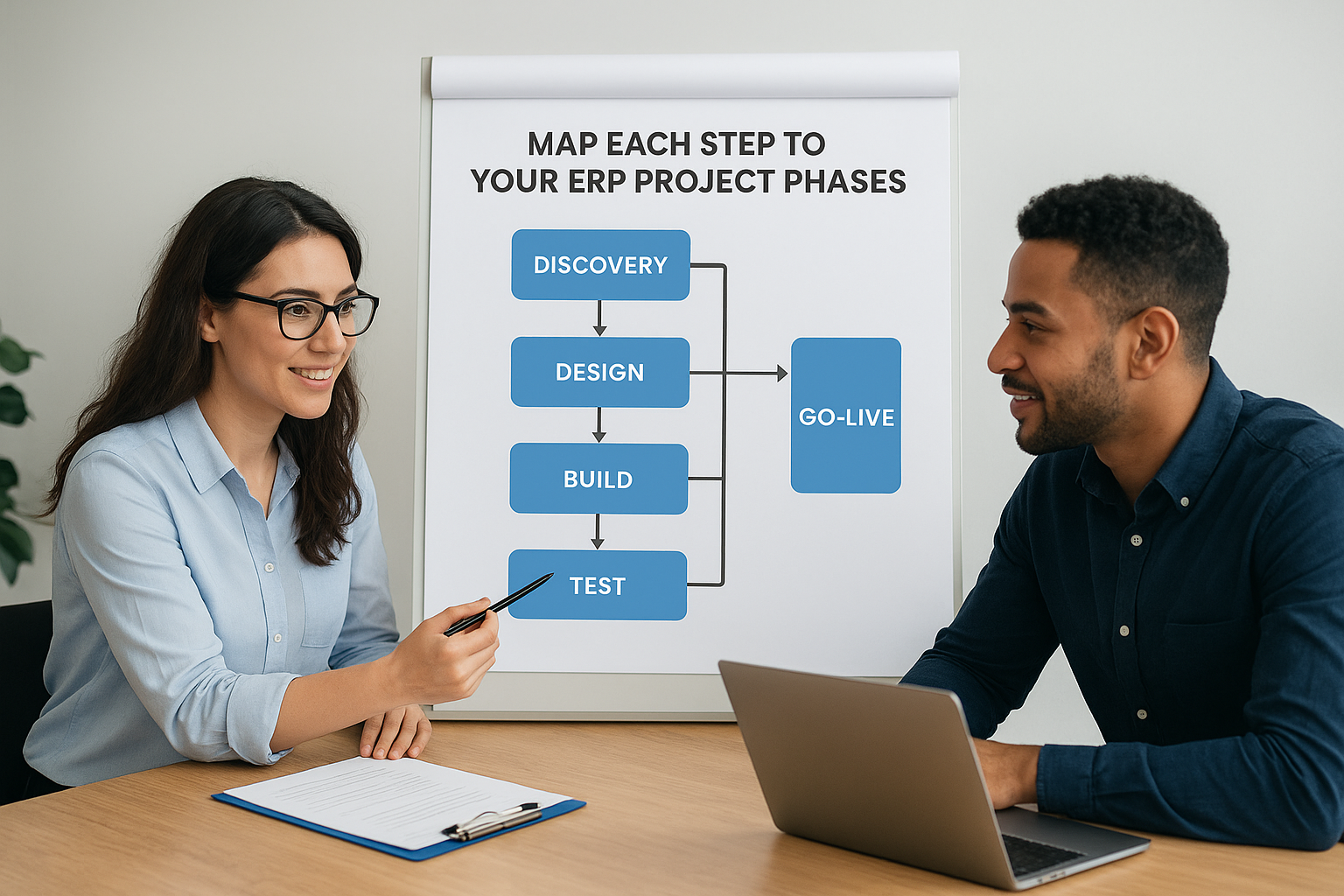
Treating change management as a parallel workstream, not an afterthought, is what separates ERP projects that deliver ROI from those that don’t.
Use this alignment as a starting point:
- Discovery phase: Create urgency by documenting the financial cost of your current system’s limitations and sharing that data with department heads.
- Design phase: Build your guiding coalition by pulling key users and functional leads into design decisions so they have ownership from the start.
- Build phase: Form and communicate your strategic vision so the broader team understands what the system will deliver, not just what it will do.
- Testing phase: Generate short-term wins by highlighting early efficiency gains from UAT feedback and showcasing what the system already does well.
- Go-live and post-go-live: Remove barriers, sustain acceleration, and begin anchoring new behaviors into daily workflows and performance expectations.
Address the human side before go-live
Finance leaders often underestimate how much resistance surfaces during testing and training, well before anyone logs into the production system. Employees who weren’t involved in the design phase will push back during these final stages, and that resistance slows go-live timelines and inflates support costs. Building your guiding coalition early in the design phase specifically reduces this pattern and prevents last-minute friction from derailing your timeline.
Post-go-live is where step 8 either takes hold or collapses. If you don’t actively tie new system behaviors to performance standards and reporting expectations, teams will revert to previous workarounds within months. Anchoring the change requires deliberate leadership action, not just user adoption metrics.
Examples of Kotter steps in finance and ERP
Seeing the Kotter change model applied to abstract scenarios is useful, but seeing it applied to situations that finance leaders actually face is where the framework becomes immediately actionable. The examples below pull directly from the kinds of ERP and finance transformation scenarios that midsized companies encounter, so you can map the logic to your own initiative without translating from theory first.
Creating urgency with financial data
One of the most effective ways to apply step one in a finance context is to quantify the cost of your current system’s limitations in terms that leadership cannot dismiss. For example, if your close cycle takes 12 days and your industry benchmark is 5, the gap represents real labor cost, delayed decision-making, and compounding risk. Presenting that gap in dollar terms, not just days, gives your guiding coalition a concrete financial case for urgency that moves faster than any slide deck about digital transformation.
Urgency built on financial exposure lands harder than urgency built on operational inconvenience.
A manufacturing company implementing NetSuite might calculate how much inventory carrying cost and expediting fees stem directly from the lack of real-time visibility in their current system. That number, presented to the CFO and operations leads together, becomes the foundation for building the coalition that drives the rest of the implementation forward.
Generating short-term wins during an ERP rollout
Short-term wins during an ERP project don’t have to wait until go-live. During user acceptance testing, you can surface early examples of time saved or errors eliminated and share those results with the broader team. If your accounts payable team discovers that three-way matching now takes minutes instead of hours, documenting and communicating that finding during the testing phase builds visible momentum before the system is even live.
Another approach is to track and report on training completion rates and system proficiency scores during the build phase. When you show leadership that 80% of your finance team has completed core training ahead of schedule, you give them evidence that the initiative is moving in the right direction. Those early signals keep the guiding coalition engaged and give skeptics fewer reasons to withdraw support before the transformation reaches its most critical phases.
Common failure points and how to prevent them
Even well-intentioned leaders run into predictable problems when applying the Kotter change model to real organizational change. Knowing where these breakdowns typically occur lets you build countermeasures into your project plan rather than scrambling to recover momentum after you’ve already lost it.
Declaring victory too early
The most common failure across all eight steps is stopping after the first visible success. When your ERP goes live or your team hits an early efficiency milestone, the pressure to shift focus back to day-to-day operations intensifies quickly. Leadership attention drifts, the guiding coalition disbands, and the behavioral changes you worked to build start reverting within months because no one is actively reinforcing them.
The change isn’t finished when the system is live. It’s finished when the new behaviors are the default.
To prevent this, keep your guiding coalition intact through the full post-go-live period. Set a deliberate timeline for when you will formally evaluate whether the change has been embedded, and tie that evaluation to specific KPIs like close cycle time, error rates, or system utilization before you declare the initiative complete.
Underestimating resistance during late stages
Most leaders expect resistance at the start of a transformation. What they don’t anticipate is the second wave of resistance that surfaces during training and testing, well after the strategic vision has been communicated and the coalition is in place. Employees who weren’t included in earlier phases often use the testing period to raise objections that could have been addressed months earlier.
You prevent this by pulling functional leads and end users into the design phase rather than waiting until the system is built to gather their input. Ownership built during design converts potential resistors into advocates long before the resistance has a chance to form.
Failing to remove real barriers
Step five asks you to enable action by removing obstacles, but leaders frequently identify only the visible barriers like access permissions or missing training resources, while leaving the structural ones in place. Compensation structures, approval workflows, and reporting hierarchies that reward the old way of working will undermine adoption even when the new system is technically superior.
Audit your processes and incentive structures before go-live. If your team’s performance metrics still reward the behaviors your ERP is designed to replace, you have a structural conflict that no amount of training will resolve.
Kotter vs ADKAR and other change models
The change management space has no shortage of frameworks, and choosing the right one matters more than most leaders realize. The Kotter change model is not universally superior to its alternatives; it’s optimized for a specific type of challenge. Understanding how it compares to ADKAR and other widely used models helps you select the right tool for the transformation you’re actually leading rather than defaulting to whichever framework you encountered first.
How Kotter compares to ADKAR
ADKAR, developed by Prosci, stands for Awareness, Desire, Knowledge, Ability, and Reinforcement. Where Kotter focuses on what leadership teams need to do at an organizational level, ADKAR focuses on what individual employees need to move through change successfully. The two models are not mutually exclusive; many organizations use Kotter to structure their leadership strategy and ADKAR to diagnose individual adoption gaps at the employee level.
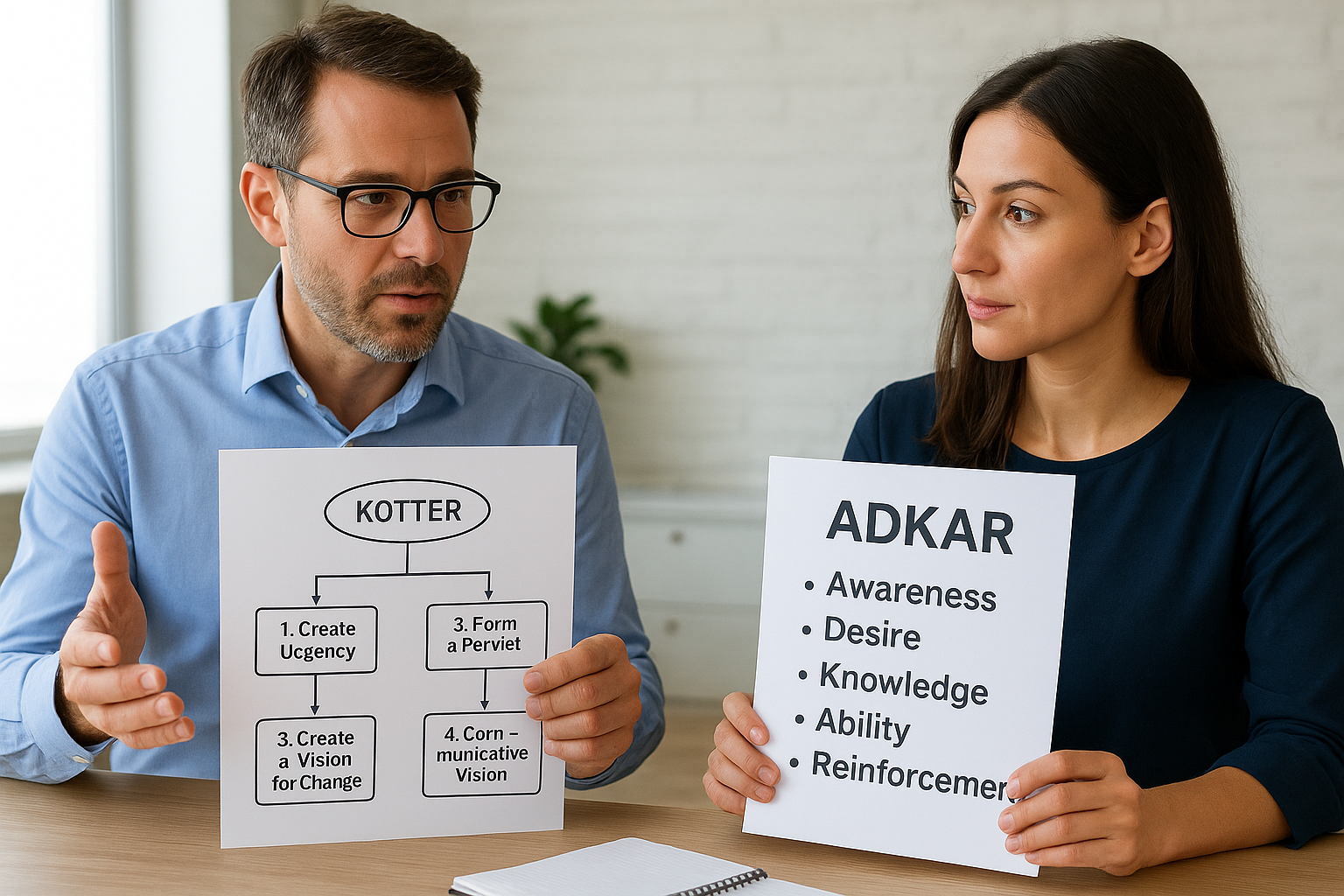
Kotter gives you the organizational roadmap; ADKAR gives you the individual diagnostic tool. Using both together covers more ground than either does alone.
The practical difference shows up in how you identify and address resistance. Kotter points you toward removing structural barriers and sustaining momentum at scale. ADKAR helps you pinpoint whether a specific employee’s resistance stems from lack of awareness, missing knowledge, or insufficient reinforcement, giving you a more targeted intervention when broad adoption measures aren’t producing results fast enough.
How Kotter compares to Lewin and McKinsey 7-S
Kurt Lewin’s three-stage model (Unfreeze, Change, Refreeze) is simpler and faster to apply, which makes it useful for smaller or faster-moving change initiatives. Kotter built on Lewin’s core logic but expanded it into eight steps to address the additional complexity that large organizations face. If your transformation involves multiple departments, significant cultural resistance, or a multi-year timeline, Kotter’s additional granularity gives you more practical guidance than Lewin’s three stages provide.
The McKinsey 7-S framework takes a different angle entirely. Rather than sequencing change actions, it maps seven interdependent organizational elements (strategy, structure, systems, shared values, skills, style, and staff) to diagnose why an organization might struggle to align around a change. McKinsey 7-S is better suited for assessing organizational readiness before you select a change model, while Kotter is better suited for executing the transformation once you understand what you’re working with and where your biggest alignment gaps actually sit.
How to measure adoption and sustain the change
The Kotter change model defines step eight as instituting the change, but that step only holds if you build a measurement system that tells you whether adoption is real or just surface-level compliance. Without specific, trackable metrics tied to the behaviors you changed, you have no reliable way to know whether your transformation is sticking or quietly eroding. Measurement isn’t the final act of your initiative; it’s the ongoing mechanism that keeps the change alive after leadership attention naturally shifts to the next priority.
Adoption you can’t measure is adoption you can’t protect.
Metrics that tell you adoption is real
Measuring adoption requires you to separate activity metrics from outcome metrics. Activity metrics, like training completion rates or login frequency, tell you whether people are engaging with the new system or process. Outcome metrics, like close cycle time, error rates, or manual workaround incidents, tell you whether that engagement is producing the behavioral change you actually needed. Both matter, but outcome metrics carry more weight when you’re evaluating whether the transformation delivered its intended value.
For ERP-specific initiatives, track these indicators consistently in the months following go-live:
- Close cycle duration compared to your pre-implementation baseline
- System-generated report usage versus manually built spreadsheets
- Approval workflow completion rates inside the ERP versus outside it
- Support ticket volume related to process confusion or system avoidance
- User proficiency scores at 30, 60, and 90 days post-launch
How to keep the change from reverting
Sustaining change over time requires you to connect the new behaviors to how performance gets evaluated. If your team’s metrics, incentives, and reporting expectations still reflect the old way of working, people will drift back to familiar habits regardless of how well your initial rollout went. Review your performance standards and adjust them explicitly to reinforce the behaviors your transformation introduced, before the first post-go-live performance cycle runs.
Leadership visibility also plays a direct role in sustaining results. When executives continue referencing the transformation’s outcomes in team meetings, board reports, and budget discussions, they signal that the change is permanent, not a project that has wrapped up. Sustained leadership reinforcement, even in small and consistent doses, does more to anchor new behavior than any formal reinforcement program running in the background.
Next steps
The Kotter change model gives you a structured path through organizational transformation, but following the framework only produces results if you apply it with discipline at every phase. You now have the full picture: what each step requires, where the common failure points hide, how to measure whether adoption is real, and how Kotter compares to the alternatives. The critical next move is translating that knowledge into action before your next ERP initiative, restructuring effort, or operational overhaul loses momentum to the same patterns Kotter identified decades ago.
For midsized companies navigating ERP implementation or rescue, pairing this framework with expert guidance significantly improves your odds of protecting the ROI you’re counting on. Concentrus builds measurable financial outcomes into every phase of the work, so your transformation delivers results you can track, not just a system that’s technically live. Talk to an ERP and ROI expert at Concentrus to see how that approach applies to your specific situation.