

Every ERP implementation is, at its core, a change initiative. New systems reshape workflows, redefine roles, and force teams to abandon familiar routines. When that transition is managed poorly, even the best technology fails to deliver results. That’s why understanding the change management definition, and what it actually involves, matters so much for CFOs and finance leaders evaluating or recovering an ERP investment.
Change management is more than a buzzword attached to project plans. It’s a structured discipline with proven frameworks, defined roles, and measurable outcomes. It addresses the human side of transitions: how people adopt new processes, why they resist, and what leaders can do to move an organization forward without leaving half the team behind.
At Concentrus, we see the consequences of overlooked change management constantly. Our ERP rescue work often traces back to the same root cause, technical implementation moved forward, but people didn’t. That gap between system go-live and actual adoption is where ROI goes to die. It’s also why our ROI Roadmap™ methodology accounts for organizational readiness alongside platform configuration.
This article breaks down what change management really means, walks through its core principles and processes, and provides concrete examples of how it plays out in practice. Whether you’re planning a NetSuite or Acumatica rollout or trying to recover from a stalled one, this foundation will help you approach the human side of ERP with the same rigor you bring to the financial side.
What change management means in business
The change management definition used in most business contexts refers to a structured approach for transitioning individuals, teams, and entire organizations from a current state to a desired future state. It’s not a single action or a training session bolted onto a project. It’s a deliberate, ongoing discipline that runs parallel to technical implementation, ensuring people understand, accept, and sustain the changes being made around them.
Change management is what bridges the gap between a system being live and a system being used.
The organizational side vs. the people side
Most organizations treat change management as a communications plan, but it’s broader than that. On the organizational side, it includes process redesign, role clarification, governance updates, and policy alignment. These structural elements define how work gets done after the change. Without them, people may have a new system in front of them but no clear understanding of how their day-to-day responsibilities have shifted.
On the people side, change management addresses awareness, willingness, knowledge, and reinforcement. Your team members go through predictable emotional stages when their routines are disrupted. Resistance is not irrational; it’s a normal response to uncertainty. Effective change management accounts for this by building communication and coaching into the project timeline, not as an afterthought, but as a core workstream with defined owners and milestones.
What change management is and isn’t
Change management is not project management, though the two work together. Project management focuses on tasks, timelines, and deliverables. Change management focuses on the human experience of those deliverables. A project can finish on time and within budget while still failing if the people it was built for never fully adopt it.
Change management is also not a one-size-fits-all process. The scope and complexity of the effort scales with the size of the change. Updating a single workflow requires minimal intervention. Replacing your core ERP system across multiple departments requires a full change strategy, including stakeholder analysis, training plans, and post-go-live reinforcement built into a structured timeline.
Why change management matters for ROI
When finance leaders evaluate an ERP investment, they focus heavily on software costs, implementation timelines, and projected efficiency gains. What often goes unmeasured is the cost of poor adoption. That gap is where most ERP projects lose their return. A proper understanding of the change management definition tells you this directly: the value of a system is only realized when people actually use it correctly and consistently.
The cost of skipping it
Resistance and confusion after go-live are not soft problems. They create hard financial consequences: duplicate data entry, workarounds that bypass controls, delayed closes, and reporting errors that force manual reconciliation. According to research from McKinsey & Company, approximately 70% of change programs fail to achieve their goals, largely because of employee resistance and lack of management support. Every week your team operates at partial adoption is a week your ERP investment delivers fractional value against its full cost.
The system is never the reason an ERP fails. The people side is.
How change management protects your investment
Structured change management directly ties to measurable ROI milestones by reducing the time between go-live and full adoption. When your team understands why the change is happening, what is expected of them, and how they will be supported through the transition, they move through the learning curve faster. That speed translates into earlier realization of your projected gains, whether that means faster monthly closes, cleaner inventory data, or improved cash flow visibility.
Principles and common frameworks
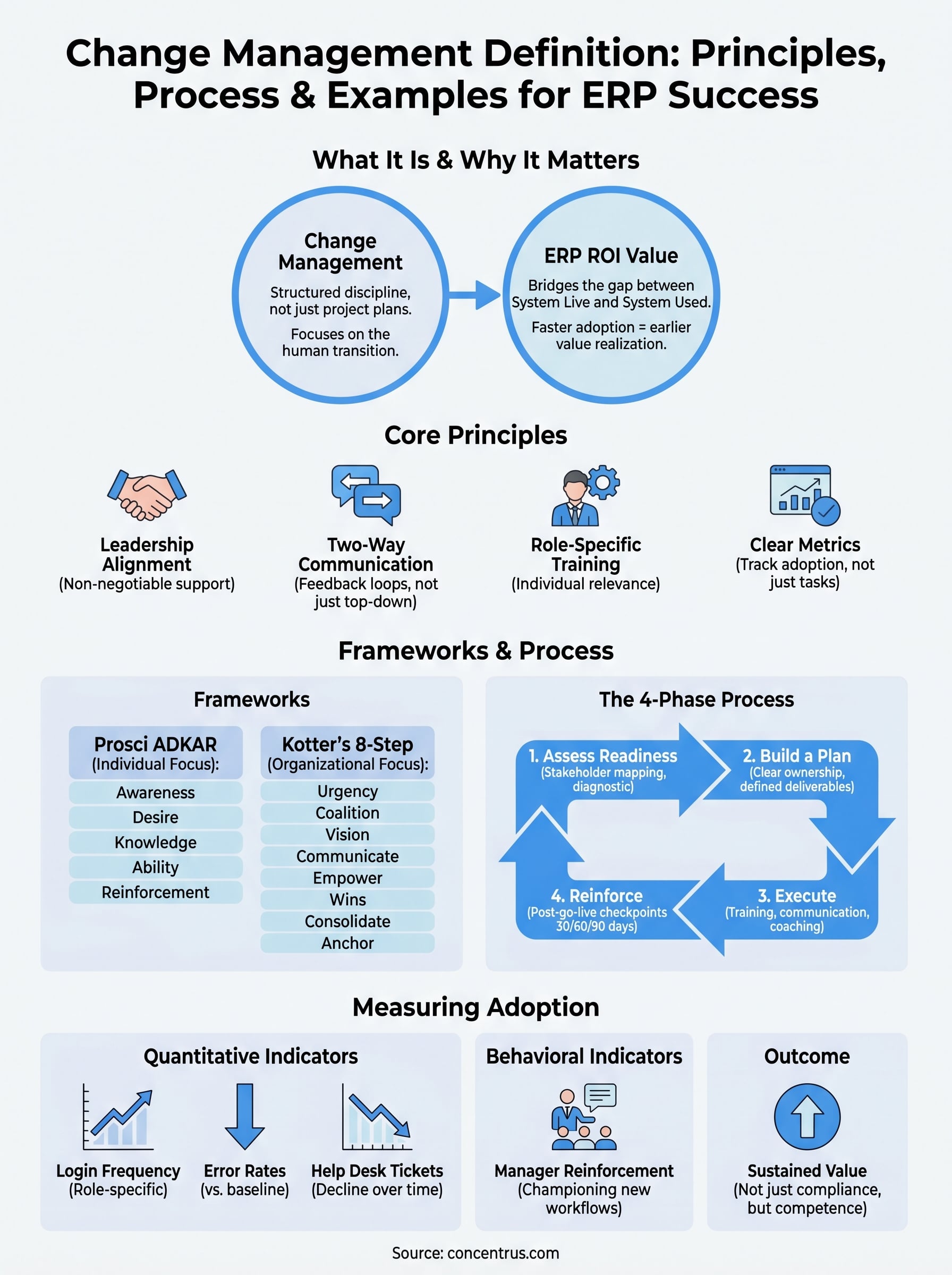
The change management definition you apply in practice depends on the principles and frameworks you choose to follow. Principles give your effort direction: focus on the people experiencing the change, communicate early and often, tie every action to a defined business outcome, and reinforce new behaviors until they stick. Frameworks translate those principles into repeatable processes your team can follow.
Core principles that guide the work
Regardless of which framework you choose, four principles hold across most serious change efforts. First, leadership alignment is non-negotiable: if your executive team isn’t visibly behind the change, your workforce won’t be either. Second, communication must be two-way, not just top-down announcements, but structured feedback loops that surface resistance before it hardens into obstruction.
Adoption is not an event. It’s a result of repeated, intentional reinforcement over time.
Third, training must be role-specific, not generic. People need to understand how the change affects their individual responsibilities, not just the organization’s broader goals. Fourth, you need to measure adoption formally with clear metrics and checkpoints that confirm whether the change is taking hold or stalling.
The most widely used frameworks
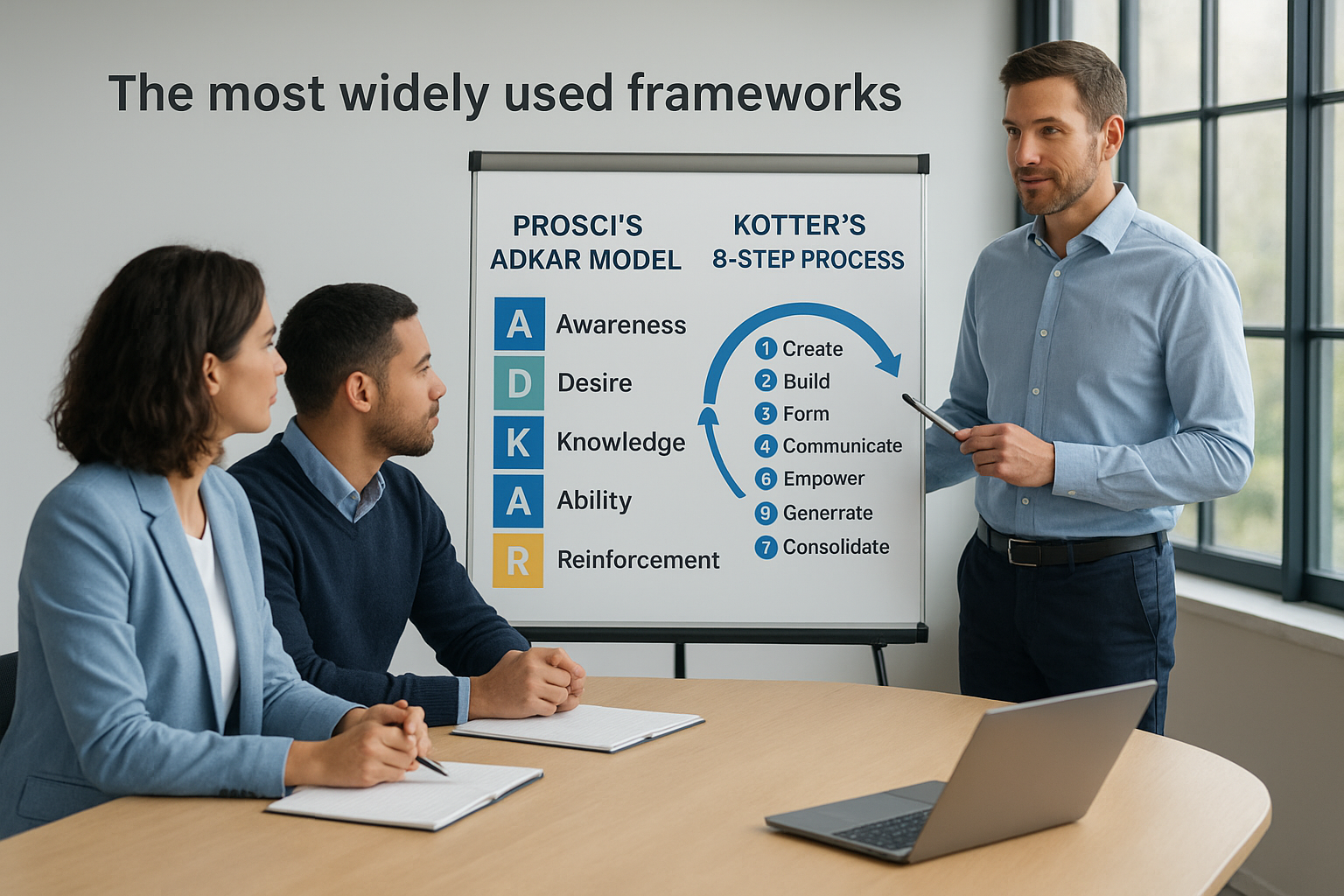
Two frameworks dominate organizational change work. Prosci’s ADKAR model breaks adoption into five sequential building blocks: Awareness, Desire, Knowledge, Ability, and Reinforcement. It maps directly to individual adoption, which makes it well-suited for ERP rollouts where each department’s experience differs. Kotter’s 8-Step Process, developed by Harvard Business School professor John Kotter, takes a broader organizational view, focusing on building urgency, forming coalitions, and anchoring change in company culture. Both frameworks work well together: ADKAR guides the individual level while Kotter drives organizational momentum.
How to run a change management process
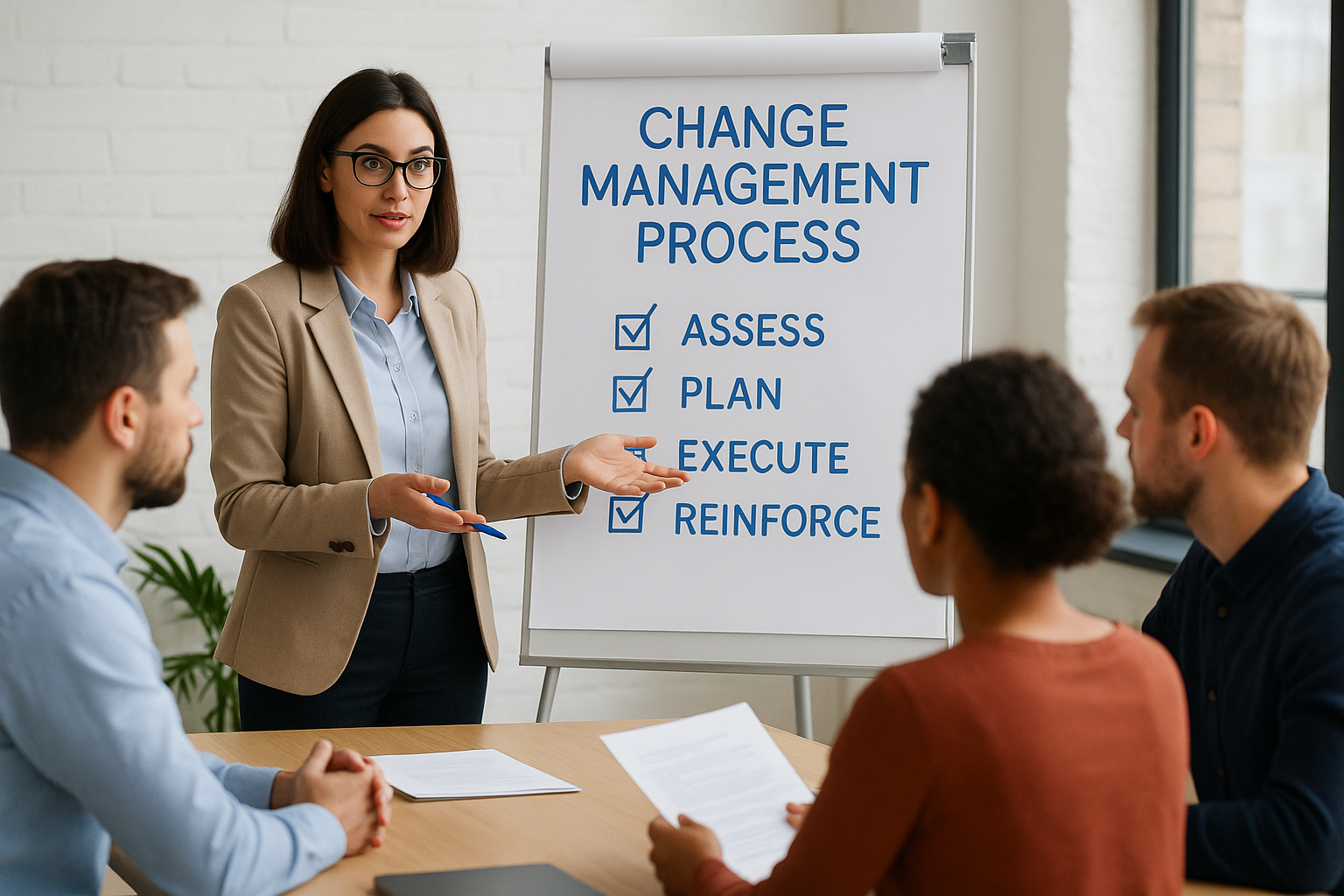
Running a change management process means treating people readiness as a parallel workstream, not an afterthought. You start planning it at the same time you start scoping the technical implementation. The change management definition you apply in practice takes shape through a sequence of structured phases: assessment, planning, execution, and reinforcement. Each phase has clear deliverables, and skipping any one of them creates gaps that compound over time.
Assess readiness before anything else
Your first step is understanding where your organization stands before the change begins. This means identifying key stakeholders, mapping which roles are most affected, and conducting a readiness assessment that surfaces likely resistance points. Without this baseline, your training and communication plans will miss the people who need them most.
A readiness assessment is not a formality. It’s the diagnostic that shapes every decision that follows.
Stakeholder mapping goes beyond listing names. You need to categorize each group by their level of impact and their likely attitude toward the change, so your communication and coaching efforts can be calibrated accordingly. High-impact, high-resistance groups need direct engagement from leadership, not just email updates.
Build a structured plan with clear ownership
Once you understand the landscape, you need a documented change plan that assigns specific owners to each workstream: communications, training, coaching, and reinforcement. Each owner needs defined deliverables and deadlines tied to the project timeline. Vague ownership is where most change plans collapse.
Make sure your plan includes post-go-live checkpoints, typically at 30, 60, and 90 days, where you measure adoption formally and address gaps before they become habits. Reinforcement converts short-term compliance into long-term adoption.
Examples and metrics that show adoption
Putting the change management definition into practice looks different across organizations, but the outcomes you measure share common patterns. Whether you’re rolling out NetSuite or Acumatica, how adoption actually progresses tells you whether your change effort is working or whether you’re heading toward an ERP rescue scenario.
What adoption looks like in an ERP rollout
Consider a mid-sized distribution company moving from spreadsheets to a cloud ERP. Before go-live, their change team ran department-specific training sessions and assigned internal champions in each functional area. Thirty days after launch, they tracked how many users logged in daily and how many transactions were entered directly into the system versus submitted through manual workarounds. Usage rates above 85% within the first 30 days indicated strong initial adoption, while exception reports showing fewer manual overrides confirmed the team was actually working inside the system correctly.
Adoption is not visible on a dashboard until you deliberately build the metrics to surface it.
Metrics that confirm adoption is taking hold
Your adoption tracking should include quantitative and behavioral indicators measured at consistent intervals. Three metrics that consistently reveal real progress are: system login frequency by role, error rates in data entry compared to pre-go-live baselines, and help desk ticket volume over time. A rising ticket volume right after go-live is normal and expected. What you watch for is a steady decline by week six, which signals your team is building competence, not just compliance.
Behavioral metrics matter too. Track whether managers are reinforcing new workflows in team meetings or reverting to old habits. That leadership behavior is one of the strongest predictors of whether change will stick long-term.
Next steps
The change management definition covered in this article points to one clear takeaway: the human side of any ERP transition is not optional. It’s the factor that determines whether your investment delivers its projected return or stalls at go-live. You now have the framework language, the process steps, and the metrics needed to treat adoption as seriously as implementation.
Your next move is to apply this thinking to your specific situation. If you’re planning a new ERP rollout, start your readiness assessment before the technical scoping begins. If you’re already in the middle of a stalled implementation, the gap between system capability and actual team adoption is likely where your ROI is leaking.
Concentrus builds change readiness into every engagement through our ROI Roadmap™ methodology, so your ERP project moves from go-live to full value faster. Talk to an ERP and ROI expert at Concentrus to get started.