

Excess stock drains cash. Stockouts kill sales. And somewhere between too much and too little inventory sits millions in working capital that CFOs struggle to optimize. If your financial reports show ballooning carrying costs or your operations team constantly firefights supply chain gaps, you’re not alone, and you’re likely a candidate for inventory management consulting services that deliver measurable results.
The challenge is that inventory optimization doesn’t exist in a vacuum. It’s deeply connected to your ERP system, your demand forecasting accuracy, and your ability to translate operational improvements into CFO-grade financial outcomes. That’s where Concentrus operates. As specialists in NetSuite and Acumatica ERP implementations, with a proprietary ROI Roadmap™ methodology, we’ve seen firsthand how the right consulting approach transforms inventory from a cash trap into a strategic advantage.
This article breaks down what inventory management consulting services actually involve, who benefits most, and how to evaluate whether an engagement will generate real ROI or just produce another binder of recommendations that collects dust. Whether you’re implementing a new system or rescuing one that’s underperforming, understanding this discipline is the first step toward inventory that works for your bottom line.
Why inventory consulting matters to CFOs
Your inventory doesn’t just sit on shelves or in warehouses. It represents working capital that you could deploy elsewhere, and every dollar tied up in excess stock is a dollar that isn’t earning returns. Most CFOs know this intellectually, but they lack the operational visibility to act on it. That’s the disconnect inventory management consulting services address: translating operational inventory problems into financial solutions you can track, measure, and optimize.
The financial impact of inventory mistakes
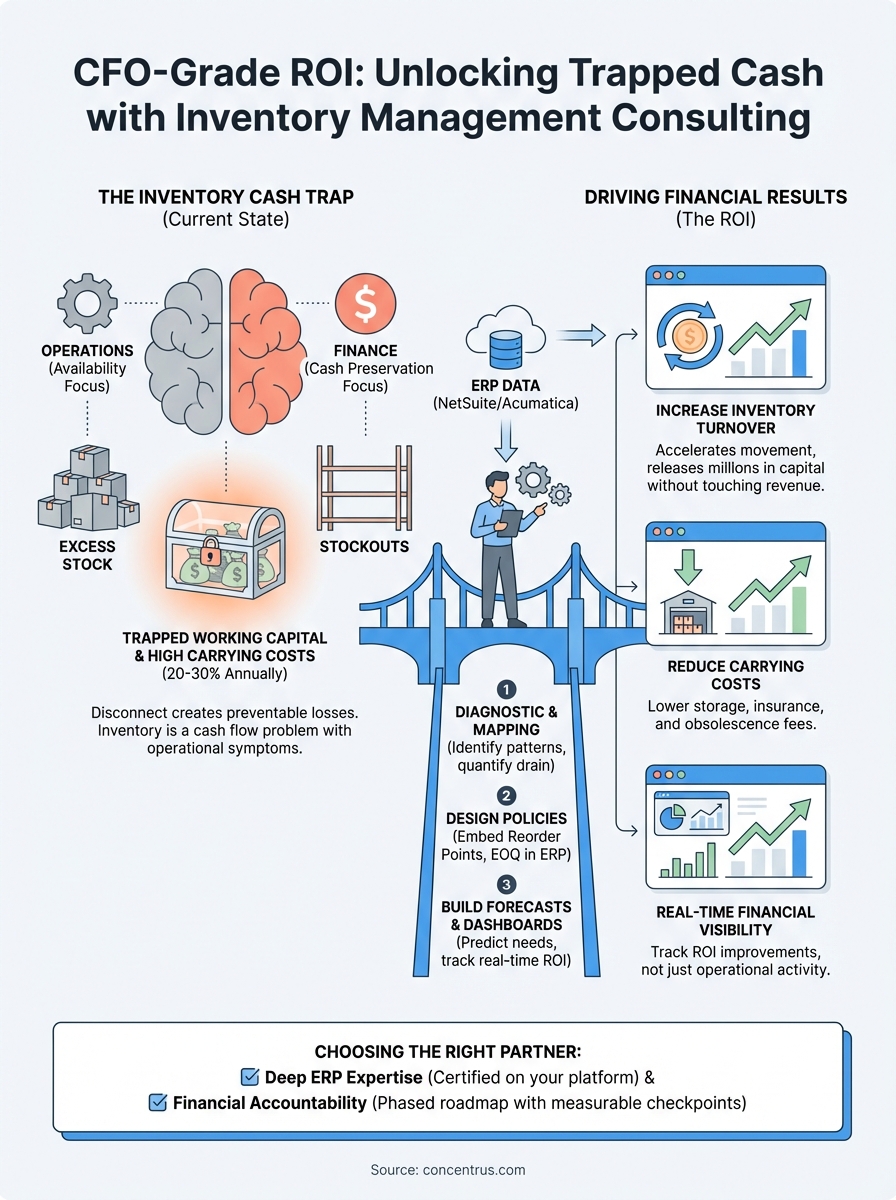
When inventory management fails, your P&L takes multiple hits. Carrying costs alone typically run 20% to 30% of inventory value annually when you factor in warehousing, insurance, obsolescence, and opportunity cost. Add in stockouts that kill margin on lost sales, rush shipping fees that erode profitability, and write-offs from dead stock, and you’re looking at millions in preventable losses. Consultants who understand both your ERP system and your financial statements can quantify these drains and build a roadmap to plug them.

Inventory optimization isn’t an operations problem. It’s a cash flow problem with operational symptoms.
What traditional approaches miss
Your operations team optimizes for availability. Your finance team optimizes for minimal cash lockup. Without a consultant who bridges both perspectives, you end up with either too much inventory or too many stockouts, neither of which serves your ROI targets. Traditional inventory management consulting services often deliver static models or spreadsheet-based forecasts that your team can’t maintain. The best consultants embed optimization logic directly into your NetSuite or Acumatica ERP, creating dynamic reorder points, safety stock calculations, and demand forecasts that adjust as your business changes. You need real-time financial visibility, not quarterly guesswork.
What inventory management consultants do
Inventory management consulting services start with a diagnostic phase where consultants map your current state against best practices and financial targets. They analyze your ERP data to identify patterns in stockouts, overstocks, and demand variability. This isn’t about opinions; it’s about extracting hard numbers from NetSuite or Acumatica that show where cash is trapped and where operational bottlenecks create financial drag.
Designing inventory policies that match your cash goals
Consultants translate your CFO-level objectives into specific inventory parameters. They calculate optimal reorder points, safety stock levels, and economic order quantities based on your actual demand patterns, supplier lead times, and service level targets. You get formulas and rules embedded directly into your ERP system, not spreadsheets that require manual updates every quarter.
Building forecasting models and dashboards
The best consultants don’t just set policies and leave. They build demand forecasting models that use historical sales data, seasonality patterns, and planned promotions to predict future needs. They also create financial dashboards that track inventory turns, carrying costs, and days of inventory on hand so you can see ROI improvements in real time.
Consultants who understand both inventory mechanics and ERP architecture deliver solutions you can sustain without them.
What a good engagement looks like
A successful consulting engagement has clear milestones tied to your financial targets from day one. You shouldn’t see vague promises about “optimization” or “best practices.” Instead, expect a structured project plan that defines what gets delivered each phase, how success gets measured, and what financial outcomes you’ll achieve by the end. The best inventory management consulting services build ROI tracking into every deliverable so you know whether you’re on pace to hit your cash flow and profitability goals.
Phased implementation with financial checkpoints
Your consultant should break the work into digestible phases that each produce measurable results. Phase one typically involves diagnostic work and quick wins like clearing dead stock or adjusting safety stock parameters. Phase two builds forecasting models and demand planning processes. Phase three embeds everything into your ERP workflows so your team can sustain improvements without constant consultant involvement.
The right consultant leaves you with systems, not dependencies.
Each phase should end with a financial checkpoint where you review actual improvements in inventory turns, carrying costs, or working capital release before moving forward.
Key methods and metrics that drive ROI
Effective inventory management consulting services rely on proven methodologies that translate operational improvements into financial gains. Consultants deploy specific techniques to reduce working capital lockup while maintaining service levels, and they track progress through metrics that CFOs actually care about. The difference between a good engagement and a waste of time comes down to whether your consultant measures what matters to your balance sheet and cash flow statement.
Inventory turnover and carrying cost reduction
Your consultant should focus on inventory turnover as the primary metric because it directly affects cash availability. Turning inventory 6 times per year instead of 4 releases millions in working capital without touching your revenue targets. Consultants calculate your current turnover ratio, identify SKUs dragging down performance, and implement policies that accelerate movement. They also quantify carrying costs as a percentage of inventory value so you see exactly how much each optimization saves.
Fast-moving inventory generates cash. Slow-moving inventory generates storage bills.
ABC classification and demand forecasting accuracy
Consultants use ABC analysis to segment your inventory by value contribution, applying tighter controls to high-value items while simplifying management of low-value SKUs. They also measure forecast accuracy because every percentage point improvement reduces safety stock requirements and the cash tied up in buffer inventory.

How to choose the right consulting partner
Not all inventory management consulting services deliver equal results. The firms that generate real ROI combine deep ERP platform expertise with proven financial accountability frameworks. You need consultants who understand both NetSuite or Acumatica architecture and how inventory optimization flows through to your cash flow statement. Ask prospective partners to show you actual case studies with quantified financial outcomes, not vague testimonials about improved efficiency.
ERP platform expertise matters
Your consultant must know your ERP system inside out because that’s where inventory policies get executed. Generic consultants who work across multiple platforms rarely understand the specific workflows, automation capabilities, and data structures of NetSuite or Acumatech well enough to build sustainable solutions. Look for partners with certified implementation experience on your exact platform who can demonstrate inventory module mastery.
Platform-agnostic consultants deliver platform-generic results.
ROI accountability, not just deliverables
The best partners tie every engagement milestone to measurable financial outcomes from day one. They should propose a clear ROI roadmap that tracks improvements in inventory turns, carrying costs, and working capital release throughout the project. Avoid firms that promise to deliver reports or process documentation without committing to specific financial targets you can validate against your actual results.
Next steps to get ROI moving
You now understand what separates effective inventory management consulting services from firms that deliver reports instead of results. The difference comes down to three factors: ERP platform expertise, proven financial accountability frameworks, and consultants who measure success by your cash flow improvements, not their billable hours.
Start by auditing your current inventory performance metrics. Calculate your turnover ratio, quantify carrying costs as a percentage of inventory value, and identify how much working capital sits trapped in slow-moving SKUs. These numbers give you a baseline to measure ROI against once you engage the right partner.
Your next move depends on whether you need a fresh implementation or a rescue of an underperforming system. Either way, you need consultants who guarantee measurable financial outcomes and embed optimization directly into your NetSuite or Acumatica workflows. Talk to Concentrus about building an ROI-focused inventory roadmap that turns your stock from a liability into a competitive advantage.