

NetSuite ERP Implementation Guide: How to Get It Right the First Time
A NetSuite ERP implementation can fundamentally improve how your finance organization operates—or it can quietly erode ROI through delays, cost overruns, and underutilized functionality. Industry research shows that ERP failures rarely stem from the technology itself; they are far more often caused by weak planning, unclear ownership, and misalignment between system decisions and financial objectives (Panorama Consulting Group, 2023).
For CFOs and finance leaders, generic ERP advice isn’t enough. You need clarity on scope, realistic timelines, internal resource requirements, and the true cost profile of a NetSuite implementation. This guide breaks the process into four disciplined phases, grounded in real-world NetSuite project experience and ERP benchmark data, so you can move forward with confidence and control rather than uncertainty (Gartner, 2024).
At Concentrus, we’ve guided midsized organizations through NetSuite implementations—and rescued projects already in trouble—using our ROI Roadmap™ methodology. Every recommendation in this guide reflects a core principle: ERP only delivers value when it is designed and governed around measurable financial outcomes, not just system features (Deloitte, 2023).
Scope, Timeline, and Cost Basics
NetSuite implementation scope is driven by three primary variables: organizational structure, process complexity, and customization depth. Oracle NetSuite notes that the number of subsidiaries, reporting requirements, and integration points has a far greater impact on implementation effort than company revenue alone (Oracle NetSuite, 2024). A basic deployment may include GL, AP, AR, and core reporting, while more advanced implementations extend into inventory, manufacturing, revenue recognition, or CRM.
Understanding scope upfront is critical. Scope creep remains the single largest contributor to ERP timeline slippage and budget overruns across the mid-market (Panorama Consulting Group, 2023). Internal staffing is equally decisive. Successful implementations require a committed executive sponsor (typically the CFO or Controller), a dedicated project manager, and subject matter experts from finance, operations, and sales. Gartner research shows that underestimating internal time commitments is one of the fastest ways ERP projects fall behind schedule (Gartner, 2024).
What Drives NetSuite Implementation Scope
Industry requirements heavily influence NetSuite configuration. Manufacturing organizations require production planning, work orders, and inventory costing controls, while distributors focus on order management, fulfillment, and warehouse operations. Professional services firms emphasize project accounting and revenue recognition. Each vertical also introduces regulatory and compliance requirements—such as SOX or industry-specific controls—that add testing and governance complexity (Deloitte, 2023).
Legacy system maturity further expands scope. Organizations migrating from lightly customized accounting systems face fewer data and process challenges than those replacing heavily customized legacy ERPs. Integration requirements compound this effect. Each external system—e-commerce platforms, payroll providers, WMS solutions—adds design effort, testing cycles, and long-term maintenance risk if not governed properly (Oracle NetSuite, 2024).
Typical NetSuite Implementation Timelines
For midsized organizations, standard NetSuite implementations typically take four to six months from kickoff to go-live when scope is controlled and internal resources are dedicated. Panorama Consulting Group reports that implementations exceeding this window usually suffer from unclear requirements or late-stage customization requests rather than software limitations (Panorama Consulting Group, 2023).
More complex, multi-entity implementations often extend to nine to twelve months. While accelerated implementations can be completed in as little as three months, Gartner cautions that compressed timelines often lead to post-go-live remediation costs that exceed the savings achieved by rushing the project (Gartner, 2024).
Cost Components and Ranges
NetSuite implementation costs fall into four categories: licensing, implementation services, internal labor, and ongoing support. Oracle NetSuite licensing commonly ranges from under $1,000 per month for small deployments to well over $10,000 per month for multi-entity, high-transaction environments (Oracle NetSuite, 2024).
Implementation services for midsized organizations typically range from $50,000 to $500,000+, depending on scope and complexity. Internal labor costs—often overlooked—frequently match or exceed external consulting fees once fully accounted for (Panorama Consulting Group, 2023). Gartner recommends fixed-fee engagements with milestone-based deliverables to manage financial risk, provided scope is clearly defined during planning (Gartner, 2024).
Phase 1: Plan and Design the Implementation
Planning is the most decisive phase of any ERP initiative. Deloitte research shows that organizations investing sufficient time in upfront planning and governance are significantly more likely to achieve their projected ROI (Deloitte, 2023). This phase typically spans six to eight weeks and focuses on business process analysis rather than system configuration.
CFOs should define success in financial terms before configuration begins—metrics such as close cycle reduction, working capital improvements, or cost-to-serve reductions. Gartner emphasizes that ERP projects lacking quantified success metrics struggle to demonstrate value even when systems function as designed (Gartner, 2024).
Phase 2: Configure, Customize, and Integrate
Configuration translates planning into execution. While NetSuite offers robust native functionality, over-customization remains a leading risk factor. Oracle NetSuite advises prioritizing standard functionality and deferring non-essential customizations until after go-live to reduce complexity and long-term maintenance costs (Oracle NetSuite, 2024).
Integration strategy is equally critical. Deloitte identifies poorly governed integrations as a primary cause of ERP instability and reporting inconsistencies. NetSuite should function as the system of record, with clearly defined data ownership and synchronization rules across connected applications (Deloitte, 2023).
Phase 3: Migrate Data and Validate Controls
Data migration quality directly impacts trust in financial reporting. ERP failures frequently trace back to rushed migrations that import inaccurate or incomplete data into production systems (Panorama Consulting Group, 2023). Best practice involves iterative test migrations, data cleansing prior to import, and structured validation of results.
For audit-sensitive organizations, validating segregation of duties, approval workflows, and audit trails is essential before go-live. Gartner notes that ERP systems must be validated not only for operational accuracy but also for internal control effectiveness (Gartner, 2024).
Phase 4: Test, Train, and Go Live
Comprehensive testing and role-based training materially reduce post-go-live disruptions. Deloitte research shows that organizations with structured user acceptance testing and targeted training programs achieve higher adoption and fewer costly post-implementation fixes (Deloitte, 2023).
A disciplined cutover plan—aligned with natural reporting boundaries—minimizes risk and simplifies reconciliation. Oracle NetSuite recommends go-live timing that supports clean financial closes and audit continuity (Oracle NetSuite, 2024).
Final Thoughts
A successful NetSuite implementation is not defined by going live on time—it is defined by delivering measurable financial value. Organizations that underestimate planning, data preparation, or internal governance often spend more correcting issues after go-live than they would have investing upfront (Panorama Consulting Group, 2023).
If you are evaluating implementation partners, prioritize those who anchor every recommendation to business outcomes rather than technical configuration alone. That discipline is what separates ERP projects that create ROI from those that quietly erode it.
Next steps
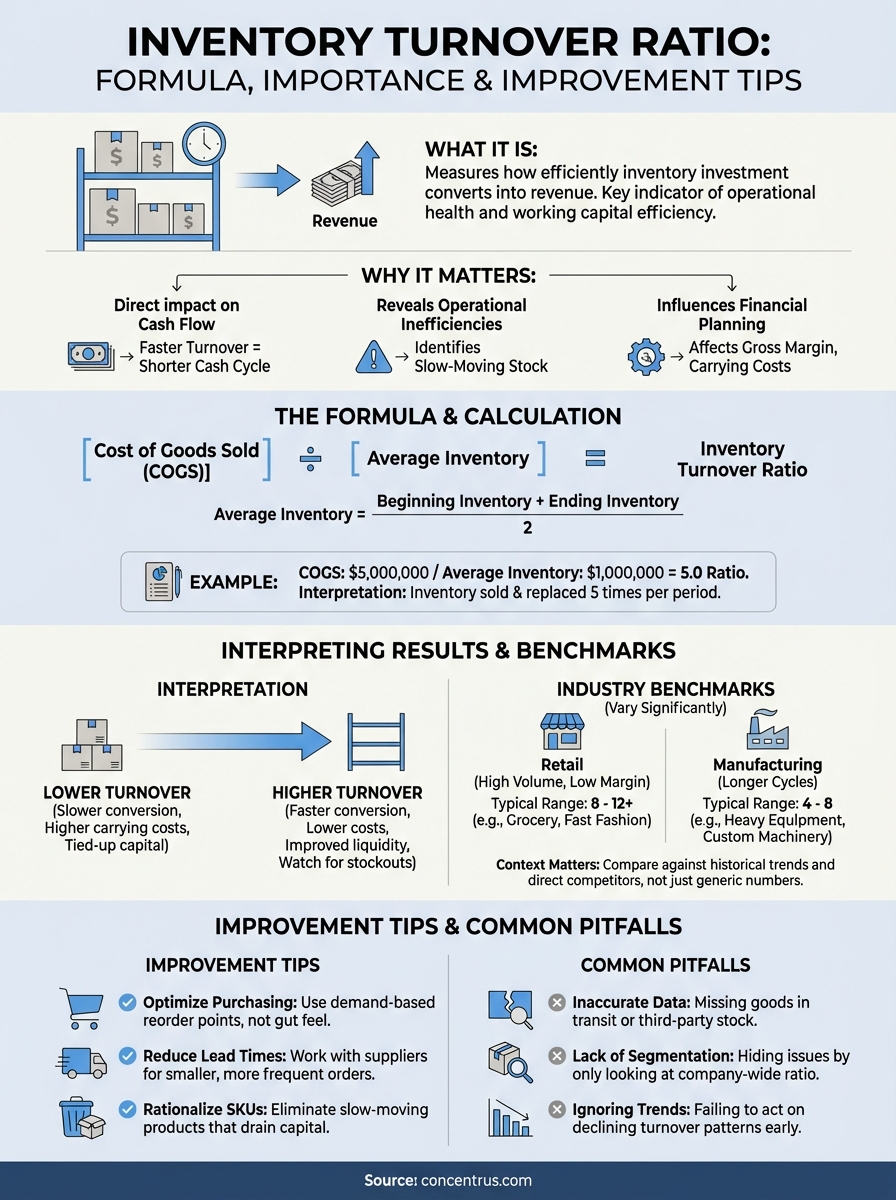
Understanding the inventory turnover ratio explained in this guide gives you the foundation to make data-driven decisions about working capital and operational efficiency. Start by calculating your current ratio using your most recent financial statements, then break down the results by product category or business unit to identify specific opportunities for improvement. Track your turnover quarterly to establish baseline performance and spot deviations early.
Your ERP system should automate these calculations and provide real-time visibility into inventory metrics that drive cash flow decisions. If your current systems lack this capability or you’re struggling with inaccurate inventory data and unclear reporting, it’s time to evaluate whether your technology supports your financial goals. Concentrus helps CFOs implement NetSuite and Acumatica ERP solutions that deliver guaranteed ROI through accurate inventory tracking, automated KPI reporting, and strategic alignment between your finance team and operational reality.
References
- Deloitte. (2023). ERP Transformation and Value Realization. Deloitte Insights.
- Gartner. (2024). Best Practices for ERP Implementation and Governance. Gartner Research.
- Oracle NetSuite. (2024). NetSuite Implementation and SuiteSuccess Methodology. Oracle Corporation.
- Panorama Consulting Group. (2023). ERP Report: Implementation Success and Failure Factors. Panorama Consulting Solutions.